

Much More Than Just an Accessibility Acronym

Rosemary Musachio, Author of Article
Rosemary Musachio

By Rosemary Musachio, CPACC, Chief Accessibility Officer

Notice the acronym after my name. CPACC stands for Certified Professional in Accessibility Core Competencies. I recently discovered that I had earned this title after I took the certification exam in January. I’m excited and honored to be among the few so far to be recognized as an expert in the accessibility industry. Currently, around 200 industry professionals have earned their CPACC. The International Association of Accessibility Professionals (IAAP) offers the certification to qualified individuals who have worked in the accessibility industry for several years. CPACC candidates also must be proficient in English.

IAAP: International Association of Accessibility Professionals (Logo)

By being certified in accessibility, something that I’ve been doing for sixteen years, I will be seen as more credible. More people on social media networks, such as LinkedIn, are reaching out to me for advice and input. Not only does that strengthen my self-esteem, it also makes me feel that I’m making a difference in the business and education worlds.

Having a CPACC means companies will know you have fundamental knowledge about disabilities, accessibility and universal design, and laws and standards. With the prestigious credential following your name, business leaders will recognize your commitment to the accessibility field. They seek your advice and insights on accessibility issues regarding technology, architecture, commerce, and transportation. If an employer seeks applicants who have CPACC or require current employees to take it, the company realizes how important accessibility and inclusion are to its success. The certified accessibility professional ensures the office environment and technologies would be accommodating for employees with disabilities. For instance, someone who’s accredited in accessibility would be sure to know that buttons on a kiosk should be in different shapes or sizes for a blind person to use it, than someone who lacks the accreditation.

CPACC’s also are more competent in helping businesses reach out to customers with disabilities. For example, an accessibility accredited web developer ensures that they can use a website without difficulties based on laws and standards such as Americans with Disabilities Act (ADA), Section 508 Refresh, Web Content Accessibility Guidelines 2.0 (WCAG 2.0). Consequently, the certified personnel are expected to know accessibility laws thoroughly so a business would avoid potential litigation.

CPACC also is beneficial because it gives credence to accessibility principles in college courses and job training. Right now 92% of federal websites don’t comply with accessibility standards. This is because many web developers don’t have instructors who were accredited in accessibility. Besides technology, other fields lack accessibility competence in educating their professionals. For instance, if pre-meds and

Young boy holding an iPad at an Assistive Tech Demo, Taken by Raminta Zebrauskas - AMAC Team Photographer
Young boy holding an iPad at an Assistive Tech Demo, Taken by Raminta Zebrauskas – AMAC Team Photographer

nursing students have courses who are taught by CPACC professors, they would treat patients with accessible attitudes, learning how to communicate better with them. Or if future teachers take courses in universal design for learning, which is part of CPACC, they would know to apply different learning and testing techniques based on students with

diverse abilities.

As more professionals become CPACC certified, persons with disabilities will start noticing the impact. Accessibility in every realm of life will become the norm, not the exception. The employment rate of individuals with disabilities will increase. Commercial and professional services will reap from our patronage. ADA and other disability-based lawsuits will dwindle, being replaced with appeals for more consumers to buy from businesses. Medical professionals who will receive CPACC-based training will communicate with patients with disabilities more effectively, and teachers will understand better the learning dynamics of students with diverse abilities. That’s what being certified in accessibility does.

For more information on becoming a Certified Professional in Accessibility Core Competencies, Please visit the CPACC’s FAQ Page.

Learning to Use an Augmentative Communication Device

Rosemary Musachio

By Rosemary Musachio

Although I’ve been communicating with a manual communication board with letters and words since I was eight, speech therapists have been trying to help me use electronic augmentative assistive communication (AAC) devices.  I had never been thrilled with the idea until recently.

Back in the 1980’s, AAC devices had robotic sounding voices that some people couldn’t even understand.  The voice made me sound like a teenager from outer space.  Now synthesized voices are much more human sounding.  Some voices actually would make me sound as I should sound—a sexy woman speaking.

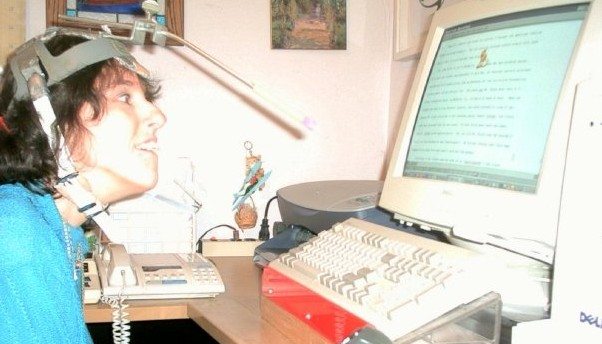
Additionally, since the idea was to use the AAC device away from home, I didn’t (and still don’t) want to use the headpointer out in public for aesthetic reasons (Wearing a helmet with a protruding stick makes me look like I belong in Star Wars!).  So, I used my thumb knuckle, which I use to point on my manual communication board, to access buttons on the first AAC device I tried when I was in grade school.  When I targeted a single button, I pressed several others with the rest of my hand.

Rosemary Musachio
Rosemary Musachio using a head pointer

The idea of AAC devices went on the back burner until I started attending college.  Since I didn’t have aides as I did in grade and high school to voice what I pointed to on my manual board, I had to find a way to communicate independently.  The Cleveland Hearing and Speech Center set me up with a Light Talker.  Each button on the device could be activated with an infrared light.  Because I couldn’t hold and manipulate the infrared light pointer, a rehab engineer created an iron-like object that I would drag across the surface and stop at the icon I wanted.  Tapping two picture icons were required to say a phrase.  For instance, I had to activate the SUN icon and the ELEPHANT icon to say, “I’m happy to meet you.”  The Light Talker required users to have photographic minds to memorize all those combinations. 

Light Talker
Light Talker

Often the Light Talker stopped working, sometimes in the middle of my forming a sentence.  I would look helplessly at my listener until he or she finally understood that the stupid thing died.  This would also happen when the plug came out of the pointing device.  I used the Light Talker only at school, not at home.  Therefore, my manual communication device still was more effective for my personal interactions. 

Over the years I’ve tried other AAC devices without avail.  I tried scanning where the cursor goes through words or letters.  When I wanted to select something, I’d hit a button with my hand so the cursor would stop on an item.  Stephen Hawkins uses this method to communicate and operate the computer.  Scanning is not for me, however.  Either the cursor went too slow that I would forget what I was trying to say in the first place, or it went too fast so I felt like Lucille Ball, working on an assembly line in an “I Love Lucy” episode.

I’ve also tried the eye gaze method.  I became excited about it because I assumed it was easy to use.  I mean, you stare at an item to activate it through infrared.  Well, it isn’t that simple.  Your eyes have to be calibrated first.  In other words, the device has a camera that takes an image of your iris position so it knows where the infrared light is reflected.  If you move your head a lot—as mine usually does–the device continues to recalibrate, causing you not to activate the correct item.  Besides not keeping my head steady, I also have one lazy eye that made calibration difficult.  Consequently, practicing to use the eye gaze device made me frustrated and tired.  Nevertheless, new eye gaze systems have been developed that supposedly improve calibration.  I still may try one soon.

Tobii EyeMobile
Tobii EyeMobile Eye Gaze. Image from www.slashgear.com

Currently, I’m trying the “dot” system on a ChatFusion device.  This device still uses infrared.  Instead of using my eyes to activate the device, I use an adhesive dot.  You can stick the dot anywhere on your body that has the most control and best target position to activate buttons on ChatFusion.  I stick it between my eyes since that position allows me to follow the cursor on the screen in relations to my head movement.  If I wrinkle my nose, my target range becomes skewed.

Unlike the other devices I’ve used, ChatFusion using the infrared dot has worked so far.  Head movements do not have to be calibrated constantly like eye gaze systems.  The device can be set according to how much “dwell time” you need to hover over an item to activate it.  The device—and it goes with any device—should be positioned correctly so the user can access any item on the screen.  For example, if I sit too close, I may not be able to target items at the bottom of the screen well.

Chat Fusion 10
Chat Fusion 10. Image from www.Saltillo.com

ChatFusion works better also because I’m investing more practice time.  Practicing with someone who I can use the device with to converse engages my attention more than practicing alone.  During my practice sessions, I keep telling myself to relax; otherwise, my head becomes one of those bobbing toys in the back of a car.  Additionally, I become conscious of how I approach each item with each movement.  If I make the cursor slides onto an item from the bottom rather than targeting it in the middle, my head is steadier.  The downside is that I may activate other items that I don’t want in the process.

Learning to use an augmentative device takes patience and practice.  You need to pace yourself.  If you get too tired or frustrated, you need to stop and restart at another time.  After 30 minutes using ChatFusion—or any other AAC device—I start losing concentration and my head movements become more random.  At this point, I even compose sentences like someone from another planet.

Clearly, my attitude towards electronic AAC devices has changed.  Since AAC technology has advanced from 1970’s, I know I will be using a device that will allow me to communicate independently in business and social situations.  It may not be Chatfusion; it may be a better eye gaze system or even a brainwave AAC.  Once I find the right AAC device and access method, I probably won’t stop talking.

What Being A Chief Accessibility Officer Means

Photo of Rosemary Musachio

Author: Rosemary Musachio, Chief Accessibility Officer at Ruh Global Communications

Recently, Ruh Global Communications appointed me its Chief Accessibility Officer (CAO).  In my role, I will manage internal and external accessibility projects.  I will ensure that accessibility best practices will be followed within the company and help clients meet their accessibility needs, including website and product accessibility.  I will consult on accessibility and inclusion issues that clients face from the employee to the customer level.

Every business needs to include accessibility in its fabric to become stronger.  Otherwise, it will rip and create big gaps.  Making every aspect of a company accessible and inclusive increases productivity, embraces diversity with common goals, and promotes more of a positive image to the public.  According to Frances West, CAO of IBM, “Today, it affects everyone’s use of a product or service and helps deliver information in the most consumable way possible.  Organizations that have embraced and embedded accessibility throughout the enterprise are better connecting with customers, expanding their market reach and creating an inclusive workplace environment where everyone has the best chance of success.”

Since I have cerebral palsy, I bring a personal perspective to my role as CAO.  I know what a company needs to do for employees with disabilities to feel accepted and purposeful, and what a business must do to serve customers with disabilities with consideration and respect.  Other persons with disabilities have held CAO or similar positions.  For example, Microsoft recently hired Jenny Lay-Flurrie as its new Accessibility Director.  Becoming deaf from an ear infection during childhood, Jenny will integrate her personal experiences into her new position.  As it’s inferred in the article Talk to the Hand, Lay-Flurrie’s motto “You can do anything” is helping Microsoft execute programs to assist persons with disabilities with technologies.  For instance, she helped plan Ability Summit, a showcase of products and services to empower them for the future.

Another accessibility executive who has a disability is Jonathan Avila.  His vision impairment has brought a personal perspective to his job also.  Who else better than a person who cannot see can develop solutions and innovations for users with vision, as well as other, impairments?  Avila also serves on WCAG working group and mobility accessibility task force.

You can be skilled at accessibility testing and know all about best practices and guidelines.  But the first-hand experience of facing accessibility barriers gives a CAO an extra edge.  It brings empathy to the role, making the CAO passionate about helping businesses bulldoze those barriers that other persons with disabilities have encountered.

If a company even creates a COA or a Director of Accessibility position, it is taking a smart business move.  With 15% of the world’s population having a disability and $1 trillion in aggregated spending by consumers with disabilities, appointing a skilled COA will allow a business to be more profitable and reputable.  If the skilled COA has a disability, it makes the company more credible, sending a strong message to the public that it is serious about accessibility.


Learn more about our work at www.RuhGlobal.com or follow us on Social Media @rosemusachio, @debraruh and @ruhglobal on most channels.


PR: Ruh Global Communications Announces Rosemary Musachio Chief Accessibility Officer

Rockville, Virginia — Ruh Global Communications, a global leader with corporate inclusion strategies, accessibility advocacy and corporate inclusion industries, announces today it has named Rosemary Musachio Chief Accessibility Officer.


Rosemary Musachio, Chief Accessibility Officer

Ruh Global Communications, an international leader in strategic disability inclusion and accessibly policies, programs and marketing, announced that it has named Rosemary Musachio as Chief Accessibility Officer (CAO).  With over fifteen years in the arena of electronic and Information technology (E&IT) accessibility, Miss Musachio will manage internal and external accessibility projects.  She will ensure that accessibility best practices will be followed within the company and help clients meet their accessibility needs, including website and product accessibility.  Additionally, she will consult on accessibility and inclusion issues that clients face from the employee to the customer level.  Prior to this new position, Miss Musachio was the company’s Chief Strategy Officer.

“Every business needs to include accessibility in its fabric to become stronger.  Otherwise, it will rip and create big gaps,” Miss Musachio explains.  “Making every aspect of a company accessible and inclusive increases productivity, embraces diversity with common goals, and promotes more of a positive image to the public.  Since I have cerebral palsy, I bring a personal perspective to my role as CAO.  I know what a company needs to do for employees with disabilities to feel accepted and purposeful, and what a business must do to serve customers with disabilities with consideration and respect.”

“Honored to promote Rosemary Musachio as our Chief Accessibility Officer (CAO). She has been in the ICT Accessibility field for over 16 years.  She has worked with national and multi-national corporations, non-profits, agencies and organizations all over the world,” says Debra Ruh, Ruh Global Communications, CEO.  “Rosemary represents everything we want to achieve in the field.  She is a talented technologist, college graduate, tester, user of Assistive Technology (AT), published author, poet, person with Cerebral Palsy (CP) and undisputed global expert in ICT accessibility.  This woman is changing the world with her talents and we are extremely proud of her.”

About Rosemary Musachio

Since 2001, Rosemary Musachio has been well versed in the accessibility realm.  She has been an accessibility analyst and training manager.  She has worked with a number of major cooperate clients on accessibility projects and has written numerous blogs on the topic.  Before Rosemary entered the accessibility industry, she was a local monthly columnist and freelance writer.  She also edited and published resource newsletters for persons with disabilities.

 About Ruh Global Communications:

Founded in March 2013, Ruh Global Communications is a strategic digital marketing firm that helps businesses and government entities include persons with disabilities within every level of an infrastructure, from interviewing and hiring to job training and retention.  We help countries implement of the United Nations (UN) Convention on the Rights of Persons with Disabilities (CRPD).  We also work with national and multi-national firms to help them include persons with disabilities in their workforce and developing accessibility and social media programs, providing outreach and training, and helping companies procure assistive technology.  Ruh Global has presented at conferences throughout the world about accessibility and disability inclusion.

For further information, please visit us at www.ruhglobal.com , and follow us on Twitter: @RuhGlobal  or @DebraRuh. or call: +1 (804) 986-4500


Press Contact:

Debra Ruh, CEO
Ruh Global Communications
18122 Vontay Rd.
Rockville, VA 23146, USA
(804) 986-4500
Debra@RuhGlobal.com
www.RuhGlobal.com

PR: Ruh Global Communications Wins AI Business Excellence Awards


AI Business Excellence Banner: Ruh Global Communications 'Digital Marketing Firm of the Year - VA'
AI Business Excellence Banner: Ruh Global Communications ‘Digital Marketing Firm of the Year – VA’

Rockville, VA.—Ruh Global Communications, an international leader in strategic disability inclusion and accessible policies, programs and marketing, has won the Acquisition International Business (AI) Excellence Awards for 2016 as the Strategic Digital Marketing Firm of the Year.  These awards recognize and honor outstanding achievements of companies and their executives through a variety of industries that have succeeded despite the high level of corporate competition.

Ruh Global Logo

Ruh Global is one of the award-winning companies that have consistently shown creativity, innovation, and perseverance in building a solid business even though recent economic times have been tough.

Recipients of the AI Business Awards were determined by the number of votes cast by AI subscription members, submission of supporting evidence, and AI in-house research.

""
Debra Ruh – CEO

“Ruh Global Communications is humbled to win this award.  Our global efforts teach countries, agencies, and corporations to include effectively, the community of persons with disabilities into the workforce and respective cultures.  As social entrepreneurs, we focus on our efforts to make a positive difference in the world.  We are honored to be acknowledged for our efforts,” says Debra Ruh – CEO at Ruh Global Communications.


About Ruh Global Communications

Founded in March 2013, Ruh Global Communications is a strategic digital marketing firm that helps businesses and government entities include persons with disabilities within every level of an infrastructure, from interviewing and hiring to job training and retention.  We help countries implement of the United Nations (UN) Convention on the Rights of Persons with Disabilities (CRPD).  We also work with national and multi-national firms to help them include persons with disabilities in their workforce and developing accessibility and social media programs, providing outreach and training, and helping companies procure assistive technology.  Ruh Global has presented at conferences throughout the world about accessibility and disability inclusion.  For further information, please visit us at RuhGlobal.com , and follow us on Twitter: @RuhGlobal  or @DebraRuh.

About Acquisition International

Founded in 2011, Acquisition International, Acquisition International (AI) is a publication that focuses on global corporate news, events, and opinion.  The world-known publication has 108,000 subscribers in over 70 companies.  AI also maintains an active website with the latest news in the global business world, including the Deal Diary that features 100 daily deals from companies of various industry sections.  For further information, visit Acquisition-intl.com.

Ruh Global Communications
Twitter: @Ruh Global and @DebraRuh


Press Contact:

Debra Ruh, CEO
Ruh Global Communications
18122 Vontay Rd.
Rockville, VA 23146, USA
(804) 986-4500
Debra@RuhGlobal.com
www.RuhGlobal.com

PR: Announcing Ruh Global Communication’s newest addition: Richard J. Streitz, Chief Operating Officer

Richard Steitz – Chief Operations Officer

Ruh Global Communications, a global leader with corporate inclusion strategies, accessibility advocacy and corporate inclusion industries, announces today it has named Richard J. Streitz Chief Operating Officer.

As COO, Mr. Streitz will have overall responsibility for the company’s growing domestic and international operations, including strategic business development, implementing global growth strategies, and overseeing the company’s recently expanded services in the North American and European regions. He will focus on continuing to build a strong, client-focused organization, while increasing efficiency across all aspects of operations. In addition, he will have day to day responsibilities over finance, marketing, logistics and information technology.

”This re-alignment strengthens our executive management team and greatly adds to our capacity to implement our growth strategy,” said Debra Ruh, CEO of Ruh Global Communications. “Richard’s proven outstanding leadership and deep knowledge of the industry coupled with his international corporate experience will be instrumental in aligning Ruh Global Communications to meet the present and future needs of the company implementing inclusionary corporate strategies worldwide.”

Ruh Global Communications recently expanded its domestic and international operations as part of its strategic growth plan to accommodate a rapidly growing list of customers exploring corporate inclusionary strategies globally. PRESS RELEASE R. Streitz – COO Ruh Global Communications

“The increasing value of corporate inclusionary strategies properly implemented has made accessibility management an essential component to developing corporate level inclusion strategies that strengthen engagement within their respective communities,” added Ruh. “With Richard leading our global operations, I have full confidence that Ruh Global Communications will continue to be a resource and a trusted strategic partner for larger corporations, institutions and governmental agencies worldwide.”

Richard Streitz first worked together with Debra Ruh in 2011 when he was president of an international resort and entertainment development company. Richard worked with Debra’s group to assist in reviewing the company’s inclusion practices through its worldwide strategic planning, project development, corporate branding and international marketing. Recently, Richard served as consulting executive director of corporate strategies for Ruh Global Communications, where he helped develop macro level planning for their new global client services.

Prior to joining Ruh Global Communications, Mr. Streitz was President of S&S Theme Parks and Resorts S.A., a Costa Rican company focused on creating universal designed living, entertainment and recreational built environments. Richard also worked for the prestigious Walt Disney Imagineering group for over a decade where he was actively involved with supervising the design, fabrication and construction efforts for their attractions, theme parks and resorts in Europe, Asia and the USA. Mr. Streitz has served on the Board of many different companies and non-profit organizations where he enjoys sharing his corporate expertise and international experience for a greater common good.

About Ruh Global Communications: Ruh Global Communications are experts in compliance and ICT Accessibility (CRPD, Section 503, 504, and 508 and ADA). We understand the unique needs of businesses and organizations and how to protect them by reducing risks, while at the same time maximizing value and ROI based on crucial accessibility initiatives. Our goal is to ensure that our clients are aware of and prepared for mounting changes in global and national accessibility and disability guidelines and mandates. We possess the inherent capability of realistically evaluating accessibility and compliance technology, as well as disability employment solutions, from the perspective of the target audience – people with disabilities. Ruh Global Communications is privately held and headquartered in Rockville Virginia.

For more information, visit Ruh Global or call: +1 (804) 986-4500


Press Contact:

Debra Ruh, CEO
Ruh Global Communications
18122 Vontay Rd.
Rockville, VA 23146, USA
(804) 986-4500
Debra@RuhGlobal.com
www.RuhGlobal.com

A girl’s anger transformed into a woman’s advocacy

Rosemary Musachio

Growing up with spinal muscular atrophy, a genetic neuromuscular disease that affects all muscles of the body, can bring social challenges for anyone.  For Alice Wong, the challenges made her angry.  Rather than the anger becoming a negative impact on her adult life, she has been able to utilize it to fight for her rights and those of others with disabilities.

Alice Wong

As she wrote in her essay Hey, Angry Girl, Alice faced a lot of attitudinal barriers while she was growing up in Indianapolis, Indiana.  Besides the usual stares and naïve questions from people, she also faced barriers in her education.  For instance, to complete her second year drama class, one of the requirements was to do a skit that required physical action.  The professor insisted it had to be done standing up, which Alice couldn’t do.  So she had to forego it.

Attending the University of California, Alice discovered ways to break down barriers that she had encountered during her youth and still was facing.  Works of disability activists and researchers such as Paul Longmore, Irving Zola, Erving Goffman, and others inspired Alice to express her ideas and voice her frustration through writing and research.  Her writings have helped people with disabilities to live as independent as possible.

Direct Course Online

For instance, Alice is the Staff Research Associate for the Community Policy Living Center at the University of California where she authors curricula for the College of Personal Assistance and Caregiving and producing reports on Olmstead-related legislation and lawsuits.  In fact, Alice is the co-author of several online courses on personal assistance care, which can be found at Direct Course Online.  She’s also the founder of the Facebook group “Self-Directed Care Discussion Group”, where members can voice their concerns and ask questions about personal assistance issues.

National Council on Disability Image from: https://www.facebook.com/NCDgov/

Besides personal care assistance, Alice also has motivated other persons with disabilities to make their voices heard.  She has launched the Disability Visibility Project, a blog-like platform so persons with disabilities can write about their challenges and successes.  These stories make our voices heard, act as a historical resource, and illustrate their diversity.  As with the Facebook personal assistance group, she also utilizes Twitter to encourage them to discuss issues that concerns the disability community.  Hopefully, agency or government officials notice these discussions and act upon what needs to be done to ensure our basic rights as humans.

President Obama Appoints Alice Wong to National Council on Disability. Image from: www.ucsf.edu

Alice also promotes social media accessibility as a council member of the National Council of Disability (NCD).  In 2014, she co-moderated a series of online dialogues to discuss how social media platforms can become more accessible, such as users adding text alternatives to images and including correct captions for videos.   “{O}ne of my advocacy efforts is through community-building efforts on social media such as Facebook and Twitter,” Alice says. “I’ve come across some amazing people with disabilities all over the world and we share our experiences that seem to be universal.”

As an avid advocate for persons with disabilities, Alice offers three bits of advice.  First, don’t consider yourself the problem.  Society creates most of the barriers that you need to overcome.  Second, reach out to other persons with disabilities who have experienced similar situations that you do for guidance and mentoring.  Third, share your struggles and successes with others who may need help.

Alice turned her anger as a little girl into something positive as a woman—her passion and desire to help others with disabilities.

Follow Alice on Twitter at @SFdirewolf.

Uninorte bets on the inclusion of people with disabilities By Leidys Rios Lopez (Uninorte le apuesta a la inclusión de las personas con algún tipo de discapacidad)

Photo by Josefina Villarreal “Debra Ruh with her daughter Sara & Maria Medina, representative of Eleven of Spain Foundation.”

Last Sunday an Australian model with down syndrome conquered the catwalks of Fashion Week in New York. This 18 year old wants to change the image of the disabled in the beauty sector codes as marked as that of fashion. Likewise, there are other examples of people who have a disability and who have managed to realize their dreams as anyone. In this context, the University of North today makes the eighth edition of ‘Development Dialogues’, a conference where experts will discuss social inclusion, employment and accessibility for people with disabilities.

To this will be present, the US consultancy Debra Ruh and her daughter who suffers from Down syndrome, Sarah Ruh, which together have traveled the world defending the rights of people with physical and cognitive disabilities. “The event is to show that it is possible for people with disabilities to work, this is what makes them part of society,” he said Debra Ruh. Another issue to be discussed at the conference is accessibility, which according to Maria Medina, Ilunion Eleven representative of Spain Foundation, is a right of every human being to access any setting or service. “It’s important to have accessibility in the city, at universities, it is necessary for anyone to move autonomously condition,” he added.

For experts on the subject, aim of this conference is that families and businesses remove the barrier to see that people with disabilities can labor as a human being. The event begins today at 4:30 pm and will be in the auditorium of the Uninorte.

The importance of social media for persons with disabilities by Rosemary Musachio

Rosemary Musachio, Chief Strategic Officer

I just landed my dream job of doing social media marketing.  A few reasons why this line of work have lured me.  My dad was a public relations guy.  He used to market politicians and local celebrities by writing to newspapers and organizing events for them.  I acquainted clout and glamour to that.

I also had dreamed of becoming an advertising executive.  I would use my creative writing juices to develop media ads that would grab the public’s attention and hearts.  I figured this would be the most lucrative path to utilize my writing skills.

My career took a different road, however.  Since the computer had become my bridge to the rest of the world, I discovered the field of electronic and information technology (E&IT) accessibility; how I could help other persons with disabilities and myself access the Internet, web applications, and software more effectively.  My keen sense of observation has contributed to my success as an E&IT Accessibility Analyst.

Yet, examining webpages and software screens for issues does not involve creativity or interactions with the public.  While I still wanted to help other persons with disabilities, I wanted to do it on a social and cultural level, not on a technical one.  Someone “up there” must have heard my desire and dropped a position in my lap as a Marketing Strategist for Ruh Global Communications, a company who helps persons with disabilities become more recognized in society.

Now I can help persons with disabilities make their voices heard loudly.  I can proclaim their accomplishments and vent their complaints through social and media networks.  By broadcasting their ideas and principles, I, along with the rest of the Ruh Global team, is making the rest of the world more aware of what we can do and what we face.  With social media marketing, we can help change government regulations, business policies, and public views much more rapidly and effectively than we were able to twenty-five years ago when the Americans with Disabilities Act (ADA) was ratified.

For instance, if a person with cerebral palsy was barred from a restaurant because someone else had to feed him, the incident may have received little media coverage a quarter of a century ago.  Today if that person tweets and Facebook post his story, it would go viral.  People would retweet it and share it on other social networks.  News outlets would spot it and do reports on the discrimination incident.  Consequently, the restaurant would feel the pressure from the public, apologize to the patron with the disability, and change its policy.

On a personal level, doing social media marketing allows me to learn constantly about new assistive technologies, programs, policies, and stories about other persons with disabilities.  Because I don’t get out much due to transportation issues, my involvement with social media allows me to interact with the rest of the world, meeting new people and  keeping in contact with individuals I already know.  Other persons who can’t venture out of their homes much due to a disability take advantage for the same reasons.

Thanks to social media, persons with disabilities have a giant outlet to express themselves to become heard and get action.  Thanks to social media marketing and Ruh Global Communications, I am helping them connect to businesses and governments to build a more accessible, open-minded world.