Kim Ades, CEO of Frame of Mind Coaching, shares her perspective on how to discover the limiting thoughts and beliefs that are holding you back and how to shift those beliefs in order to achieve success. Kim addresses the notion that one of the biggest disabilities is our limited thinking about who we are and what we can do in the world.
Dr. Joe Vitale discusses his new book “The Miracle” and the “missing secret” of the law of attraction. Learn how to clear out beliefs that keep you stuck, and how we can manifest collective change through individual transformation.
To get more information about the book “The Miracle” and get $6300.00 in bonuses, visit: http://themiraclebook.info/
This episode features an interview with author, journalist and human rights activist Rebecca Tinsley as she discusses her work in Darfur, as well as her book “When the Stars Fall to Earth”. Rebecca shares her perspective on what needs to happen to create a world where all human potential can be realized as well as her work with President Carter.
Episode Flyer for #33: Listening More Deeply: A Conversation with Sara Ruh
This episode features an interview between Debra Ruh and her daughter Sara, as they discuss Sara’s feelings about Down syndrome and how society talks about people with Down syndrome. The beginning of the conversation starts with a conversation between Debra Ruh and Doug Foresta as they discuss the takeaways from the conversation between Debra and Sara and their reflections upon the broader implications of that conversation.
Author and civil rights lawyer Lainey Feingold discusses the power of structured negotiation to increase access for persons with disabilities. Discover how structured negotiation works, and how it can be a winning alternative to lawsuits.
This episode features an interview with breast cancer survivor Emma Claire as she discusses her journey of staying body positive and the lessons she has learned along the way. Emma also discusses the power of social media in helping her through her journey.
This episode features an interview with Deb Dagit, as she discusses how inclusion and diversity help to unlock human potential. Deb shares her own journey as a person with a disability and what we can do to create more diverse and inclusive work environments.
This episode features an interview with Dennis Palumbo, a former Hollywood screenwriter (Welcome Back Kotter, My Favorite Year) turned psychotherapist and novelist. Dennis shares his journey of how he became a psychotherapist and his perspective on creativity and the depiction of disabled persons in Hollywood. Doug Foresta co-hosts the episode.
Rosemary Musachio, Chief Accessibility Officer at Ruh Global Communications
I’m a person who holds down a full time job. I also happen to have Cerebral Palsy. I cannot talk, walk, or use my hands to perform daily tasks. Yet, I work from home as Chief Accessibility Officer for Ruh Global Communications. Until recently, my mother has been
Rosemary photographed with her Mother
taking complete care of me. However, because of aging issues, she has become disabled herself and needs help with caring for me.
Fortunately, I applied for Waiver Home Care Services years ago, which now provides us with needed assistance. Nevertheless, Waiver only provides a limited number of hours of care. Consequently, I, an intelligent productive member of society, may be placed in a nursing home. This has been my biggest fear!! That’s why the passage of the Disability Integration Act is urgent, not only for me but also for millions of other Americans with disabilities who have the right to live at home.
Introduced by New York Senator Chuck Schumer in 2015, the Disability Integration Act (DIA) would ensure that persons with disabilities who need long term care assistance have the choice of remaining at home instead of being forced into an institution. The DIA originated from a report by the HELP committee entitled “Separate and Unequal: States Fail to Fulfill the Community Living Promise of the Americans with Disabilities Act” (ADA).
Americans with Disabilities Act logo
According to the report, the ADA must be amended to emphasize that persons with disabilities have a civil right to stay at home to receive personal care services rather than be institutionalized. This right was upheld in Olmstead vs. LC, ruling that states should remove segregation barriers for us and provide opportunities for full integration in the community. Although the DIA won’t amend the ADA, it will create a civil right law to guarantee our independence. Not only would the DIA prevent individuals with disabilities from being placed into nursing homes, it also would ensure that those who reside in nursing homes are protected under the ADA.
Besides guaranteeing independence to adults with disabilities, the DIA also would free loved ones from emotional and financial burden. No longer would they feel guilty about not being able to take care of us and thus compelled to place us in nursing homes. The DIA would not allow state social services to separate us from family members and from the comfort of our homes. Under the DIA, states (Medicaid) and private insurance would pay for home and community-based care.
So why wouldn’t such a positive life-changing law be supported? Many Congress representatives assume it would be another huge entitlement program too costly to maintain. Yet, the average cost of home health care, where an aide would come and take care of an individual, is $29,640 a year. Currently, the average cost of having someone live in a nursing home is $90,000 a year.
DIA Logo
Another argument against the DIA is that nursing home employees would lose their jobs, many nursing homes would close, and the economy would be dented. Granted, nursing homes would see a drastic change once the DIA passes. However, some nursing homes could be transformed into skilled rehab centers where persons who just became disabled could learn to live independently and may get jobs once they are out in the community. Nursing home employees who might be laid off could find positions in the home healthcare industry, where trained professionals truly are needed. Therefore, the economy will get a boost from the DIA instead of a slam.
Currently, the DIA bill sits in the House waiting to be passed. It has a long way to go before it reaches the President. If we write to our Congresspersons emphasizing the importance of the DIA, write blogs about how it will impact society, and help it maintain a constant exposure on social media; the bill would become a cannon ball gaining force as it rolls to the President’s desk. With so much support behind it, it will become law and give us the independence we deserve.
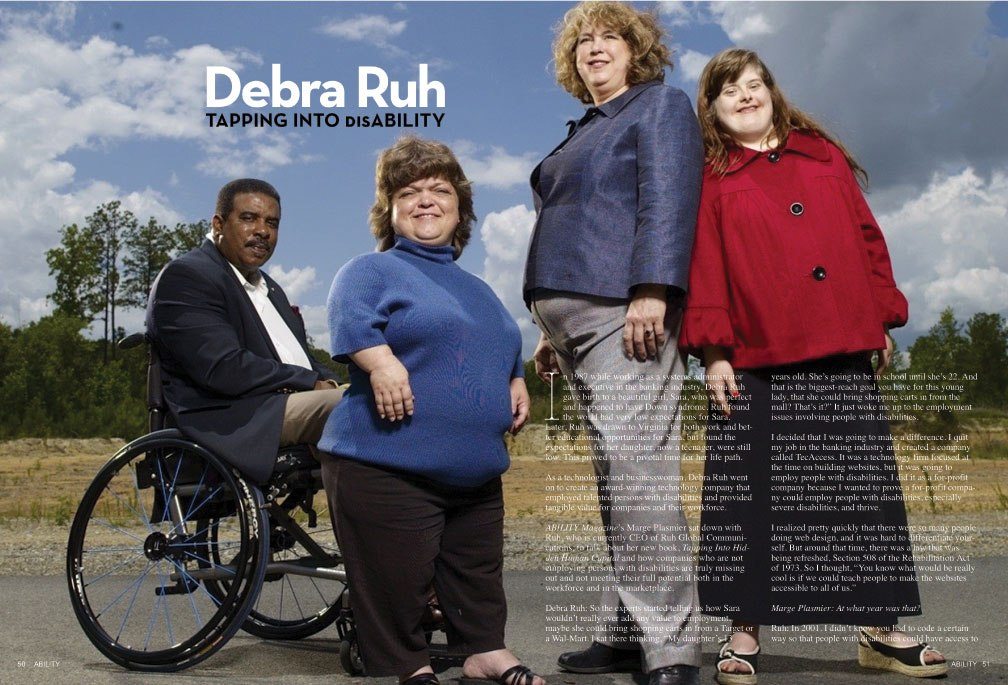
In 1987 while working as a systems administrator and executive in the banking industry, Debra Ruh gave birth to a beautiful girl, Sara, who was perfect and happened to have Down syndrome. Ruh found the world had very low expectations for Sara. Later, Ruh was drawn to Virginia for both work and better educational opportunities for Sara, but found the expectations for her daughter, now a teenager, were still low. This proved to be a pivotal time for her life path.
As a technologist and businesswoman, Debra Ruh went on to create an award-winning technology company that employed talented persons with disabilities and provided tangible value for companies and their workforce.
Marge Plasmier, from abilityJOBS and ABILITY Magazine, sat down with Ruh, who is currently CEO of Ruh Global Communications, to talk about her new book, Tapping Into Hidden Human Capital and how companies who are not employing persons with disabilities are truly missing out and not meeting their full potential both in the workforce and in the marketplace.
Debra Ruh: So the experts started telling us how Sara wouldn’t really ever add any value to employment, maybe she could bring shopping carts in from a Target or a Wal-Mart. I sat there thinking, “My daughter’s 13 years old. She’s going to be in school until she’s 22. And that is the biggest-reach goal you have for this young lady, that she could bring shopping carts in from the mall? That’s it?” It just woke me up to the employment issues involving people with disabilities.
I decided that I was going to make a difference. I quit my job in the banking industry and created a company called TecAccess. It was a technology firm focused at the time on building websites, but it was going to employ people with disabilities. I did it as a for-profit company because I wanted to prove a for-profit company could employ people with disabilities, especially severe disabilities, and thrive.
I realized pretty quickly that there were so many people doing web design, and it was hard to differentiate yourself. But around that time, there was a law that was being refreshed, Section 508 of the Rehabilitation Act of 1973. So I thought, “You know what would be really cool is if we could teach people to make the websites accessible to all of us.”
Marge Plasmier: At what year was that?
Ruh: In 2001. I didn’t know you had to code a certain way so that people with disabilities could have access to the information. So that’s when I thought, “Wow! What a great idea!” And it just unfolded. I built the company to a multimillion-dollar business. Eighty percent of my team were technologists with disabilities.
It was all focused on mainly helping corporations, but we also had government and university clients, making sure their websites were accessible to people with disabilities. And who better to do it than the people who have those types of disabilities and who would know whether it’s successful? At the time, very few of my competitors employed people with disabilities. I just kicked their butts. I did so well.
Plasmier: So in the early 2000s you already had a game plan. What value did people with disabilities bring to your company?
Ruh: They were such amazing employees. It was interesting because I also employed people, a smaller segment, who didn’t have disabilities. But I found that the technologists with disabilities were more productive. They showed up more often than the people without disabilities, they whined less, they were very creative and innovative, and they were really my top performers.
And then I found that the more I involved them with my clients, the clients loved it. And so it became a huge differentiator for us. Our competition—we were just beating them terribly.
Plasmier: You talk about that a lot in your book. That was the big differentiator for your business?
Ruh: Yeah, it was a huge differentiator. And I won so many awards. And I thought, “That is great for my ego, and my mom’s proud of me for winning all these awards, but the only thing I’m doing differently is employing qualified technologists with disabilities.” I hoped for a world some day that wouldn’t think it was so unusual to employ talented people with disabilities who were qualified to do the jobs.
Plasmier: For the people who were working for your company who had disabilities, what did they bring to the table?
Ruh: What they brought to the table was a real understanding of accessibility. Because, at the time we were trying to figure out exactly what it meant to code a website, a mobile app or anything so that it’s accessible to all of us. How can you do it in a way that works for people who are blind, deaf, aging, losing their mobility, etc.?
They brought creativity. “How do you make a website accessible to screen readers in a way that doesn’t change the product?” That’s what everybody was really concerned about at the time… creating something just in text. It was going to be boring, and the rest of the customers aren’t going to like it. So we were able to show that’s not true, and we were able to build real awareness about the value people with disabilities brought not only to my workforce but also to other people’s workforce.
I remember saying, “I know that I’m going to be successful when my clients or others start stealing my employees from me.” When it started happening, I wasn’t happy. I was happy, but I wasn’t happy because I was losing these really talented individuals.
Ruh: Yeah, you probably did. They’re top of the field. They’re the best. And that is what should be happening. We should be creating really amazing jobs for these individuals who are so talented.
Plasmier: Your book, Tapping Into Hidden Human Capital, was a very concise road map for companies. When I finished reading it, my initial thought was, “Why wouldn’t people hire, incorporate or identify more people with disabilities in the workforce?”
Ruh: And I love that comment, because that’s what I tried to do. I wrote it for employers to demystify this issue and take away some of the misinformation.
Plasmier: Why don’t employers hire people with disabilities?
Ruh: Companies are afraid that if their facilities aren’t accessible, even after 26 years of the Americans with Disabilities Act (ADA), they’re going to get sued. They’re afraid that their websites and their intranet, internet and software systems are not accessible to assistive technology that a person might use. They’re afraid the assistive technology might be really expensive. They’re afraid that people with disabilities are going to be out sick more or they’re going to say the wrong thing. Another thing employers are afraid of is that we’re expecting them to hire somebody who’s not qualified to do the job.
Plasmier: What do you say to a company that has these fears?
Ruh: First of all, I say, “I understand you have all these legitimate fears. Let me tell you why they’re not true.” Then I go point by point, and there’s so much great data out there proving it’s not true. And then where we are right now with employment, you do not have a choice if you’re in the U.S. You have to employ people with disabilities in your workforce. If you’re not, you’re probably breaking a law or multiple laws. It’s not, should you do it? You have to do it.
You probably already have people with disabilities working for you, by the way. It’s about retention, too. And people who work for you are acquiring disabilities because we are in these fragile bodies. I don’t mean that as a threat, but as we age and as we live our lives, quite a few of us acquire disabilities.
But any time you’re broaching something new that you don’t understand, instead of just jumping in, why don’t you put a plan together? Understand what you have to do. You can say, ‘Oh, yes, we’re hiring people with disabilities,’ but if your website is not accessible, if the career portion of your website is not accessible, if you don’t know how to accommodate an individual with a visible disability or invisible disability, there are a lot of ways to get in trouble right now in the US with this. ADA lawsuits are up 63 percent from this time a year ago.
Plasmier: Lawsuits are up 63 percent from last year? Why do you think that is?
Ruh: We can do a bunch of lawyer jokes here, but part of the role that lawyers play in US society is pounding out our laws. We’ve had the ADA law on the books for 26 years, and many, many, many businesses are not accessible physically or technologically. And employers are not employing people with disabilities. I’d like employers to do it because they get innovative, creative, talented employees and because we have studies, which I’ve mentioned in the book, that prove customers want companies to do hire people with disabilities, and employees become more productive. If it takes a lawyer suing a company to do it, they have to include us in the workforce no matter what. Period. End of story. I don’t want to hear your excuses any more. Sorry.
Plasmier: Get on your soapbox, by all means!
(laughter)
In comparison to the settlements these companies have to endure and legal fees, what is the cost of making a company accessible?
Ruh: It’s really not very expensive at all. You can even make your company fully accessible without paying one penny outside. There’s so much free information on the internet. WebAIM, for example, gives step-by-step instructions of everything a company needs to do, and there’s W3C. You can join things like AXSChat that we run every Tuesday. We talk about it. You do have to update your policies and processes.
I can’t talk about this topic of employment without talking about accessibility. If you have an individual who gets into a car accident or has a stroke, and they’ve been a great employee and have a lot of good intellectual data, you don’t want to just kick them to the curb. You want to work with people.
Plasmier: That’s the change of our humanity. We’re aging, time passes and we acquire a disability?
Ruh: Right. And a lot of us keep disabilities quiet because we don’t want somebody to look at us and judge us and decide we’re less. A man, who was at the very top of a very large government agency, said, “Well, I have multiple sclerosis, but I haven’t told anybody because if I tell them, they’ll start thinking that I can’t add any value. I think my peers will start thinking it’s time for me to retire. They’ll start pitying me.”
About a year ago, I was diagnosed with ADHD, which made a lot of sense to me. I’ve struggled my whole life with depression, sometimes really bad depression. I believe I’m a better communicator because of the ADHD. I believe that because of the depression I’m more empathetic to others. I think that all of us have abilities and disabilities, and some of us, maybe we have more obvious disabilities than others, but it doesn’t mean that we’re broken and we can’t add value.
I talk about Rosemary Musachio in my book, who’s one of my team members. Since the box isn’t made for her, she’s always outside the box. She’s always thinking so creatively and innovatively.
Plasmier: What about the value people with disabilities bring to that so-called bottom line? That’s a big thing. It’s a way to move the needle with these companies.
Ruh: And that’s the language they understand.
Plasmier: What’s the bottom line, the down-the-line benefit of having people with disabilities in your workforce?
Ruh: One of my favorite stories is about Canon. A few years ago Canon decided they wanted to be more environmentally friendly. So they hired a small team, about 20 people, with intellectual disabilities, outside Chicago in Naperville. They worked with a service provider to bring people in and taught them how to take broken cameras apart. They learned about all of the pieces, which piece was destroyed and needed to be sustainably thrown away, the right way, which pieces could be fixed, and which pieces were still good.
In that one location of about 7,000 employees, the overall productivity across the plant went up by 36 percent. The only thing that was different was the little group of individuals with disabilities who were working for Canon.
Plasmier: That was the only thing they changed?
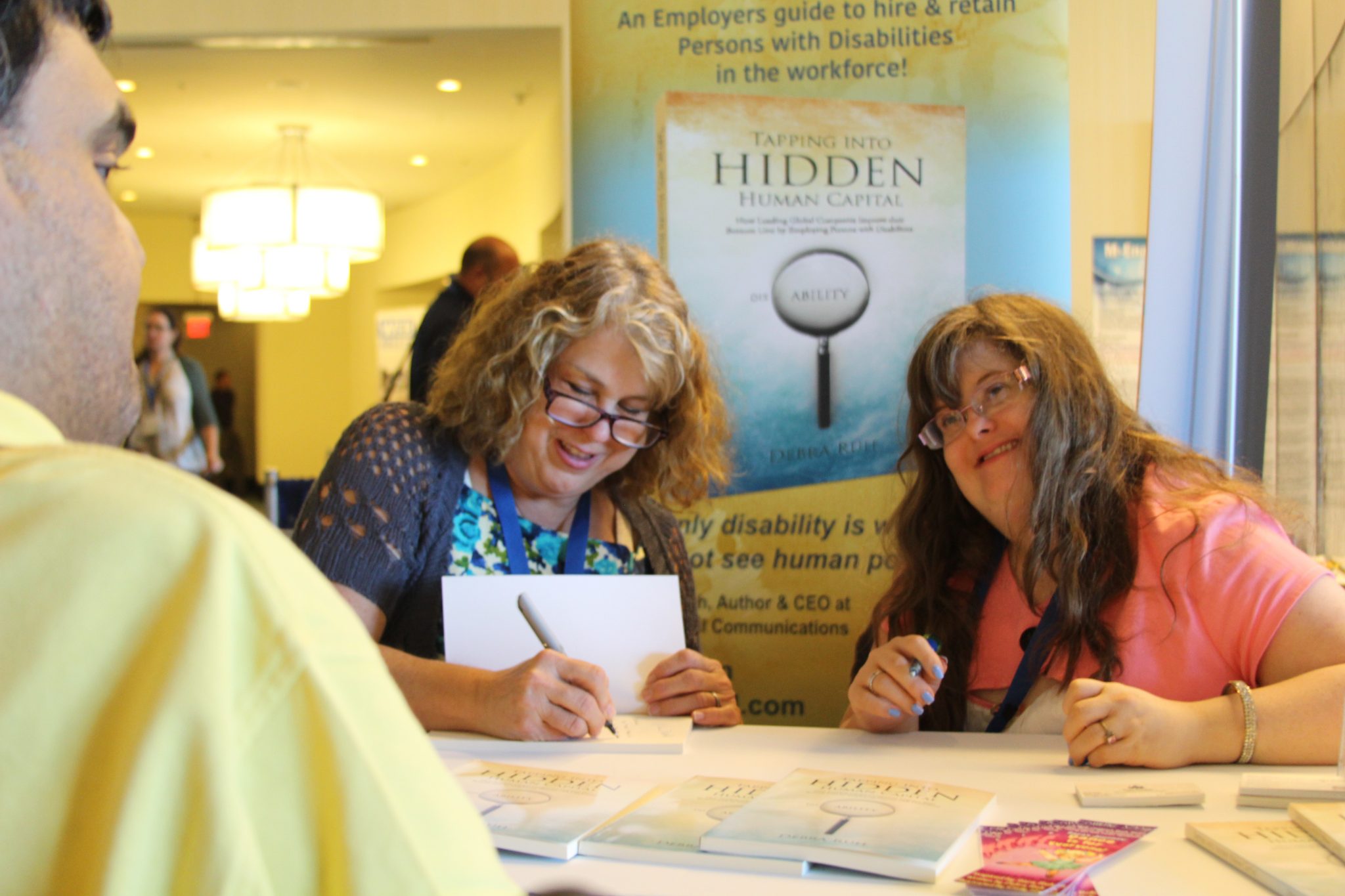
Debra Ruh (L) and daughter, Sara (R) are all smiles while Debra signs her book for a fan — published by G3ict.
Ruh: It was the only thing. And they started interviewing their employees. And the employees said, “I’m very proud to work for Canon. I like going to lunch with Joe, who has Down syndrome, or Donna, who has autism. It makes me proud to work for Canon and to be so socially evolved.” When people are proud to work for a company, they’re more productive.
The employer of choice has become more important than ever. It’s become more important to be a socially responsible company. One way they can prove they’re socially responsible is by employing a diverse workforce that includes qualified people with disabilities and retaining people with disabilities
Plasmier: Not only is it social achievement, but what about the monetary benefit?
Ruh: When you make things accessible to individuals with disabilities, it becomes more usable for everybody, which improves the bottom line. Another bottom-line benefit: why would you build any technology that 20 percent of the population might not be able to use?
A good example is Comcast. They’ve made sure their machines—their DVRs and all of their equipment—are fully accessible to everybody. They have talking remotes, and the different machines will talk to you. The Comcast guy came and was explaining to my mom how to use it. My mom was getting really overwhelmed. He started talking to her about these talking features, where it would talk her through it. I got excited because I knew they had done that for their clients with disabilities, but it benefited older people as well. This man was so proud of this company. Employees need to feel proud about the companies they work for.
Plasmier: Kevin Bradley of the Boeing Company talked about how hiring people with disabilities is not only the right thing to do, it’s the smart thing to do.
Ruh: It is. Why would you ever want to leave people out? If you have two equally qualified people with equal degrees and the same amount of past history, but one is in a wheelchair, I would pick the person in a wheelchair over the other candidate because the person in the wheelchair has had to work harder to get there.
Plasmier: Now we’re talking about affirmative action.
Ruh: We are.
Plasmier: How is that happening? Is it happening?
Ruh: I see it, but I will tell you I’m not as much looking at it from that lens. There are a lot of people looking at it from that lens, such as our Department of Labor, our Equal Employment Opportunity Commission (EEOC), and vocational rehabilitation people. I’m always looking at it from the corporate lens.
Plasmier: Disability Rights activist Emily Ladau is one of your contributors.
Ruh: Oh, yes! She’s a rock star.
Plasmier: She has very strong feelings about herself as a person with a disability and her value.
Ruh: Yeah, she says, ‘Don’t hire me because I’m a person with a disability. Hire me because I’m a rock star, and you’ll be lucky to get me.’
Don’t you want that employee? You do want that employee. If you do not recognize the value of employing people with disabilities, your competitors do. And be prepared to start failing, because you’re going to fail. We’re evolving with or without you…
Continued in Print, PDF or Digital versions. Order Here. Receive a free Digital version ofABILITY Magazine, with full images, videos and text, by clicking“Like” on our Facebook page
Debra Ruh — Hire Talent, Now!
Articles in the Jon Cryer Issue; VOICEYE — It’s Free; Ashley Fiolek — On the Go!: Humor — Dying to Know: Geri Jewell — Sticky Situation: China — The Great Tangshan Earthquake: Part 1: Long Haul Paul — A LifeCycle: Ruderman — A Family with a Strong Foundation: Comcast — Live Olympic Games Audio Description: Hugh Herr — Bionic Innovation: Jon Cryer — Two and a Half Miles for Shane’s Inspiration: Debra Ruh — Hire Talent, Now!: Jennifer Sheehy — Deputy Assistant Secretary of Labor: ABILITY’s Crossword Puzzle; Events and Conferences… subscribe