
Hello world!
Welcome to WordPress. This is your first post. Edit or delete it, then start writing!
Living Afraid: Impacts of Anxiety and UDL with WCAG Solutions
Living Afraid
Impacts of Anxiety and UDL with WCAG Solutions
Introduction
The day dawns bright with a clear sky and a warm temperature. Getting out of bed is easy. The night’s sleep was restful and long enough. Waking up in a good mood is the best way to begin any day.
The dog pulls himself out from under the bed, his favorite place to sleep. He stretches, stumbles a bit and then limps over to say good morning. The limp is new. The endless stream of questions begins like water cascading over a cliff: What happened to him? How bad is it? Was it something I did? Did I not hear him in the night? Should I make an appointment with the vet? How can I fit a vet visit in to the day’s schedule? Should I call in a PTO day? How much will this cost? What if it’s cancer? What if he needs to be put down?
The questions spiral down to ever-increasing depths of unfounded possibilities and settles into a full rolling boil of panic. Blood pressure rises. Heart rate soars. All this physical and mental reaction occurs before the dog even makes his way over for morning scratches. This is how the day may start for a person living with an anxiety disorder.
Anxiety Explained
The reaction in the introduction is called a panic attack – “an intense fear response to aroused sympathetic activity is manifested in the absence of actual danger.” (Jieun E Kim, 2012). Panic attacks can happen to anyone and are estimated to occur in about 28.3% of the people at least once during their lifetime. (Jieun E Kim, 2012)
What happens to the body and brain in the introductory example is called an Amygdala Hijack. (Goleman, 1995) When a threat is perceived, the amygdala triggers a flood of stress hormones that are released into the body, the physical source of the elevated heart rate and blood pressure.
Most people learn to recognize and evaluate perceived threats and respond in more controlled methods. In the case of the dog, before reacting, one person may watch the dog’s movements for a while to see if they persist; another person may bend down to examine the dog’s leg closely for injury; another may dismiss the limp temporarily and file it away as something to consider at the end of the day (wait and see).
People with anxiety disorders, specifically Panic Disorder, may not have the ability to react in a controlled manner. “Unlike the general belief that ’cognition rules over emotion,’ there is evidence that emotion modulates cognition from perception and attention to higher domains of judgment and reasoning.” (Jieun E Kim, 2012)
The frontal cortex in humans performs a function to sooth unwarranted fears. As children grow, they learn skills to calm anxiety. Studies of brain activity show that people who use self-talk in upsetting situations have an increased activity in the prefrontal cortex with decreased activity in the amygdala. The amygdala response does not go away completely. Even with well-practiced skills, when the cortex is otherwise occupied with other stress when a perceived threat arises, the Amygdala Hijack can come back at full-force. (Cain, 2013)
For people living with an anxiety disorder, the incidence of panic attacks may be frequent. The person may stay in a hyper-alert state anticipating the next attack. The panic attacks and hypervigilance both manifest in physical and mental reactions. The elevated heart rate and blood pressure may be accompanied by lowered cognitive ability, slower processing times, and slower reactions. Reading is slower. Understanding is slower. Deciding is slower. Reacting is slower. To compensate for the internal slowness, the person may speed up their physical movements. They may become clumsy, exhibit tics, or make repetitive motions.
People with anxiety disorders, specifically Panic Disorder, may not have the ability to react in a controlled manner.
Anxiety Disorder Defined
Anxiety disorders include GAD (Generalized Anxiety Disorder), PTSD (Post Traumatic Stress Disorder), OCD (Obsessive Compulsive Disorder) and PD (panic disorder), among others. Anxiety disorders may be mild to severe. Milder cases may not disrupt daily life but may require structure, such as the rituals of those with Obsessive Compulsive Disorder needing to have a perfectly tidy bath and bed room before leaving the house, for instance. Severe cases can cause the person to withdraw from daily social activities, impair work, and create major distress.
GAD (Generalized Anxiety Disorder) may be diagnosed when a person is unable to evaluate perceived threats properly and stay on high alert excessively.” Although the exact cause of GAD is unknown, there is evidence that biological factors, family background, and life experiences, particularly stressful ones, play a role.” (Anxiety and Depression Association of America, n.d.)
OCD (Obsessive Compulsive Disorder) is an anxiety disorder where the person, over time, develops recurring and unwanted thoughts, ideas or sensations that cause them to do something repetitively (compulsions). These compulsions become persistent and rigid to the point that they disrupt daily life and cause great distress. (American Psychiatric Association, n.d.)
PTSD (Post Traumatic Stress Disorder) is an anxiety disorder caused by experiencing or witnessing a traumatic event. People with PTSD may relive the traumatic event through flashbacks or nightmares. The impact includes irritability, feelings of guilt (survivor’s guilt included), lowered ability to concentrate, and social isolation. Sufferers of PTSD may also develop insomnia. (NHS Choices, n.d.)
Panic Disorder (PD), though also not fully understood, is emerging to be associated with dysfunction of the hypothalamic-pituitary-adrenal axis. The amygdala, it has been suggested, may play a critical role. Panic Disorder is often accompanied by anticipatory anxiety, fear of losing control or sanity and other behaviors associated with fear. (Jieun E Kim, 2012)
Spectrum of Impact
It is easy to conceptualize sight and hearing impairment being on a spectrum from minimal impairment (hearing loss, tinnitus, presbyopia) to full impairment (deaf, blind). When it comes to anxiety and the resulting cognitive impairment, the spectrum is harder to understand. The strides in Autism Spectrum Disorder (ASD) research and publicity have helped in recent years to build public awareness of the oft-times hidden disability and the breadth of its spectrum of impact. Anxiety disorder spectrum may be like that of ASD, in that the disorder is often a hidden one and the spectrum of impact is variable based on a combination of environment and personal perception.
With sight and hearing impairments, the impact is stable. With anxiety, the impact to cognition can change very rapidly. Someone with a sight impairment, for the most part, puts on their glasses each morning and is confident that they can see all day until they take their glasses off to go to bed at night. The individual goes to bed confident that the same pair of glasses will work tomorrow. An annual checkup may be all that is needed to accommodate change.
We often overlook the fact that a person who wears glasses is not considered to have an impairment because the accommodation is stable and consistent, and the impact to daily function is low. The person with an anxiety disorder, however, may not share their impairment and may do very well. So well, in fact, that it may be forgotten or overlooked that an impairment may even exist. The disorder may have only vague impacts such as irritability or forgetfulness that is easily explained by an “off day.” When an Amygdala Hijack occurs, it not only catches the individual who is impacted off guard, but also people around them who may know nothing of the anxiety.
One parent of a child with an anxiety disorder was heard saying, “She does so good that people forget. I forget. When she has an event, it becomes a crisis.” This is a very different challenge than a person with a vision impairment losing the screw to the earpiece of their glasses. It is easy to fit an earpiece on glasses with a paperclip for a few days until it is replaced. Workarounds for cognitive lapses are not so easy or obvious. The individual is often left to cope by themselves, and within themselves, as they try to hide the distress. The impact may also have long-lasting effects.
There is little shame in losing a screw to the earpiece on glasses. It may even become a fun event where everybody searches for the screw and the finder becomes the hero. However, the person who suffers a panic attack can suffer extreme shame. Reentry to a classroom or work group can also bring on additional anxiety. Workers who once thought of the person as smart and inventive may suddenly see the person as unstable and unreliable. People may act cautiously around the person and withhold humor, assignments or forthrightness, the very things that may help the individual cope.
One parent of a child with an anxiety disorder was heard saying, “She does so good that people forget. I forget. When she has an event, it becomes a crisis.”
UDL as a Method to Prevent and Dispel Anxiety
When the Universal Design for Learning (UDL) Guidelines are used to design content, there are several benefits for learners with anxiety disorders. Because UDL is about providing opportunities, the learner with an anxiety disorder and their teachers, they have built in avenues to prevent heightened anxiety or dispel anxiety, so these students can continue to learn and succeed.
Providing options allows the learner with anxiety to select the method that is best in situations they do not have controls over. When anxiety is high regardless of the situation, having options may allow them to continue learning and can be instrumental in decreasing or dispelling the anxiety. The following examples from Guideline 1 explore some common situations:
Guideline 1: Provide options for perception (UDL: Perception, n.d.)
- Checkpoint 1.1 Offer ways of customizing the display of information
Being able to personalize the perceptual features can prevent the anxiety trigger of losing study time. Modifying the background color of learning materials to individualized colors can reduce eye strain and allow the learner to study for longer periods of time. When a learner must take time away from study for eye strain, this can trigger anxiety as the learner thinks about the study time that is being lost.
- Checkpoint 1.2: Offer alternatives for auditory information
Text equivalents are used by many learners and is not limited to those with low vision and blindness. For learners with anxiety, have text alternatives provides a way to learn and review the content when they are in environments where audio would be difficult to hear and where audio is not an option such as when siblings are sleeping in a shared room.
For all learners, having technology fail can bring on anxiety. For those with anxiety disorders, technology failure can be derailing. Knowing that an alternative is available when the earbud wires are cut from the family pet biting them or if the wires get accidentally closed in the car door, can mean that the learner with anxiety stays the course and continues with their learning.
- Checkpoint 1.3: Offer alternatives for visual information
When opportunity for additional time to study is given to a learner with anxiety, it can dispel the anxiety of not having enough time. For the learner with anxiety, having alternatives for visual information, especially text-to-speech, provides opportunities to study by listening to lessons in places where reading would not be easy. Listening to lessons from a lightweight audio player on a bumpy bus or train ride home is easier than carrying a large book and trying to focus on the content that moves with every bump.
The benefits of UDL also extend to the teacher of the student with an anxiety disorder or any student who may find themselves with an Amygdala Hijack. Having choices to present to students during times of high anxiety, can help the student focus on what they can handle now. Starting the student with an audio lesson with eyes closed, may help them focus when visual stimulation is disturbing them. Having a student read a lesson, when anxiety is heightened because a video is being presented at too fast a pace for them to digest, can help them continue without an anxiety attack.
Teachers can work with students during times when anxiety is low to develop strategies for times of high anxiety. Preparing ahead of time can help both the teacher and student to employ the strategy so that it does not bring undo focus on the student. Curriculum designed with UDL makes development of strategies much easier than curriculum designed without the choices inherent in UDL.
Web Accessibility as a Method to Prevent and Dispel Anxiety
Applying the Web Content Accessibility Guidelines (WCAG) 2.0 Success Criteria (SC) can also be helpful with anxiety disorders. Combining Universal Design practices along with ensuring access by following WCAG 2.0 provides people with anxiety an improved chance of success. The following are specific examples of how applying WCAG 2.0 SC is helpful.
- SC 1.4.2 (A) Audio Control – Unexpected audio can be a source of anxiety for some people. Those with PTSD may associate certain sounds with a traumatic event. Being able to control “when” and “how” loud audio plays can be critical in preventing an Amygdala Hijack. Fortunately, devices have user-controlled settings for volume.
- SC 2.2.1 (A) Timing adjustable – Time limits add undue stress on people with anxiety disorders, people who know they process information slower, those who use assistive technology, or use alternate formats. When timeouts are encountered, providing a clear method to turn off or extend time is important to prevent anxiety. (SC 2.2.3 (AAA) No timing – is even better!)
- SC 2.2.2 (A) Pause, Stop Hide – Information that is moving on a webpage needs a mechanism to stop, pause or hide the motion. I have heard people say that this Success Criteria is for people who are easily distracted. Anxiety is also a valid reason to be able stop motion. For instance, a person who got t-boned in a car may also flinch at information moving across their field of view. With no mechanism to stop a carousel from advancing, people with anxiety disorders may leave the page quickly to avoid a panic attack.
- SC 3.2.3 (AA) Consistent Navigation – The impact of inconsistent navigation can be very distressing. It can cause a person to fail at the task they are trying to perform. The task may be of critical importance, such as signing up for health insurance, filing taxes, banking, or communicating with health providers.
When navigation is inconsistent, people may begin to doubt their own ability to remember the location and order of menus and menu items. Self-doubt can be a big contributor to increased anxiety. It might not occur to the person with an anxiety disorder that the lack of consistency is a result of the design of the website.
- SC 3.3.2 (A) Labels and Instructions – having enough information to complete a task successfully the first time is important. This may seem self-explanatory, but the following scenario is an example of a person’s experience when the correct labels and instructions are not implemented:
Filling out a form is fast when the form is well designed and developed – Tab, type, tab, type, tab, type, submit!
With submit, errors are identified. The date format is incorrect. Try again. Search for the format instructions. There are none to be found – even in the error message (SC 3.3.3 (A) Error Suggestion). It takes three or more attempts to finally enter the date in the correct format.
Anxiety mounts as the task takes longer to complete and the user is told repeatedly by the web page that they are wrong. For the person with anxiety, having an inanimate web page pointing out their mistakes can have a profound impact to self-esteem.
Of course, the polite thing to do is to provide format instructions to begin with. It is polite and conforms with 3.3.2.
Looking ahead to WCAG 2.1, SC (AA) 1.3.5 Identify Input Purpose and SC (AAA) 1.3.6 Identify Purpose may help diminish anxiety by providing support for inputs, User Interface Components, icons and regions (such as input customization, autocomplete, and symbol mapping to user agents). (W3C, 2018) (W3C, 2018) (W3C, 2018) Saving time and having additional cognitive support are both strategies for success for people with anxiety disorders.
Conclusion
Anxiety is often the companion of other disabilities and can take a backseat, not getting diagnosed and treated. Or, it may be treated as symptomatic relief and not diagnosed on its own standing. This article does not address the process of diagnosis, treatments, and therapy. Those topics are highly individual and should be addressed with health professionals.
Anxiety disorders have long been ignored in many modern cultures or have been fraught with shame and humiliation as a sign of immaturity or a conscious choice. The shame and humiliation of being identified with the disorder and accepting treatment is not trivial. Anxiety is not something to “get over.” It is something to accept, work with and share so that others experiencing the same, or similar, disorder will hopefully experience a smoother path to success.
UDL provides choices and they provide relief to both student and teacher. Having options is good for planning strategies, helping the student focus during difficult times and helps the student discover what works best for them. Students with an anxiety disorder who have the benefit of a learning career developed under UDL, may be able to succeed throughout their years in school. When the person gets into the workforce, they will have the benefit of knowing what works best for them and can work with colleagues and managers to develop strategies for a successful career. The benefits can also carry into their adult home life with strategies to building strong partnerships and raising their own children.
Anxiety is something most human beings experience at one time or another. It should not be difficult for people to understand how having an anxiety disorder is difficult at best. Our cultures and societies, however, have not provided an easy way for this understanding to occur. We are getting better – that is the good news. As cultures continue to adopt and strengthen the use of guidelines such as UDL and WCAG 2.0 (2.1), the world will become an easier place for people with differences to succeed at the same levels and opportunities as those who are considered normal.
Works Cited
American Psychiatric Association. (n.d.). What Is Obsessive-Compulsive Disorder? Retrieved from American Psychiatric Association: https://www.psychiatry.org/patients-families/ocd/what-is-obsessive-compulsive-disorder
Anxiety and Depression Association of America. (n.d.). Generalized Anxiety Disorder (GAD). Retrieved from Anxiety and Depression Association of America (ADAA): https://adaa.org/understanding-anxiety/generalized-anxiety-disorder-gad#
Cain, S. (2013). Quiet: The Power of Introverts in a World That Can’t Stop Talking. New York: Random House.
Goleman, D. (1995). Emotional Intelligence. New York: Bantum Books.
Jieun E Kim, S. R. (2012, 11 20). The role of the amygdala in the pathophysiology. Retrieved from Biology of Mood & Anxiety Disorders: https://biolmoodanxietydisord.biomedcentral.com/articles/10.1186/2045-5380-2-20
NHS Choices. (n.d.). Post-traumatic stress disorder (PTSD). Retrieved from NHS.UK: https://www.nhs.uk/conditions/post-traumatic-stress-disorder-ptsd/
UDL: Perception. (n.d.). Retrieved from CAST: http://udlguidelines.cast.org/representation/perception
W3C. (2018, 4 20). Understanding Success Criterion 1.3.5: Identify Input Purpose. Retrieved from Understanding WCAG 2.1: https://www.w3.org/WAI/WCAG21/Understanding/identify-input-purpose.html
W3C. (2018, 04 20). Understanding Success Criterion 1.3.6: Identify Purpose. Retrieved from Understanding WCAG 2.1: https://www.w3.org/WAI/WCAG21/Understanding/identify-purpose.html
W3C. (2018, 04 24). Web Content Accessibility Guidelines (WCAG) 2.1. Retrieved from Web Content Accessibility Guidelines (WCAG) 2.1: https://www.w3.org/TR/WCAG21/
About the Author:
Find Valorie on LInkedin
#105: Inclusion in a Digital Society
Guest: Christopher Johnson, Rob Price Date: April 27, 2018
Guest Company: Atos
[Intro music]
Debra Ruh: Hello everyone this is Debra ruh and we are recording on Good Friday so happy Good Friday to everyone. I have two guests joining us from the UK and I’ve had the pleasure to speak to both of these gentlemen about the work they’re doing on AXSChat and also on couple of other times and a couple of other scenarios. So, I’m really excited to have Rob Price and Christopher Joynson joining us today and they’re joining us from Atos and Price… I’m going to say it wrong Rob, Worldline.
Rob Price: Worldline, that’s it. Absolutely.
Debra: Right. And Worldline and Atos are sort of sister companies or…
Rob: Yes.
Debra: There’s a connection.
Rob: Yes. So, Worldline is a payment business within the broader Atos group.
Debra: Alright good. Good good good. And, for those of you that don’t know it; Atos is a French corporation and they’re a multinational corporation with locations all over the world and we’ve had Neil Milliken from Atos and AXSChat on before so I’m very impress with the work that Atos and Worldline is doing and I think you will be too. So, welcome today to the program and thank you for being on the program on your days off as well; we appreciate that.
Rob Price: Thanks Debra.
Debra: So, why don’t we start with… Rob, why don’t we start with you and you tell us a little bit about yourself and then we’ll pass it to Christopher. But let’s just do some introductions of who you are as individuals.
Rob: Okay. So, thank you for the introduction and it’s fantastic to be on. So, my role in Worldline is Chief Operating Officer for the UK and Ireland. My background with Atos, I suppose probably for the last 10 years I’ve been working in what you might broadly call digital transformation of various forms. Whether that’s working with global organizations helping them transform the language they’re working with their consumers or indeed to ourselves.
So, previous role was head of digital so chief digital officer within Atos itself. And the work that we’ll talk about today is something that I probably kind of talk about in the context of forward look in research so it’s in addition to the data if you like but it’s something that we became increasingly passionate about thinking what more beyond digital transformation of business. How does that impact citizens or consumers and society as a whole. And we’ll of course come back to that after Christopher introduced himself as well.
Debra: Yes. Thank you Rob. Christopher?
Christopher Joynson: Thank you Debra. And to give you Minnie introduction; yes, my name is Christopher Joynson. I work for Atos consulting in UK and I’ve been with the business for about two to three years now so it’s not very long but I’ve had the good fortune to work alongside Rob on this piece of work and we’re really intrigued by some of the insights we’ve received from it and we’re looking forward to sharing them even more in the future. So, I’m excited to be here today.
Debra: Yes. And Atos has a scientific community and both of these gentlemen are part of their scientific community. And I wrote a blog recently with Christopher so I’m participating in small ways as well. But it’s… I’ve always been very interested in obviously inclusion as a whole and digital inclusion and how do we solve the digital divide. But one thing that we… and all the conversations we’ve had is you talk about result of your survey and where we go from here is the digital divide has sort of changed and I think that might be a real good place to start. So, Christopher, I don’t know if… what I’ll do is just throw out the question and you’ll decide how you want to answer it because I know you bring different things to the table. But, let’s talk first about the digital divide.
Christopher: Sure. I can go first. So, I think our traditional conception of digital divide in our society has always been about access to technology. It’s all about whether I have a smart phone or a none smart phone. Whether I have Wi-Fi or 4G or connectivity to the digital world. Our thinking is that although accessibility is still a problem around the world; there are still areas in the country that still don’t have access to the internet. For many of us, it’s ubiquitous and it’s a huge part of our day-to-day lives.
So now it’s becoming more about our emotions and feelings towards technology. it’s about whether I feel comfortable with it or uncomfortable with it and that’s going to impact on whether I’m going to adopt it or reject it or not and that’s going to become more and more important as the technology becomes more and more intrusive and impactful into our lives. Before, technological changes was having a thinner phone or a lighter laptop. Whereas now, we are seeing artificial intelligence and blockchain and things that could have a much more integral impact on the way we live our lives.
So that’s how we think it’s progressing from an accessibility agenda to a comfort agenda on a very individual level and it’s based on that new concept that we’ve done that work. Want to expand on that a bit Rob?
Rob: Yes. Sure. I think if anyone looks online in terms of definition of digital divide; often it’s very much as what Christopher said. It talks about those web access broadband services and those that don’t. Those that can get online and then those that don’t and I think it’s…
One of the things that we’re looking at very much was how that differs in different geographies, in different age groups. The things that we might assume are normal within the UK or within the US are quite different in other parts of the world. And I think, if we go back in time, 18 months to when we started thinking about this; we’re also kind of seeing things. Political decisions such as Brexit, changes in the US election and more. We were looking at adoption and rates of adoption of mobile apps or on new technologies that continue to kind of emerge. And I think it was asking the question then; just how are people managing to keep up? How does the divide evolve over the next five, 10 15 years?
I’ve read a lot that makes the assumption that those of my age perhaps who are less comfortable with such technologies will be overtaken by those of Christopher’s age who were born using those technologies; the millennials. And I think our hypothesis all along has been it’s not as simple as that. That the rate to change of technology’s some of those that Christopher talked about blockchain content. These are things that many others are not comfortable with in terms of their understanding and clarity about how those can be used to add value to business, to people, to people’s lives and the society. And I think therefore, our hypothesis was, actually it’s the divide growing and that was the reason why we started looking at the divide and the people’s ability to understand and value the impact of those technologies on their lives and therefore on society and that’s why we did the survey.
Debra: Yes. And the survey is very interesting. The questions, I want to dig into the survey. Excuse me a little bit. But, one thing that I thought was interesting in some of the conversations that we’ve had about this topic is, one of my customers, a very very well-known brand in the United States would call their customers that weren’t very technologically savvy lagers. And they said, “well, most of the lagers are your age Debra or older.” And I said, “well, first of all, don’t call us a lager, that makes us mad.” And they weren’t openly calling us that but it was just this little nickname they have in the company but you know how that goes wrong.
But it was interesting because I agree with what you just said Rob, that what we understand about the digital divide is that we can’t just assume that people our age, you know my age, your age Rob that we are lagers. You know, some of us are very active on social media and very active on technology. And we also at the same time cannot assume that people Christopher’s age always have the answers either as far as digital inclusion goes. And it’s fascinating because some of it is tied to economics and culture and other countries and how does it accept… there’s just so many factors. And just speaking from the United States for a minute, there are still big pockets in the United States where we don’t have good access to Wi-Fi.
I live in Virginia, 2hours from Washington DC and what I have to pay for internet would shock everybody. It’s ridiculous but it’s the only way that I can get access and I work from my home so I have to have this access. So I happen to be in the position I can pay this ridiculous amount of money but I have to have access. And it’s affecting prices of homes. It’s just a really big topic.
And so, why don’t we talk a little bit more about… you’ve already talked a little bit about… you know, tell us about the study. Tell us about the countries that were involved. You know, you’ve talked a little bit about what you’re trying to accomplish with it but, I just think the work that you’re doing is very very important to all of us all around the world. And I don’t know Rob if you want to go first this time and then Christopher to add on to your comments but let’s stick a little bit more to the study.
Rob: Yes. Sure. So I think, the first thing to say was we wanted to try and understand how people felt as Christopher was saying earlier. Maybe, I mean, you said this was part of scientific community; maybe it’s probably important to say that this is not a scientific study. This was about asking how people felt about a number of scenarios whether there were things that we know kind of people use day-to-day or perhaps we felt were emerging. And what we’re trying to do was try and understand where perhaps the differences were so we asked around. It’s an anonymous survey should they hasten to add birth, their geography, education, gender were the main kind of areas that we looked at. And I think… so we asked for three questions. And those questions ranged from, “how do you feel about using the internet?” which it’s probably fair to say was very highly used. It was an electronic based survey so that’s not a surprise. Three or two something kind of more extreme. As an example, one we’ve talked about many times is, “how comfortable are you with nanobots in your bloodstream?” not something I think kind of we would often use day-to-day now but we could foresee that would be the case.
So, it’s a range and it was how do we feel? Do we like it? Do we dislike it? Do we hate it? Do we love it? What’s our reaction? It’s important to say that what we’re trying to kind of understand was relative feeling so the fact that everyone was probably online to fill the survey in in the first place isn’t actually a problem because we’re not testing the divide in the context of are you online or are you not online. We’re almost asking, “Given that, what are your feelings about these subsequent areas?”
So, what was interesting is that we guest launched that survey in English. And I think within a week or two we’ve got that in English, French, Spanish, Portuguese, Mandarin. So we try to make it as accessible as possible to translate to as many people around the world, “what do you think?”, “how do you feel?” and we got a great response.
Now, some of that was we use Twitter to engage with some organizations. In Africa for example, South America just to kind of make them aware of the survey. But Christopher, how about you pick up the story from there?
Christopher: Yes. Sure. So we published in October last year and as Rob mentioned, to many social media channels to try and get as diverse range of people as possible. And we’re really pleased with the amount of people who got involved and completed the survey. We got over 1500 responses in total and from 63 countries all over the world. So as far filled is Singapore and Thailand and Afghanistan and all sorts of places.
Obviously, there was a lot of people from the UK because that’s our closest network but we also saw a similar amount of people from Asia so we’re able to compare to 38 different ends of the spectrum in terms of culture and perception potentially and explore how that impacted on our uptake of technology and our feelings towards it. I also have mentioned that it was… this is a sample of society. Obviously it’s not going to be entirely representative and it will be very difficult to do. What we feel is that this is indicative. And if you pull those 1500 people in a room and said to them, “how do you all feel about the same technology?” it’s going to be fascinating to see how they would respond and what the reasons would be and how they were different between each other and that’s what we’re attempting to do through the survey and some of the insights received were fascinating.
Debra: Yes. And I was really impressed with the amount of people that responded and from all the different countries.
Christopher: Indeed. Yes. I think we’re setting targets at the beginning and I remember saying that I’d be really pleased with 500 and sure a bit more ambitious than me. But, people could have said a lot of time to me it’s my time, I don’t give a way but that we really got involved. When we found out that the messages we gave around, “see, this is a different type of survey. It’s trying to measure something more emotive than quantitative.” And people really bought into it and they got excited about it and that really helped us get the amount of survey responses that we did.
Debra: So, let’s… so let’s talk a little bit more about the responses and what can we conclude from the responses. And I know you’re still working through that but, you know…
Rob: So, I think if I could kick off… And in a sense, I think every time we have a conversation like this, there’s always a bit more that we’ve kind of picked up and learned. But let me start with some of the basic things. So, I think, when we started to look at the data, it’s probably fair to say that the first thing that we looked up was age difference. So, across those 43 questions, could we spot any particular patterns? And we did.
I mean it’s as simple as if I’m with the over 60 group, I was less comfortable with the technology in question than in the under 29 group. And it was. I mean, that line was almost kind of uniformed in every single case. Perhaps with a slight tip up at the end for the over 60s. They seemed less, more or less comfortable perhaps than kind of as with the line.
Now, what was interesting is that there are some exceptions to that. So there are three categories of exceptions which I’ve talked about before. So, the first one of those was where there is a clear and direct benefit for me personally in time. If something is so easy that it would be nonsense to not do it; then, it’s a much flatter bases between those age groups irrespective of age.
If I can give an example, using a contact us payment card; it’s not something that everybody was so comfortable with because it’s used in different right of adoptions around the world. So geographically, it’s different but age wise, wasn’t that different. Once people realized that it was really quick, people have obviously started to get comfortable with it quickly.
The second category was around health benefit. So, if it was something that had a potential benefit for me now; then I was more likely to be comfortable with it irrespective of age. So, if I could go back to that example I used earlier, nanobots in the bloodstream. Actually, that was pretty positively seen and interestingly probably more so by those over 60. And therefore, is there a conclusion? And we can only form a hypothesis because ultimately we don’t know. It’s a hypothesis that says, “Absolutely, those in that age group would be more comfortable with the idea of that if it helped address a disease that they would kind of exposed to in later life.” So I can understand that.
And then the third category was what we might call consumer products. So, things that people have used because it was easy. That’s about time but maybe this is about accessibility actually. So, for example the Kindle, “what’s the most use of the Kindle?” “How do you feel about using a Kindle or similar device?” Was uniformly flat age group wise. And I think the thing for us there is… actually, I would point… well, you can see the books in my… behind me actually.
Actually, I’ve got a device like that, but I love books. My 15 year old daughter loves books. She loves the feel of them. But there are times when that’s helpful. If you go on holiday; you don’t have to carry so many things. If your eye sight isn’t so good; then you can easily change the size of the text.
So I think those three areas, there were patterns that was sufficient commonality across the place. If I can use a different kind of area when we looked at gender; there was actually very little difference in gender across most of the questions. Actually, the only group of questions where I would say that there was a difference was the gaming questions where there was more comfort if you like with the male respondents than the female around some of the gaming technologies. There was an exception which I still love… I would love to know why which is over 60s, female were more comfortable with VR as a gaming technology than men quite clearly, quite significantly. I don’t know why is that. We have some ideas, but we don’t know.
Debra: So, what are your ideas?
Rob: Oh, well actually, so I’ve got a VR headset of the PlayStation. My kids kind of use it on a regular bases and therefore when their grandmother visits, they see them using it. Now, it’s clear that, well I can say, my mother does not come into the house and puts on the VR headset. But through association, she has a degree of comfort because I use it and my children use it.
Now, it might be something completely different but, “is it association of comfort of how they feel rather than direct experience?” Might be an idea. Christopher.
Christopher: Yes. I feel it’s a good place for me to pick off because… actually you’re right, we don’t know for sure why people responded the way that they did. We didn’t ask them why they felt that way and maybe we will do that next time. But, we can start to hypothesize about the underlying factors that are causing this feeling.
There’s elements of our context in our social lives that might mean that we end up feeling a certain way towards technology. And I found in particular the concept of technology being intrusive in our lives. And in the past, it’s been something that we can pick up and use and then put down. Now, it’s something that we can talk to, physically talk to and it could be right next to my bed and I can listen. It’s listening to me the whole time which is much more intrusive than it would have been before. So we found that people over the age of 40 were more likely to feel uncomfortable with artificial intelligence providing lifestyle guidance than people under the age of 39 significantly so.
Rob: I mean, there was an age kind of… there’s difference there that Christopher’s talking to about AI. But actually kind of one of the interesting areas was the geographic difference around people’s thoughts about AI. So it was interesting to know that both Asia and Africa were significantly more open to AI and voice assistance and the use of the technology than Europe and the North America. I found that quite interesting in the sense that perhaps kind of we might say Europe and North America certainly in the use of things like Alexa or Google Home were probably more prevalent in terms of direct experience.
So again… often a survey raises more questions than the answer. But at least it gives us the data to start to kind of wonder how does that therefore have a relevance for our business, your business, anybody’s kind of business in a way in which they then begin to make such technologies more widely available. Now, I’ve got a great little story around Alexa.
So, first thing in the data which I still am fascinated with this one. I’ve used it many times so those who have heard me before won’t be surprised that people were more comfortable with nanobots in the bloodstream than they were around use having Alexa in their bedroom or Google Home or any voice assistance which I still can’t… and I think it’s that point that Christopher was talking about in terms of the listening piece, the trust, that they’re feeling secure.
Now, this all started out about actually a piece of work that Christopher did before I actually started looking at the use of technologies for the over 75s. So it was how can we make it more inclusive, more accessible to improve people’s lives. And there’s a great example of a friend who has a grandfather who is 90 plus. And one day, she turned up and brought this speaking device, doesn’t matter which one, into his environment.
Now, we know that the survey will be quite negative broadly about what their age group would say about voice assistance. But I think that’s often because lack of familiarity, lack of understanding. And what he found was he could speak to this piece of technology and the technology would speak back and he found it engaging. He found it friendly and it made a big difference for the way in which he, he was living less lonely actually.
And there’s plenty of other examples that Christopher has looked at in the past where we’ve looked at older age groups using YouTube for example or video forums. And I think, whatever the survey says about the data, we know that there are exceptions there. But at least the data in the survey gives us things to explore and more information.
Debra: When you… when you’re looking at this data, did you specifically look at it from the eyes of different groups of people like people with disabilities? I know you were looking at it age and gender and you were looking at others but, were you looking at some other diversity types so you could try to hypothesize you know what it means to different groups?
Rob: So I think… something I’ve not particularly talked about before, but if I can just kind of have a slight of slide. So, when I was 13, 14, 15, so the early 1980s, I was playing with technologies Tandy TRS-80 was the thing that I was playing with at that time for those that remember that far back.
Debra: I remember it.
Rob: Yes. And actually, what I was spending most of my time apart from learning kind of how these things worked was working with my dad on a volunteer bases using these technologies to create accessible services for those with very severe disabilities.
Debra: Wow.
Rob: So, I still clearly remember the beginning… so this is nearly 35 years ago using kind of single kind of head pointers capacitors that detected kind of electrical movements in the eye. My university project was a single switch operated word processor and language learning system. One of the frustrating things was I almost kind of did text messaging without knowing what I was doing at the time.
So, why have I done that diversion back? I started off in technology by trying to improve the way in which people could interact with the content, could learn, create content in a way that they couldn’t otherwise. So I think when we’re talking about many of these technologies now; voice, AI, machine intelligence, many of the accessibility or different ways of assisting, then absolutely, our goal with understanding the data was to work out how we as businesses can make the services and solutions that we deliver more accessible to everybody. No matter whether somebody was old or young, in a far far along parts of the world, couldn’t see, couldn’t hear, whatever it was, how do we have a more inclusive way of engaging with these digital technologies in a way in which people feel is safer, secure, trusted, valued, making a difference to their life and making a difference to society as a whole?
So, a long winded way of trying to answer the question. We didn’t asked people kind of what their particular situation was. Whether they have a disability or not. We kept it simple and anonymous. But in essence, kind of the information gives us more insight as to perhaps how to do valuable things with some of these technologies on a broader bases.
Debra: I think that’s very interesting that you did it that way because I think as society, and I know we all agree here, that I don’t really want you just speaking from my lens. I don’t want people just to focus on that I’m a woman, I’m a woman over a certain age, I’m a woman that has a disability. I really want you to focus on me as a human being and everything that I bring to the table.
So, the way that you did your study choosing not to necessarily dig into those details, “who are you Debra? Are you you know, Are you Sara Ruh with Down…” and then making all kind of speculations based on how I identify, how I present I might say.
I think that the direction that you went in is where we all may develop a little bit more because the reality is, it shouldn’t really matter to you whether or not I have a disability, whether I have blond hair or brown hair or grey, it doesn’t matter. What should matter is, do I have access? Am I included? Can I be included? Can I participate? Can I provide content? And so, if we’re really looking at the society in technology is we all should be included. Why would we not include anyone?
I know as a technologist of many years, I used to be a programmer. I programmed for many years and we would spend a lot of money on the programs that we created, the technology that we’ve bought and created and we really did not want 10, 15, 20 percent of the population not to use it. We wanted everybody to use it because at the time I was in the banking industry; we were trying to push our customers to use the technology and not the human beings because it’s more expensive to us when we use a human being. And so, that continues to be the case but I like the direction that you went with the study because I think that is the way that we need to be looked at. We need to be looked at at what are our preferences, what can I not do because and things like that.
And Rob, I know we want to turn the mic over to Christopher since he got technology got involved. But, one thing that you said before we started the show was this was something that you did for governments and I was just wondering if you would… do you remember when we were talking about that earlier Rob? And then we’ll pass it to Christopher.
Rob: Yes. I think we were talking about what’s the core message and kind of how do we all interpret the same thing. What does digital society mean. What does digital inclusion mean. And I think the point that I was trying to get across was, it can mean lots of different things. That the point is that we have an underlying understanding now of how people feel about a range of digital technologies and services that maybe we kind of gives us a bit more insight than we have before.
How organizations look at that and determine what they should do and what’s appropriate to do is their choice. How government might kind of look at that or look at the data themselves is their choice. How we choose to is our choice.
I think, and I didn’t say this before but it’s the question that I’ve been asking a long time around digital transformation as a whole is trying to get digital transformation driven that gives an equal benefit to each of business consumers employees and shareholders that they’re all for. In a sense, why I said that? Because that’s a slight evolution in a way that organizations think at the moment.
And one of the things that possibly going to get test search on later is just really going to say… fundamentally, I think what we’re asking is, what is the responsibility of businesses or governments or individuals in interpreting this information or the wider thoughts and conversations around digital society and inclusion and accessibility to bring about a more positive society. And that’s our goal. That’s why we did the work; was to try and help that thinking, help that conversation continue on a global level. And what’s been fascinating is to see that if we’d have said that 18 months ago, we would have had very few people that were understanding what we were trying to talk about. It would have been less filled and there’s plenty of people that I’m talking about over the last 18 months.
Debra: Which is exciting. Christopher, we know that you had to leave us for a minute and come back. But, I would really like you to talk a little bit about the study from your perspective as a young man, as a millennial, as a working man that has… your generation has a lot of stuff to do. You know, you have a lot to fix, a lot to evolve, a lot to… but, I would be curious for you to just talk about a little bit from your generation’s perspective and what can we learn from this. What can… I think I’m older than Rob but, what can other generations learn from this data that you’re putting together and where we’re going from here?
Christopher: Yes. It’s an interesting one for my generation and we included area to the concept that perhaps millennials are more comfortable with technology and we’ve got a bit of a hypothesis at that might not always be that way. That when I’m older in 40 years’ time; I’m likely to feel uncomfortable with whatever future versions of millennials are. I don’t know what that be called then.
For example. I’ll use this sample when I do online gaming, I’m into Call of Duty at the moment admittedly and I play quite often. But when I play; I mute the people online. So, I’m playing against them and I’m shooting them but I’m not hearing what they have to say because I don’t want to. They could say horrible things, they could say nice things but I’m happy just being in my little online bubble. And just like with people out there who are using VR chatrooms to engage with each other. So they’re putting on their VR headset and they’re going into this new world and going out to people and hugging them and interacting with them and talking about all sorts of stuff which it couldn’t be much further away from my positive muting people online.
So, what’s that mean? Well, today, VR chatrooms are quite in this thing. Well in the future, the future Facebook for example might be that instead of us talking online and people seeing us in their newsfeed right now; we might all be in the VR chatroom on Facebook and we might go up to someone and say, “hey, how are you?” it might be a totally different way of interacting.
Now, what happens to me when that concept comes about? Do I transition with the society and also embrace this new technology? Or do I say, “Actually that’s not for me.” and resist it and be outside of it? And I’d say that those new concepts I’m talking about is going to be more and more important that we’re able to feel included and that these companies who are driving this technology are taking our emotions into account.
I think that’s the other side I liked from this survey. And the corporate side, it’s … what we’re trying to do is give organizations an indication that they have a social responsibility when they rollout technology. We use a… we use a team called for social responsibility but what we actually normally mean is corporate environmental responsibility. And that’s normally gender that’s associated with that term.
What I’d like to see is it broadens that a bit so we see something like corporate digital responsibility. So that I… now that me as an organization, I’m using people’s data, I’m engaging with them through new channels that might be mandated and these might be valuable services to them. I have a responsibility to the society in how that is rolled out. And the decisions I make in rolling that out are vital to the individual and to all of us. So, that’s something that I really hope is a message we can put across from doing this work.
Debra: And that’s a powerful message. I have a new book coming out next week. It was going to come out today but we tweaked something called the inclusion branding and I’m talking about scratching the surface on some of this. And I really agree with you; we have an obligation as businesses and product developers, we have an obligation to consider all of these things. And I think a lot of businesses are very confused about what to do or where to go which is why I think the work you’re doing is so important.
I know that we went overtime because I just think this is such an important topic. But, one thing I would like to do before we go is; I would like you to talk about how people could learn about this study, what can they expect for the next steps, is there any way if they want to get engaged to contribute to the studies. How can people help make sure that this information is getting out there and share it and what are the next steps? Christopher you want to go since technology was misbehaving earlier?
Christopher: Sure. I think that’s the value of having two guests in. That you can always [indiscernible 0:37:27.7]
Debra: That’s right.
Christopher: So yes, we’re really excited about the next steps actually. We want to tell the world about this concept and hope that the message really gets to people. So, our… you can reach out to us on social media and we’d be more than willing to have a conversation on the kind of results that we’ve had and give you a bit more information if you’re interested. And that’s both from our personal and our corporate perspective.
And in terms of next steps, we’ve also got another event coming up that we’ll be speaking at. And what’s the name of that Rob? It’s CAMSS…
Rob: CAMSS.
Christopher: Yes. CAMSS 18 which we’re really excited about. You’re going to see all the conversations we can have there as well. And then, perhaps the most exciting part is that Rob and I are talking about doing a new inclusion survey for 2018.
Debra: Yay.
Christopher: Doing it a point in time survey is great. We’ll know further how people felt in 2017 but being able to see how those emotions and feelings are evolving over time and maybe starting to see millennials over time feel more uncomfortable or vice versa. That’s going to be really rich and really interesting. So, we’re quite excited about what our new survey could look like.
Debra: And before you stop talking and we turn it over to Rob, tell people how they can contact you Christopher on social media.
Christopher: Sure. So, I’m on LinkedIn, apparently you can find me under my name Christopher Joynson. I’m also on Twitter quite a lot as well these days under the name “Joynsonc” or “Joynsonc” I don’t know how to pronounce it yet but yes, you can reach me there.
Debra: Okay. Great. Thanks Christopher. Okay, Rob, how about you? What are you doing next…
Rob: So…
Debra: And how do people get hold of you.
Rob: So, everyone can always talk to me on Twitter “@The_Digital_COO” with a couple of underscores in the middle and you can probably find me on Facebook. I’m into many other places as well.
So, the other thing to say that Christopher didn’t mention is we are continuing to write. So there’s a number of blog articles that we’ve both published. If you search for either of us on Google with Atos; then you’re going to see them, they’re being publish there and on LinkedIn. So I think there’s at least four or five that relate to specifically the results of the survey.
And I think, as Christopher said, it would be fantastic to have this as a regular survey. A regular test of how people are evolving their thoughts, how the digital divide is actually evolving and maybe with some insights as to kind of what they… what the reasons are for that. I suspect if we ask those same questions today; there would be less comfort with some of the answers around some of the questions simply because some of the events that have happened over the kind of previous few weeks.
So that’s the goal. If we can make it real, if we can… if we can… if we can evolved the way in which business is off thinking about these technologies. And certainly, that’s something that both Christopher and I are doing within kind of Worldline and Atos is to kind of understand how do we feed that into the evolution of these or process which is evolving fast any way. I think there’s a…
Debra: Right.
Rob: There’s a maturing of that thinking. A maturing of that process around some of the things like the UN sustainability charter 17 points there. So, yes, we’re passionate about it. Hopefully that comes through. And we’d be fascinated in engaging with anyone who’s got a similar passion for this kind of subject.
Debra: And what we want you to do is come back on the program as you go out with more data certainly as you do the 2018 survey. I know I really helped like other people socialize and raise the voice and so I think we all can do it. but, I think it’s very important work that you’re doing and we want to make sure that we’re contributing to it, we’re understanding it, we’re all growing from it.
So, Rob and Christopher, thank you so much for being in the show today and I look forward to continuing conversations. So, thank you.
Christopher: Thank you.
Debra: Bye everyone.
Rob: That’s great. Thank you.
Christopher: Bye everyone.
Rob: Bye.
[outro music]
You’ve been listening to Human Potential at Work with Debra Ruh. To learn more about Debra and how she can help your organization visit RuhGlobal.com. If you’ve enjoyed today’s episode and you want to make sure that you don’t miss any future epsiodes, go to itunes and subscribe to Human Potential at Work. Thanks so much for listening and we’ll be back next week with a new episode.
Internet: Citizenship Opportunities for Children and Youth.
Internet, new opportunities for citizenship and participation for Children and Youth.
By David Pérez and Manfred Chinchilla
According to UNESCO Citizenship can be defined as the status of having the right to participate in and to be represented in politics, it can also be defined as a collection of rights and obligations that give a person a formal juridical identity it is the definition of a full member of the community, even though there is no consensus among experts, both place of birth and heritage are cited as principles of citizenship nevertheless definitions generally include participation in one way or another.[1] And this is not a coincidence since Participation is fundamental to citizenship the UN Convention on the Rights of the Child in the article 12 defines the term, stating that “States Parties shall assure to the child who is capable of forming his or her own views the right to express those views freely in all matters affecting the child, the views of the child being given due weight in accordance with the age and maturity of the child.”[2] As we can see, it easy to justify the fact that participation is the key to create citizens, that are full members of society and governments are bound to do everything that is in their power to achieve the involvement of children.
Citizenship and participation require a medium or a channel[3], and they are intimately connected with public opinion formation. Up until recently journalism had been the sole channel of communication between the general population and government actions, with the development of new technologies, the evolution of the internet, and the growth of connected devices and access to those tools, traditional media has lost a lot of market share, young people overall tend to regard news as something necessary but boring, providing a two way street of information social media and the internet allow people, and children to develop new citizenship practices that completely change the way political communication takes place.
Young people overall tend to regard news as something necessary but boring, providing a two way street of information social media and the internet allow people, and children to develop new citizenship practices that completely change the way political communication takes place
An investigation published by the London School of Economics and Political Science, found that “The productive coincidence between young people’s preferred style of political or civic engagement and the internet is stimulated by the growing evidence that the internet especially appeals to young people – it is ‘their’ medium, they are the early adopters, the most media-savvy, the pioneers in the cyber-age,”[4] interesting programs are being developed to guarantee that teens and children have the ability to interact in an abundance of civic and political activities, including “voting, voluntarism, racism and tolerance, social activism and, most recently, patriotism, terrorism and military conflict” they have been able to build habits, develop their sense of citizenship and articulate their thinking about what we consider political.
A study by McKinsey & Company in 2014 identified the four significant barriers encountered for internet adoption, and these are: incentives, low income and mobility, user capability and infrastructure, we believe that further investigations in most territories would find similar results. The internet has positioned itself as the medium of choice for political participation and citizenship construction; the analysis and overall reparation of those barriers could yield one of the most involved generations in history.
For this reason, it is of great importance that we do everything we can to enable the use of the internet as a tool to strengthen both education and a democratic society in the young population; this initial process has to be responsible due to the potential risk of misinformation and misuse of the channel we suggest the involvement of teachers and guardians. As is well expressed by Livingstone “children are still not gaining many of the benefits of the digital age – partly because we don’t know what we want for them (or what they want for themselves); we do not as a society provide enough varied, imaginative and yet child-friendly resources for them; and often children or their parents and teachers do not know what is or could be available to them.”[5]
In other words, given that the young population already has a predisposition to the use of ICTs, it is necessary to support entrepreneurship initiatives around the use of these tools for building fairer societies, favoring safe environments and channeling efforts and means in the strengthening of citizenship through these technologies. “Children are very enthusiastic about Internet technology; they are of the opinion that by using the Internet they could gain greater opportunities.”[6]
It is necessary to support entrepreneurship initiatives around the use of these tools for building fairer societies, favoring safe environments and channeling efforts and means in the strengthening of citizenship through these technologies.
As part of the approach of youth to participation and citizenship through the Internet and ICTs, it is necessary to articulate not only the participation of people with disabilities but also that the topics addressed include this component as a critical area for citizenship development. Work hand in hand with people and children with disabilities, understand and meet their needs and take advantage of experiences to educate through the internet and ICTs that are one of the most exciting ways to consume information for new generations.
Increasing awareness of this issue and taking advantage of the options that ICTs already offer to include the population with disabilities is crucial. Also, providing the community with more power and knowledge is essential for a deep use and genuine citizen participation. UNESCO has emphasized that “ICTs significantly improve social and economic integration of persons with disabilities in society by enlarging the range of activities available to them.”[7]
Finally, it is essential that the process should be framed in the achievement of the objectives of sustainable development and the empowerment of the new generations so that through citizen participation and the use of the Internet we work proactively to favor a society in which the production of opportunities is equal for everyone.
[1] UNESCO. (2017). Citizenship. Retrieved from UNESCO: http://www.unesco.org/new/en/social-and-human-sciences/themes/international-migration/glossary/citizenship/
[2] Farrow, A. (2016, July). Children, young people, and participation. Retrieved from youthpolicy: http://www.youthpolicy.org/library/wp-content/uploads/library/Youth_Policy_Working_Paper_03_201607.pdf
[3] Hermes, J. (2006, September). Citizenship in the Age of the Internet. Retrieved from Researchgate.net: https://www.researchgate.net/publication/249720653_Citizenship_in_the_Age_of_the_Internet
[4] Livingstone, S. (2007). Interactivity and participation on the internet: A critical appraisal of the online invitation to young people. Retrieved from LSE: https://pdfs.semanticscholar.org/abab/aeb500862c3a75a7692ae837cf1f90d2fc3e.pdf
[5] Ibid
[6] Siti, O. & et al (2014) Children Internet Usage: Opportunities for Self Development. Retrieved from https://www.sciencedirect.com/science/article/pii/S1877042814057255
[7] UNESCO. (2014) Role of ICTs for Persons with Disabilities. Retrieved from http://unesdoc.unesco.org/images/0022/002298/229818e.pdf
About the Authors:
#99: Prison Reform- How It Impacts Vulnerable Populations (Including Persons With Disabilities)

Guest: Christina Block Date: March 14, 2018
Guest Title: Prison Minister
[Intro music]
Debra Ruh: Hello Everyone. This is Debra Ruh and you’re watching or listening to Human Potential At Work. Today, I have Doug Foresta, our producer joining us again who has an amazing voice and I also have Christina Block. She goes by Chris and Chris is an operations manager at my firm. So Chris, welcome to the program.
Christina Block: Thank you so much Debra, glad to be here.
Debra: So, today, we’re going to talk about difficult topic. We’re talking about disability reform and how the prison systems in the United States sometimes really impact, well not sometimes, they’re impacting our most vulnerable parts of the population including people with disabilities. And I asked Chris to join us on the show today because Chris, for many years has been involved with the prison ministry. Really supporting women that have been behind bars as they try to get back into society and the problems that they have. and so, I know that Respect Ability, an organization in the United States has done a lot of work and so we’re going to be quoting Respect Ability during the interview but also Doug has a lot of experience with this topic so I wanted his perspective from some of the people that he’s worked with in his career as well.
So, before we begin, I know we’ve already began but let me ask Chris to talk a little bit about her work.
Christina: Okay. Debra, thank you. I want to let you know I’ve done prison ministry for about 12 years. I go once a week to the women’s prison near our home and it is a not a maximum security prison. A lot of paper crimes, some drug crime things like that. It is a state prison so the people there are usually there for over a year.
The difference between a jail and a prison jail is usually where people are held while they await trial or they await sentencing or they also have a sentence that has been given to them by the courts for less than a year. In a prison situation; it is a state or a federal institute and the people have been convicted of felony charge for in excess of a year. So, again, I do volunteer at the women’s prison near our home and I find that so many of the women, they come to our program out of choice. They’re not assigned to come to the prison ministry; they kind of elect to come.
They could go and go to the gym or they could do other activities but instead, they chose to come to our program and we do the very best we can to try to fill their lives with hope while they’re there and also encourage them for what they can do when they leave which is very important I think because they’re not going to stay in prison their whole life so when they get out, we want them to be rehabilitated. We don’t want them to be a part of that two thirds of the population of prison inmates that go to prison again. It’s very sad that we don’t prepare them better and we’re just trying to do the very best we can to get that done.
Debra: Yes. And we’re going to talk about how hard it is to get back in the society after you’ve been in prison and unfortunately, the way the prison system works, we almost… there’s a reason why we have two thirds going back in the prison. Because we as society often… we still look at them as prisoners even once they migrate out. So, as we all know, a lot of us know this, we have a lot of problems with this and I know… that’s why I was very fascinated with a lot of the studies that Respect Ability did. Respect Ability has said that there are 750,000 Americans with disabilities in prison in the prison system. So, that’s pretty sad statistic. And Doug, will you talk a little bit about some of the work that you’ve done in the system as well?
Doug Foresta: Sure. Well, just to be clear, I’ve never worked inside a prison but I have been inside prisons and I’ve been inside jails because when I worked in child welfare, many times, the people that I work with were incarcerated, their mother is incarcerated and father so. And then I also have clinical experience counseling individuals who are on parole and on probation.
So, I’ve done a lot of work peripherally with people involved in the criminal justice system even though I’ve never worked directly in the criminal justice system. But, the… some of the things… I think just starting from sort of a macro perspective, you know, when you think about what happened in the 1970s when we closed institutions; we decided that we are going to be institutionalized, I think there has been a de facto kind of… the prison system is basically what’s picked up the people who fall through the cracks of service delivery. Because what we did was, yes, we got rid of the institutions, yes we could agree that nobody should have to live in the conditions that people were living in.
You know, in Massachusetts, we had they call them the state schools. I mean they weren’t schools; they were actually closer to prisons than they were to schools anyway. But, we really didn’t put in place the supports that people needed. And you know, where does someone end up? I mean, if you think about even like Dostoevsky or just think of like novels from… you know think of novelist and stories of disenfranchised and marginalized people, historically, they end up in jail because there’s no other place for them.
Debra: Right. Right.
Christina: That’s true.
Debra: And it’s a place where they can be taken care of as well.
Doug: Right.
Debra: They don’t have to worried about getting their meals and having a place to live in and so it’s some very very serious issues here. There was a report done; I’m looking down reading it. Disability in criminal justice reform; the keys to success that Respect Ability did about these problems. And some of the facts that they’ve presented in this report, they’re very scary. You know, the numbers of… one of them is; children with disabilities are three times more likely to be victim of rape or sexual assault than children without disabilities and how that ties into this prison system and the business of prison that… I’ve heard statistics that more Americans are in prison in the United States than all other countries combined.
Christina: That’s true. Scary.
Debra: It is. Because we’ve made a business of prison.
Christina: Right.
Debra: We’ve privatized all and I’m not even criticizing that but we do definitely have problems. How do we make sure that all of our disenfranchised populations are not unfairly put in prison. And a lot of Americans understand that even though the system is trying to be fair and balanced, it is ways against people of color and other disenfranchised groups like people with disabilities.
Chris and I have had a lot of conversations yesterday, when we were taping this, yesterday was the international day of women and it was a wonderful day and we all… many women celebrated all over the world. But, I often am talking to Chris about the women that she works with that had been incarcerated and we’ve talked about, this is sort of a sad story but, there was a murderer out in our community years ago, and the man, he lost his temper and he killed his girlfriend and he got eight years and she said some of the women that she worked with, they’ve had minor offenses. Like they were caught with marijuana or cannabis and don’t get eight years.
So, something… and we all have stories and I’ve read stories but something is going on and then once again taking rights away from prisoners after they get out of prison. Like you can no longer vote, you can’t do this and can’t get a job; nobody’s going to hire you. That’s a lot of the work that Chris has experience with as well.
So, let’s turn the floor over to Chris to talk about just some of the… some stories and her experiences and some of the statistic confirmation that she has.
Christina: Well, Deb, first I want to address what you were saying about the way the institutions closed. And I was looking up some information because I felt it very interesting that we went from 1955 I think they had seven… no, it was 560,000 people were institutionalized. Now, like you said, some of the conditions were horrific and people didn’t need to be there. But then in the 90s, by I guess mid-90s; they only had 70,000 people that were institutionalized.
Doug: Right.
Christina: They’re trying to claim that there was this great cure which corrects that because I was thinking, “really? That’s amazing. All these people with severe mental disability no longer…
Doug: They just got better.
Christina: Oh, they just, you know, it’s amazing.” But, you look at that and you go, “where did they go?” They went to the streets.
Doug: Right.
Christina: Many of them didn’t have a home; they didn’t have people they turn to to help them and so they ended up becoming a part of criminal justice system. Whether it was because they were sleeping on park benches or whether it was because they were stealing foods from grocery stores because they didn’t have any way to support themselves. So, you look at all the sad parts of the way that the criminal justice system has gained all of these people who really shouldn’t be there; they really need to be getting the other kinds of help.
What can we do as a society to see that these people are taken care of and not just pushed through the system because that what I kind of feel like is happening. I mean we’ve got 2.3 million people incarcerated now and it is the highest percentage for a developed country in the world. We incarcerate more of our people than any other country and that just doesn’t make sense. It’s hard.
We have 11,000,000 people that go into prison every year or into jail every year I should say. Now, I’m not saying they stay there; they get out. Some of them are out within two hours because they posted bail; they had enough money to get out. Some of them are out in a week because they could pay off their traffic ticket. But, 641,000 people are released from prison every year after serving their sentences.
If we look at… I mean it’s huge huge numbers considering our population. It’s really really impactful. The number of people that… I mean, you look at… they’re mothers, and I’m just talking about the women’s prison. So, they’re moms, they’re sisters, they’re daughters, they’re grandmothers. I had… we have one situation where we had a mother, a daughter, a grandmother and an aunt in our bible study and I was like, it just blew me away. It actually broke my heart.
Debra: So, obviously something’s wrong…
Christina: Yes.
Debra: If an entire generation…
Christina: Family. Yes.
Debra: Multiple generations are in prison.
Christina: Yes.
Debra: And women are especially hard hit. And if you look at people with disabilities; according to the bureau of justice statistics and I’m once again going to the Respect Ability report, 32 percent of federal prisoners and 40 percent of people in jail have at least one disability. At least one. So, should we be just tearing all these people in jail and prison and then when they get out; nobody wants to hire them because they’re bad people now, right? And they can’t vote and I don’t even know all the different rights that were taken away from them.
I do know that the Virginia governor pardoned a lot and… well, I don’t think pardon was the right word but they gave rights back to many many prisoners so they could vote. I mean come on; these people have actually paid their debt to society. Why do we strip all their rights away?
I have a very good friend of mine that went to jail, and once again, Chris knows this better than I do, so he was in jail / prison for 18 months. And he went because he was an entrepreneur that was growing a cash crop which is illegal in Virginia. It’s not illegal in Colorado but he also was growing on the Parkland which is against the law in the United States.
Doug: Yes.
Debra: So, he made some bad decisions but there were some other people that did the same crime but they were… one was a judge and one was a lawyer and they got off, they didn’t go to jail. But this young man that did have darker skin than I do and so we put him right in jail. I think it was considered jail.
Doug: Yes. There’s… Yes. Sorry. Go ahead. Go ahead.
Christina: I was going to say it’s just… if you look at… I keep going back to numbers but I was studying from the bureau of justice and for every 100,000 white people, we only have 380 incarcerated out of the span of 100,000 whites. You look at Latinos, it goes up to 966 out of that 100,000. And by the time you go to African American, it’s 2207 out of every 100,000. So, statistically, your prisons are very populated with blacks and other minorities and just…
Debra: Yes. Something seems off. Go ahead Doug.
Doug: Well, it’s such a massive topic that it’s hard to even… there’s so many ways in which you can come at this that are so sad. I will just say very quickly that from my clinical experience, the young men that I used to work with particularly who were arrested for selling drugs things like that. And these were low level. I mean, these were not you know, major. They weren’t buying from the cartels you know. They were selling on the street.
Debra: Right.
Doug: The vast majority of them in my experience had some type of underlying learning disorder that was not diagnosed in school that they then really didn’t do well in school, dropped out and this is what they did to make a living. So, the other piece that we haven’t mentioned to is the education system and the school to prison pipeline that exist in this country and we see it here in Massachusetts.
I think that there’s more attention now here to this but, the reality is that when you’re… if your child who’s let’s say does have a disability or has PTSD which is a disability, post-traumatic stress disorder. And you get put into a school; a reformed type of school that has a… that has a cop in it. At least one police officer. You then are running down the hall and you get into a fight with a kid which by the way many many kids in school get in fights, right? But this police officer comes to break it up and you swing your arm back and you hit the cop in the face; guess what? That’s assault and battery in a police officer and thus begins your criminal record which as you’re kind of saying, it really amounts… you could argue it amounts to double jeopardy because you serve your sentence forever and ever but…
Debra: Right.
Doug: You know the… I think one of the places it begins really is in education that we don’t… we miss so many kids who have some type of disability. Maybe it’s not an overt disability, right? Maybe it’s more of an invisible disability and we see them as a behavioral issue rather than having a disability.
Debra: Yes. Yes. I remember when my… I’ve had… I’ve known other people that have gone to jail. But this one young man, he just… this particular situation it was so sad to me and I’ve visited him multiple times when he was in the system and he would say to me… he was a good… he still is a good man. But, he would say, “Debra, they’re telling me that I’m a bad person, I’m a bad person, I’m a bad person and I go to these therapies and they’re saying you’re bad.” And he’s like, “and I keep saying in my head, I’m not bad, I’m not.” And then I said, “You’re not bad. You’ve made some really bad decisions and stupid decisions.”
And by the way, let me tell you, well, I don’t have enough time to tell you all the bad stupid decisions I’ve made in my life. And I remember, Chris and I know each other because our children went to school together and I said to my son Kevin when he was in, when he was first learning to drive you know, “you got to really… you do not want to go and get into the system. You don’t want to be driving on influence or with drugs.” Or, “don’t be stupid.” And I was lecturing and lecturing him which he didn’t really appreciate but I just said, “Once you get in the system, your rights get taken away. You’re not treated as American citizen with all the freedoms that we have.”
And so… and one of his friends, he do remind me of what you’re talking about Doug, he got into the reform school situation, he had a lot of behavior problems. He was a good kid in so many ways but he had a lot of behavior problems. Really struggled in school and he actually got into the prison system too but he was also diagnosed with schizophrenia. So a lot of the problems he was having were mental health problems.
Doug: Right.
Debra: But he did that same situation. He was getting in an argument with his mom; it got heated, she called 911, the police came again, the police have come to the house so many times. They actually got tagged. I didn’t realize that if you call the police too many times, you’ll get tagged.
Doug: Yes, you can get tagged into their system. Yes.
Debra: And he was… he was really mad. He was throwing his arms and he hit one of the officers. And so, it got much worst and it was a sad situation because he had a mental health condition. Really, he is a gentle young man but his medication wasn’t right. So, it’s just a really tragic situation and I’m hoping in the future that Respect Ability maybe Jennifer, the CEO come on and talk… really dig into some of the suggestions they have. We’re sort of really having reform and cutting some of the numbers down but…
Doug: We’re really lucky here in Massachusetts in western specifically where I am, we had a sheriff who’s very progressive and we are probably one of the most progressive systems in the nation in terms of… we have an after incarceration services; no one leaves without a place to live, no one leaves without an after care plan. But having said that, the other piece I just want to say and I don’t know what you think about this. We talk about all this but I don’t think it’s fair to only point at the prison system or the police because they don’t have… it’s really not fair to them either because…
Debra: Yes.
Doug: They’re being asked to be therapist and psychiatrist and social workers and that’s not their job.
Christina: And they don’t have the funding to…
Doug: Right.
Christina: To right all this for people.
Doug: Exactly.
Christina: I mean, it cost… in the 70s’, I did a study out in California at the jail or at the prison and they determine that it would only cost 20,000… I think it was $20,500 for someone with a severe mental disability to live in a communal situation like a group home or a special home where they could get the help that they needed provided for them while if they’re incarcerated, it cost $48,000 for them to stay there. So, you’re more than double spending by having them incarcerated. Plus, it does create a lot of upheaval for other people who were incarcerated for other reasons. I mean, you have to look at… it’s kind of like in a classroom where you put all the kids that have any kind of behavioral issues what so ever…
Debra: The bad kids.
Doug: Put them all together. Yes.
Christina: Put them all together and then that poor teacher, you know, I’m sorry but she needs backup.
Doug: Yes.
Christina: Same type situation when we look at our prison systems because… and there are many people that are trained and have a heart of gold and are trying so hard to get these people on the right path and teach them right thing. And I will tell you; there are so many women that have come in with a 7thand 8theducation and they’re incarcerated and there are programs that the prison that I’m working through that they end up getting college credits.
They get their GED, they get college credits and this is all while they’re incarcerated. So, they have a hope, they have a feeling of accomplishment and when they get out; they are fired up and ready to start a new…
Doug: Right.
Christina: And that’s what I like to see. That is how I like to see.
Doug: But why is it that we have to… the sad part is, in the United States, prison is the only place where you actually have a right to healthcare. You know the only time in our country as a citizen that you have a right to healthcare including mental healthcare is in prison.
Debra: Yes, right. Right. Which is why I think some prisoners choose to go back in because they…
Doug: 100 percent.
Debra: Nobody will give them a job, they don’t have a place to live, they’re bad people. It’s very sad situation.
Christina: And you have to consider some of the people what they have done to their families.
Debra: Right.
Christina: If you only can imagine… I mean, I’ve talked to people that… it breaks my heart when I think about it but you know, she’s like, oh yes, I stole money from my grandmother,. I took my mother’s jewelry and sold it. I broke into their house; I stole their credit cards. I did all these stuff all for drugs or all for just to go to a party with friends. I mean it’s bad choices.
Doug: Sure.
Christina: You know they’re not bad people; they make bad choices.
Doug: Right. Absolutely.
Debra: Yes.
Doug: You know, one of the things I hear a lot from people is “go back on vacation.” It’s I’m going on vacation and they meant, I’m going to prison, I’m going to jail. I’d say, “How bad is your life that jail is a vacation from your life?” and that was something that I hear a lot, “I’m going on vacation.”
Debra: Yes. That and that’s very saddening. I know I’ve mentioned before in the program that Doug and I are writing a book about technology; the good and the bad and the opportunities and as we’ve been collecting stories, I heard a story the other day that really broke my heart and there was… I was talking to a father and he had a son with autism and he was… I said, “so, tell me…” only because I’ve been really struggling with my daughter Sara with down syndrome, she’s a lot smarter than me when it comes to technology and too much technology really causes her a lot of depression, behavior issues, sadness. And so, I asked him if he’d had any issues with his son with autism and he’s like, “no. no he’s great. But, my 15 year old daughter has been killing us.” And then he said, “but I heard from another father who had a daughter, a 16 year old daughter that the police arrived on their doorsteps and it turned out that she had been taking pictures of her body parts and she was uploading it on a website that was paying her so pedophiles could look at underaged women and…” I mean, excuse me, “underaged girls.”
Doug: Right.
Debra: And so… gosh, so I guess these parents were bad. Oh no, no no no. the young girls but no, no. but the system is rigged against them. You know they’re rigged because the pedophiles are really good. This website that is encouraging girls that the brains are not completely formed yet. There some really major problems associated with this and once again people were going to prison for that.
I don’t know this family but I just felt very sad for the family and I felt sad for the young girl and I thought… and it just made me so mad that these predators are out here and how do we protect our children? How do we protect ourselves and…
Doug: That actually… I mean, that brings up another point which Chris, maybe you can speak to this too but, so, the guys, I definitely found a lot of them have learning disabilities or serious mental health you know underlying serious mental health disorders.
We know that women who are incarcerated, one of the things that we do particularly for women who are… women who’ve been sex trafficked or… the way that it works in this country for the most part is you know, if a woman… if a cop catches a guy and a woman engaged in… you know, the guy is buying sex, for the most part, they’re going to let the guy go and the woman is the one who gets arrested and she has this long laundry list because she’s a felon and she’s a con. But the reality is, if we really look at it, most of these women are not voluntarily doing this. they themselves are victims and then they become further victims of the system because of the way that the laws are in the United States which is not the way… it’s not in every country that they treat women that way that you get arrested if you’re the person who’s being trafficked.
Debra: Right. Right.
Christina: I don’t have a lot of women that I’ve dealt with in my ministry that have been arrested for prostitution. I have women that’s a, “well, you know, what I did to get drugs, I prostituted myself you know.” That wasn’t what they were incarcerated for. And when you look at people that are incarcerated; say if there’s a bank robbery and say I chose to drive my friends whether I knew they’re going to rob the bank or not, they said they needed to go to the bank, I drove them to go to the bank. All of a sudden, the people come running out, the police pull up and I’m sitting there in the car and I’m looking around and I’m going, “what is going on here?” well guess what? If a woman in the bank has a heart attack and dies because she is traumatized because men come in with guns at the bank, everyone involved in that bank robbery can be charge of murder including the person in the car…
Doug: And you’re going to get life for that.
Christina: Right.
Debra: Right.
Christina: Exactly. But, what I’m trying to say is, you don’t necessarily have to be committing the most heinous part of the crime to get charged with it.
Doug: Right.
Christina: If you’re involved; it’s guilty by association in that situation. And also they may pull you over for a faulty headlight or taillight but if you’ve got cannabis in your car or you had a drink; you’re charged with the higher of the crimes and that’s what’s recorded statistically. That’s what we read about. Those who’ve done crimes we read about.
Doug: Right. Yes.
Debra: It’s a big topic as you said Doug and I know that we can’t solve it all in one show and I’m hoping to continue the conversation and having Respect Ability on in the future. But, it really is a very serious, very serious situation that it continues to expand. And so, Chris and I talk about this all the time and I thought it would be very interesting for her to join the program to begin to talk about these conversations and I’ve talked about these conversations with Doug as well.
I know that we’re out of time but, I want to throw out Respect Ability’s website; it’s www.respectability.org. There’s one place, there’s a lot of people do an amazing work. You have people like Chris; in this prison ministry, she takes food and clothes to the women. Once they get out, tries to support them and help them, guide them back into a normal life.
It’s a big topic and Doug I know you’ve had a lot of experience with this in the work that you’ve done in the past; child welfare. And once again, think what happens to the children when this happens and Chris talked a little bit about how the families are impacted but, because of the way we’re handling this, people’s lives are being destroyed through often petty crimes.
Christina: Yes.
Debra: So there’s a lot of work to… go ahead Doug.
Doug: And just to say that I think one of the reasons is such a big topic and I’m sure we will revisit this is that the criminal justice system, it touches the deepest roots of injustice in our society.
Debra: Right.
Christina: Right. Yes.
Debra: Well said. And Chris, let’s give you the last words because you’re the expert. I mean you’ve been doing this for the reform for…
Christina: No, I’m not the expert.
Debra: I know. It’s such a big topic but, you’ve been doing this… how many years have you been doing this prison ministry?
Christina: About 12 and a half.
Debra: Right. Every Wednesday night she says she’s going to prison so…
Christina: I know. My son always finds that highly amusing. “She mama have to…” but, you know, I think we just need to look at the people that are incarcerated now. They are people…
Debra: Yes.
Christina: They’re not a number. I know they have a number and when I communicate with them, I send them a birthday card or something, they have a number that they go by but that isn’t who they are.
Debra: Right.
Christina: And we should care for one another and love one another and anything you can do to help support people that need it. If anybody needs it it’s the people getting out of prison because they have been labeled; they’ve been marked and we just need to open the doors to society to keep our society a fresh and a new and give these people another chance. I mean, you know, by the grace of God, we’re not all incarcerated because we’ve all made choices that could…
Doug: I was going to say… exactly. Everyone has done something illegal in their lives.
Debra: Yes. Yes.
Christina: You know, I’ve got so many… we all have so many stories that we can tell and I…
Debra: Because we’re not perfect.
Christina: Right. And not everybody gets caught unfortunately.
Debra: Right.
Christina: Once you get caught… like Debra said, once you get in the system; it’s so hard to break out. So, I think by showing kindness… and there are companies that hire people that have been incarcerated and give them another chance and I so appreciate them. But, I thank you for your time today and I hope that this topic has been one of interest and I hope to revisit it again.
Debra: Yes.
Christina: And I thank you.
Debra: Thanks. Thank you for everybody for joining today. And once again, check out respectability.org because they have not only a lot of good statistic but they actually have a lot of good suggestions on how to really create positive reform for these individuals. So, Doug, thank you and Chris for joining today and thank you for everybody that is watching or listening to the program. I would really appreciate if you would subscribe to the program that allows us to continue the work and also if you might share with others and encourage them to subscribe. And always interested in great guest so thank you both for being in the program today and we will continue this conversation.
[outro music]
You’ve been listening to Human Potential at Work with Debra Ruh. To learn more about Debra and how she can help your organization visit RuhGlobal.com. If you’ve enjoyed today’s episode and you want to make sure that you don’t miss any future epsiodes, go to itunes and subscribe to Human Potential at Work. Thanks so much for listening and we’ll be back next week with a new episode.
Why Weaken the ADA by Rosemary Musachio

By Rosemary Musachio
When I first learned that the Americans with Disabilities Act (ADA) might be weakened, I was mortified. I thought, “Oh no, would customer service representatives, business executives, professors, and everyone else who serve the public still regard, or try to regard, persons with disabilities (PWD) as equal? Would braille numbers be removed from elevators, captions be stripped from media productions, buildings be renovated with steps only?” Perhaps I was overreacting a bit, yet this proposed amendment to the ADA would make accessibility and inclusion less urgent to achieve.
Actually, the ADA Education and Reform Act of 2017 (HR 620), doesn’t sound threatening at first glance. The proposed bill would require the Justice Department to establish a program for state and business leaders to develop strategies to make products and services accessible and inclusive. The program can include training to avoid potential ADA violations. Sounds good so far. Businesses may learn how to make their websites accessible, their hiring practices more inclusive, their customer services more accommodating, and a hundred more ways to integrate persons with disabilities (PWD) further into society.
We start scratching our heads and blowing steam out of our ears at the second stipulation of the proposed bill.
“The bill prohibits civil actions based on the failure to remove an architectural barrier to access into an existing public accommodation unless: (1) the aggrieved person has provided to the owners or operators a written notice specific enough to identify the barrier, and (2) the owners or operators fail to provide the person with a written description outlining improvements that will be made to improve the barrier or they fail to remove the barrier or make substantial progress after providing such a description. The aggrieved person’s notice must specify: (1) the address of the property, (2) the specific ADA sections alleged to have been violated, (3) whether a request for assistance in removing an architectural barrier was made, and (4) whether the barrier was permanent or temporary.”
The latter would affect Title III of the landmark disability act. It would mean a business owner might not make their building or office accessible unless we file a complaint properly. Even if we do everything correctly, the presumed ADA violator would have two months to acknowledge the complaint and another four months to start resolving the issue. The bill doesn’t require a deadline for the business to finish eliminating the barrier. This means a person may not be able to go to a grocery store, attend a movie or concert, eat at a restaurant, or appear for a job interview for months or even years.
While the passage of HR620 as law would be a threat to our civil rights, it is supposed to be a great reprieve to businesses. In fact, that’s why Rep. Ted Poe introduced HR 620. According to the Seyfarth ADA Title III News & Insights Blog, over 7000 ADA Title III lawsuits were filed in 2017, an increase of 16% from the previous year. Forbes’ The ADA Lawsuit Contagion Sweeping U.S. States says remediating an ADA issue costs a business $16,000 on the average. If the proprietor wants to litigate, legal fees run $75,000.
If fixing the issue is less expensive than letting the case go to the court, then why not make your business ADA compliant? Moreover, businesses who comply with the disability civil rights get a tax credit or tax deduction of $15,000 a year. So, if a company invests $16,000 to widen doorways and install a ramp, it would spend only $1,000 thanks to tax benefits.
Moreover, by complying with the ADA, a business’ reputation glows with the public. According to the Association of University Centers on Disabilities (AUCD), 90% of people polled support ADA Title III. Another study conducted by the public relations and marketing firm Cone Communications and Echo Research showed that 90% of customers worldwide would rather do business with socially responsible companies. Being social responsible includes adhering to ADA guidelines. Not only companies who are social responsible to the disability community sustain a brilliant, profitable standing with the public, they also improve employee retention. It creates a positive work environment when employees become more motivated to perform better.
Therefore, contrary to what Rep. Poe and others believe the ADA Education and Reform Act would do for businesses, it would hurt them almost as much as it would harm persons with disabilities. The first part of the legislation should echo throughout the entirety: teach businesses how to become accessible. Then have inspectors assess as they do for other building codes. If violations occur, give businesses a set time frame to repair them or face penalties. Definitely a more logical reform act, wouldn’t you say?
Inivisible Disabilities

I am one of the 74% of people with disabilities that have an invisible disability[1]. But I wasn’t even aware that I had a disability until I was filling out paperwork for a state identification card at the DMV. One of the last questions on the form read: “Do you have a disability? A disability is defined as a physical or mental impairment that substantially limits one or more major life activities.” I was dumbfounded- of course I do. The reason why I was getting my state identification card was because my epilepsy prevented me from obtaining my driver’s license. However, this was the first time I had ever considered myself as having a disability because others can’t see my epilepsy unless I have a seizure.
Invisible disabilities can range from an immensely diverse range of conditions such as chronic pain, chronic fatigue, epilepsy, mental health issues, etc. All of these conditions require some sort of adaptation to continue on living life as that individual sees fit- just like any other disability. However, the social barriers are very different. Although people with invisible disabilities don’t have to deal with the perpetual stigma of being incapable of doing something that they are completely capable of doing, people with invisible disabilities face the opposite stigma. People with invisible disabilities are often perceived to be dishonest about what they can and cannot do or feel uncomfortable asking for accommodation because “they look fine”. This can create hostile work environments where the person with an invisible disability is accused of lying or told to “Just suck it up.”
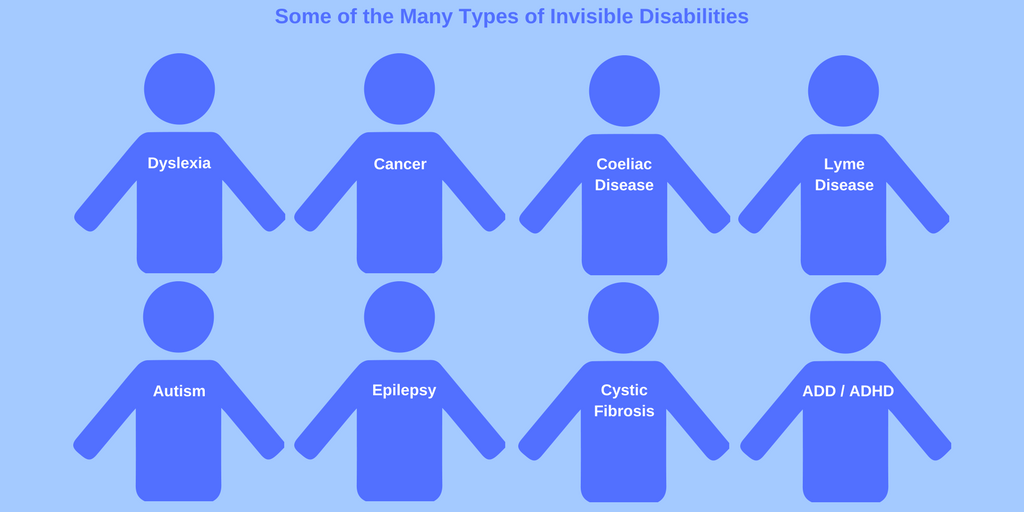
This stigma is not tethered to the workplace and is carried with them throughout the day. While trying to understand the idea of invisible disabilities, I scoured reddit for the personal, day-to-day experience of what it meant to have an invisible disability. One reddit user described having a chronic fatigue condition that caused him to faint if he stood for extended periods of time. Having just gotten off work to catch the bus, he was desperate to sit down because he felt himself on the verge of fainting. He asked a woman for a seat with a lot of reservation and shame because of the expectation that a man should stand for a woman. Despite this, he asked anyway and explained that he had a condition that required him to sit down. She replied, “You look fine to me. A young man should have some manners.” He explained that he had to beg her for the seat until she ultimately forfeited it with a large display of irritation. This anecdote was followed by an extensive thread where many other reddit users vented their frustrations about experiencing similar situations.
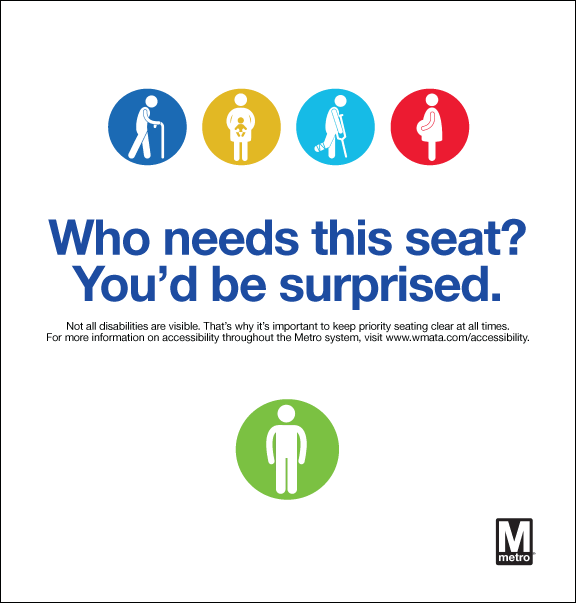
I think it’s incredibly important to understand invisible disabilities because it has the potential to change someone’s understanding of the PwD community as well as society at large. Visible or not, the expectations of what people can and cannot do is a very nuanced topic for PwD, a community of about 53 million people that is growing[2]. However, this extends itself to society at large. Invisible disabilities reinforce the idea that someone’s appearance should never be used as evidence of any definitive qualities they have. Appearance should never be how you define another person- be it their use of an assistive device or their skin color or their gender presentation. Once everyone realizes that anyone could have a disability, perhaps the average stranger will be more open-minded and understanding. With increased awareness and visibility, this could very well be the case.
[1] https://invisibledisabilities.org/what-is-an-invisible-disability/
[2] https://www.cdc.gov/media/releases/2015/p0730-us-disability.html
Traveling in a Wheelchair Ups and Downs
Written by Rosemary Musachio, Chief Accessibility Officer (CAO) at Ruh Global Communications
Ever since I was a little girl, I wanted to travel. In fact, I expressed this desire in a line from the first poem I wrote: “If I was a bird, I’d fly to every country I could find”. Although I’ve always been in a wheelchair, I didn’t think of the possible barriers I’d encounter. When I actually started traveling, however, barriers paved the way for adventure and compassion.
I quickly learned how adventurous traveling with a wheelchair was on my first trip to Germany and Austria. The adventure began at the baggage area of the Munich airport where following the baggage carousel made us dizzy. Our luggage and my chair weren’t appearing after many revolutions, making one of my friends a chicken with his head cut off. He paced around the airport asking anyone who looked like an official about my AWOL chair. Hysteria gripped him so that he wanted to return home. My girlfriend reacted completely the opposite, remaining calm and optimistic. I tried to adhere to her philosophy, though the airport wheelchair in which I sat made my body feel anything but calm and comfortable. An hour later my chair, along with our suitcases, arrived on another flight.
Yet, there was more wheelchair adventure on that trip. Let’s say I went bungie jumping without a rope while we were touring the Residence Museum in Munich. My chair wasn’t locked on a subtly slanted floor, so I rolled down four steps. This time my friend became two chickens with their heads cut off, blaming himself while trying to get help. I worried more about his distress than my chin flowing like the Red River. The ambulance ride wasn’t that bad since the blonde, blue-eyed paramedics were delicious eye candy.
Steps that have continued to be obstacles throughout my travels over the years have proven to be compassion and kindness extractors. In Austria and Germany, we encountered many steps to churches and museums. My friends dragged me in my wheelchair, or carried it and me separately, up and down those stairs. Even strangers have offered help when I toured the ancient streets of Rome or the busy cobblestone alleys of Napoli. The fact that many of these strangers were handsome Italians made me grateful momentarily for steps or high curbs.

Many European storekeepers also have recognized steps or high entrances to their businesses as barriers. When I went to Belgium and Holland two years ago, aluminum and wooden ramps were at the entrances of many stores. Most were little shops, not major department stores. If a ramp wasn’t there, the shop owner laid one down if we wanted to enter their place. I thought I was in an accessible fairyland where every structure I encountered became barrier-free. These shopkeepers were adhering to the Act of Equal Treatment on the Grounds of Handicap or Chronic Illness, which was established in December 2003. They also were following the United Nations Convention on the Rights of Persons with Disabilities (CRPD) Treaty, which was ratified by both Belgium and the Netherlands.
When I also was in the Netherlands, I also had the most accessible bathroom ever! It was something that came out of Accessible Homes if such a magazine existed! The room could fit five wheelchairs. Not only did it have a shower chair, it had a shower where I could take a shower right in my wheelchair. If the shower chair had sturdier rests and a belt, I’d have used it more. The toilet was raised high so my friend could sit me on it without straining her back and making us both fall. Of course, it also had grab bars. The only problem was the toilet seat was hard. Twisting a towel around its rim helped.

A hard toilet seat has been the least of my problems on airplanes. A bathroom on the airplane requires both you and the caregiver to be contortionists and involuntary exhibitionists if the flight attendants aren’t kind enough to block the interesting view from others while helping with the wheelchair. Accomplishing your goal can be quite difficult with the awkward logistics. Getting to the bathroom also can be quite a feat. Passengers’ eyes followed, some gawking and others staring admiringly as the airline attendant pushed me down the aisle in a narrow chair. I have felt like keeping my arms outstretched so I could palm everyone as athletes do when they emerge from the locker room onto the playing venue.
Not only is going to the bathroom on an airplane a challenge when you’re a wheelchair user, sitting in a plane seat also can be one. Because I have to readjust myself, especially if I slide down often, I have had to use the back of the seat in front of me or the airplane side panel for foot leverage to push myself up. If someone was sitting in front of me, using their seat as a foot stool could create Exorcist head turns. I gave apologetic expressions. Nine times out of ten, they understood. At times, they had to call the flight attendant to settle the matter, usually by moving either one of us to a different seat. Of course, since people now have the option of selecting seats when they book online, I try to select exit row seats that have no one in front.
Sure, traveling in a wheelchair can have trying moments. Yet, you need to look at those trials and tribulations as adventurous and humorous, as an opportunity for others to empathize and show compassion. That’s what makes a trip more meaningful and enjoyable.
Transcript #91: Fitness for Everyone- Making Health and Wellness Accessible For Persons Of All Abilities

Guest: Ryan Eder Guest Title: CEO
Date: January 12, 2018 Guest Company: IncludeFitness
[Intro music]
Debra: Hello everyone. This is Debra Ruh, and you are listening to “Human Potential At Work”, or you might be watching us on Facebook Live, which is always exciting. So, my guest today has a very interesting story, it is Ryan Eder, and he’s coming to us from Ohio, and he has been on a 12 year journey to really improve the lives of people with disabilities. So, welcome to the program, Ryan.
Ryan: Thank you, Debra. I appreciate the opportunity. It’s great to chat with you.
Debra: Yeah, I know that one of our other guests introduced you to us. August, with Pinterest, had said, “Debra, you want a good story, you gotta talk to Ryan!”, so I was totally, I was totally on board. So, I know, Doug, yeah, we were very impressed with your story. So, Ryan, tell us a little bit more. You know, I know that I read an article about you that said that you went from being a student, to a CEO, from design student to CEO. So, tell us more, about you know, how you became the CEO and what you’re doing?
Ryan: Sure, sure. Yeah, as you mentioned, this is a 12 year journey for me, so my background, like August’s, is in part design, industrial design. And so, I’m from Cincinnati. I went to the University of Cincinnati to help design, architectural art and planning. And, that’s really where this all started. So, I graduated in 2006, and right after school, I moved up to Columbus and started working for a design firm, called Priority Designs.
But, this started while I was a senior at UC, and I always liked working out, and just happened to be going to my gym, that I’d been a member there for like five years, and I was working out one day, and saw a guy in a wheelchair enter the facility. And I hadn’t seen a guy in a chair, at this gym before, so I was instantly intrigued. So, I just kind of sat back, and just kind of observed. And, quickly noticed that he had a bag full of homemade accessories attached to the back of his chair to help him adapt and transfer to the various equipment.
And, so watching that, and then watching him struggle trying to get into position, and try to work with this equipment. And in my mind, I’m thinking, “You know, it’s hard enough, for any of us to try and stay healthy and active, let alone if you’re dealing with equipment that doesn’t even consider your needs,” right, so, I wasn’t sure of this was just my gym, or something larger.
So, part of my vetting process or my thesis, was I called about 100 clubs across the country, and I told them that I was a wheelchair user, and I’m not, but I told them I was a wheelchair user. I asked them what accommodations they had, and that amount of time I spent doing that, I got insanely frustrated. Because, the responses were, “Sir,” went everything from offering equipment that didn’t even consider individual needs, down to like, “Well we wouldn’t even know how a wheelchair user would enter our facility”. So, I’m like, wow, okay, right. So, I’m like okay this is a problem, so let me try to tackle it. In my thesis, I had ten weeks to tackle this, okay.
So, I decided, you know, I’m a big believer in collaboration, and connecting the dots, and working with people. So, I just reached out to the local community of [inaudible 00:03:43]. And it’s hard to just connect. And so, I would like, rent a wheelchair, went to local facilities, I tested out equipment. I joined a wheelchair football league, for the month of May and played wheelchair football with the group. And, my whole goal was to get as immersive as I can and try to understand, not just the physical side of things, but the cognitive and emotional side as well. You know, down to the subtleties of, okay, I’m in a chair, I’m entering the facility, well, it’s really hard for me to get that threshold to even get into this gym, so I’m already irritated, right? So, like …
Debra: And also, Ryan, this is the United States, so we’ve had the Americans with Disabilities Act for 27 years, so what do you mean, that you can’t get in the facility?
Ryan: Exactly.
Debra: Sorry, sorry.
Ryan: Exactly. Exactly.
Debra: Yes.
Ryan: So, I’m going through that, and you know, I’m getting frustrated and all, but I’m working with these groups and these folks, and trying to tackle different issues. And starting to look at a variety of things, like dexterity issues, looking at stabilizing the user standing, seated, or in a wheelchair. Looking at being versatile, and making sure people can reach it from a seated position and it’s never, it’s almost independently addressable right?
It’s a variety of different things, and when I was working with this group, two things came, come to the forefront really quickly. That anyone in a chair, that I talked to, said, that, “I want to work out, with everyone else. I don’t want a wheelchair only machine”…
Debra: Right, right.
Ryan: And as a young … because I’m sitting here like well, that makes a lot of sense, and so this is going to be universal. And then, on top of that, basically, everyone I talked to hated existing equipment. It was, just regardless of demographic, it’s like it’s very cumbersome, it’s confusing, it’s intimidating, I don’t know what I’m doing, and so that kind of set the groundwork, to where the goal of my thesis was a piece of accessible, inclusive, fitness equipment that catered to people of all ages and abilities.
And, so, I came up with a concept, and I got a good grade. And I moved up as a designer, and with about six months into it, I decided to enter my project into the International Design Excellence Exhibition. At the time it was hosted by Business Week Magazine, it has a couple different co-hosts now. Global competition, design firms, corporations, submit their latest and greatest product designs, it has a little student category. [inaudible 00:06:27] it, put it in there. Got a phone call, saying, “Hey, Ryan, you won gold in the student category.” And that was like the holy grail for me, right, and so I was just like, on cloud nine, I’m running around, and they’re like, “Wait, wait, Ryan, there’s more” … talking about it and they go, “Well out of 1700 entries, from 35 countries, you also won Best in Show.”
Debra: Wow.
Ryan: And there’s literally an e-mail chain the next day, that goes, “Just to clarify, Best in Show, is like for students category, right?” And you know, Matt’s like, “No, Ryan, you’re it, the whole thing.”
Debra: Wow, wow, congrats.
Ryan: Thanks, and so it like rocks my world, right, so, I’m going to, traveling across the country, I’m going overseas, and being invited to share this concept. I’m getting floods of phone calls and e-mails from people seeing it and saying, “Hey, this could really help me, and where can I get it?” And so then I felt this inherent guilt, because, I was reaping the benefits of these awards, I’m not doing anything to solve this problem or push this further, right? So I thought maybe, I could use this as a catalyst to start raising some money, and push this further.
And so, you know, like as the years kind of progressed, I started to really slow drip this process and started to build this. And so, I went back to UC, had an opportunity to present to the collaborative, called the Live Well Collaborative, and I had [inaudible 00:07:54] build it. And said, “Look, I want to help people, I need help, helping people”, and I had no idea, what that meant, and actually at the end of that meeting I left with about 60,000 dollars from …
Debra: Wow, Good job.
Ryan: Yeah, right, it was a big moment. And so, like, Proctor and Gamble actually gave me some initial money to work back with UC, and work with engineering students to develop some prototypes. And then, a local [inaudible 00:08:21] technology investment company, CincyTech, gave me some money to start looking at the true business opportunity. And so, I moonlit, include fitness, for seven years, and just nights and weekends, again, I call it a slow drip build.
And I would work with the engineers out at UC and we’d build like really rude and crude prototypes, that like I’d joke, when you’d see pictures of them, they kind of look like poking devices and so, [inaudible 00:08:53] … was proving out the individual mechanisms, and then pulling it together in kind of one system, of prototypes.
Got to a point where we were able to raise another half million to build a looks like, works like model of this. And really to take things further, and along the way, I got invited to be part of the ASTM investment committees, put together specifically for the ASTM standpoint, looking at the lack of accessibility, inclusivity in fitness equipment, because of this work. So, we start laying out all of these different things looking at you know, left/right arm biases, minimum force requirements, visual contrast, audio feedback, all of these things … I think there’s like 120 different guides. Okay? And it’s with all the country’s researchers and all, and beyond. This is by the time I got the funding, and I go, “You know what? I gotta come in and fuse all these into my [inaudible 00:09:48].” And so, took all those in, and we kind of bunkered down and redesigned the entire thing.
So after it won, kind of the Oscars of the awards, I said I think I can make it better, I hope I don’t make it worse. So, pretty much redesigned the entire thing. And then we built a looks like, works like model, and took it on tour. So I had like a mobile show room that I built, and we took it to like the VA and VC, and the National Rehab Hospital, Lakeshore Foundation where we tried pairing with the athletes … we went to a variety of places and did these demos. Actually, our first demo was with the late Michael Graves at his design studio in Detroit.
Debra: Oh, that’s cool.
Ryan: Yeah, and so …
Debra: He’s a legend in our industry.
Ryan: He is a legend.
Debra: In our community, in our community.
Ryan: My industry, product design … you know, just engineering, you name it. So, had that opportunity and we were doing these demos, and we had people with a variety of different abilities come in and be able to interact with it. I mean, we had folks with CP, we had amputees, I actually had a quadruple UVT and was able to adjust the entire system with his elbows.
Debra: Wow.
Ryan: People are getting emotional interacting with it, I’m getting emotional, right, it’s just kind of a mess, this demo. And it’s really exciting. So we’re like, “All right, we’ve got to take this further.” We’re kind of halfway through though, so in context, this was 2013 at this point.
Debra: Okay, all right.
Ryan: So, at that time, we start talking about data, digital health, quantified self. And so I’m looking at this, you know, at this demo, and realizing, “Okay, it seems like we’ve solved physical accessibility. Now that people can use it independently, how do you know what to do, how much to do, and keep track of stuff?” Quantitative side of things. So that’s where I started to get the idea about accompanying software. I was like, “Okay, use software and then maybe you could browse through and download and look at libraries of exercises that had standing/seating wheelchair modes. And you could download these and the machine would guide you through and record your data.” So I started to float this idea out, kind of halfway through these demos, and people’s eyes got pretty big. They were like, “Oh, that’d be great!”
Okay, so I came back and instead of just launching the machine as it was, I raised another 700,000 and was able to build one that was connected and had the software. So it was part of this whole collaborative process, I started to loop in trainers, then therapists, then physicians, then payers. And really started understanding the landscape within healthcare, right? And understanding an opportunity to not just inclusivize the space, but digitize it. And so now you’re looking at ways of automating documentation. You’re looking at data sets we’ve never had before which is really exciting. We’re working with physicians and neurologists that want to map data produced from our systems to patients of … with mapping benefits of physical activity to Parkinson’s patients, Alzheimer’s patients … understanding just a variety of different conditions, right? So, kind of through this process, what started as purely accessible fitness equipment evolved into an inclusive, digital health platform. And, so just a much bigger picture, right?
So, we then … just fast forwarding through stuff to where … in 2016 we debuted the IF platform and … what we call it, and we decided to enter it back into the design awards that we’d won back in 2007, right? Like, am I going to get disqualified? I don’t know. And we won “Best in Show” again.
Debra: Wow.
Ryan: For context, like the companies that won in between us were Apple for the iPhone, Microsoft, and Tesla.
Debra: Whoa.
Ryan: So …
Debra: Wow. That’s very cool.
Ryan: It’s extremely exciting.
Debra: Good company, good company.
Ryan: Right? And so through that process, we actually now have 16 in our national design and innovation health [inaudible 00:14:04] in all, but to date now we’ve raised a little over six million dollars to develop this entire system. We are in production right now, and we will start shipping Q1 of 18, finally.
Debra: Wow. Exciting.
Ryan: Yeah, we’re shipping to a variety of different places. Looking at spinal cord injury centers, the VA, neurological rehabilitation facilities, pediatric care, aging care, traditional orthopedics, right? So, by infusing inclusivity in this entire thing, it’s applicable in all these different places. And so … with the data that we have, we’re able to just drive deeper insights into getting people of all ages as healthy as they can be for as long as they can be. So that’s really our goal. So, that’s my story.
Debra: Okay. So I have a ton of questions. So, but first of all, I really do want to congratulate you on following your hunches and just staying with it to make the world a better place. So, kudos to you for that. Your tenacity is very impressive. So, I … you and I talked about this a little bit before we started the interview, but there are some people that don’t understand why we would even need to do this.
Now, I have a daughter with Down syndrome, and I’m a big exerciser. And my daughter has always exercised too because we do it as a family. And I’ve seen articles where there was a family where they brought their daughter in … in Texas to a gym and the gym said that she couldn’t exercise in the gym. Which, by the way, it’s the United States, excuse me? And so after they were publicly embarrassed and [inaudible 00:16:11] and everything else, and at the time … I believe in rewarding as opposed to, you know, slapping. So, I just was bragging about my gym in Richmond, Virginia, American Family Fitness … that it’s for the entire family, and my daughter is part of our family.
But, I think a lot of people sometimes don’t realize that people with disabilities need to exercise just like everybody else, because you know, they’re like human beings.
Ryan: Right. And if not, more so, right?
Debra: Right, right. And so I think it’s interesting how you connected dots like aging and neurodiversity and all of these different things. And that you’ve looked at it from a global perspective. I think that’s very, very smart and astute of you. But what kind of barriers have you had to get past with just silly things like “Is this even needed?” Which, is ridiculously, because obviously it is needed. But how about barriers like that?
Ryan: Yeah, very real barriers. I’ve had … I call them three moments that I was basically brushing up with death right through this process of trying to get myself [inaudible 00:17:27]. And it is a challenge because … to commercialize something, you need to have the business case around it, right? And when someone first thinks of accessibility, they think “small market, not a lot of dollars, I’m not putting any resources into it.”
Debra: Right, right. Not really needed.
Ryan: Not a big enough piece of pie for me to care. Right, which is ridiculous. So you had to overcome that. So, you start to … I’m a big believer in empathy from all angles. And so even emphasizing with the investors looking at this sort of feedback that has that mindset … you’re saying, “Okay, here’s how they’re looking at it, how can I bridge this gap?” Right, so I think if we had [inaudible 00:18:17] just as the equipment alone, it wouldn’t have had the commercial viability without the software and data. Because the software and data can do things from a service standpoint, business standpoint, that really take things to the next level and offer value props beyond inclusivity, right? So for me, a lot of it is listening and trying to understand the perspective of everybody in the room. And once I feel like I have a grasp on that, just connecting the dots, right?
Debra: Right, right.
Ryan: It’s like okay, here’s a [inaudible 00:18:51] how do we evolve this together? And it’s not easy, but if you listen closely enough you can hear it.
Debra: Well, you know, and it’s not easy saving the world, but we all have to try.
Ryan: Yeah.
Debra: So Ryan, so … you told us, you know, some of the facilities and stuff that the equipment is going to go in. I didn’t hear you mention the mainstream gyms and so I am certainly very curious of that. I’m also curious about … at some point I want you to describe more about what this is, because I think that it’s hard to visualize.
Ryan: Sure, yeah, absolutely. So mainstream fitness is definitely somewhere where we want to be. We have community centers that have ordered this.
Debra: Okay.
Ryan: We’re looking for fitness partners that kind of want to be thought leaders in this space, right, there’s the thought leadership in inclusivity, there’s a thought leadership in connecting to healthcare in different ways, right? And we have some good conversations going. But we’re a little bit of a different beast than what they’re used to, so it takes a little bit more working with them, right?
Debra: And I’ll also say, Ryan, before you move on, I would love to connect you to some of the people. And the first place I’d love to connect you with the gym that I’ve been part of for years, just as one of their consumers, but also would love to connect you with some of the players that I’m dealing with in healthcare. There’s a … what I’m calling a tribe of people that really want healthcare to be better for all of us called PinkSocks. And just people really want to make a difference. And so I’d love to connect you with some of them and some of the people in Washington D.C. … some of our viewers and listeners might also be very interested in getting involved and making sure that we’re helping you get the word out to the people … connecting you to the right people as well.
Ryan: That’d be fantastic. I mean, that’s what it’s all about. It’s the power of collaboration, right? And being able to make things better. So, I really appreciate that. To your earlier question about describing the system, so … I’m a very visual person, so I’m just going to be waving my hands here, but you can go to our site includefitness.com, and get to our videos, testimonies, and all so that you can see us in action. But to kind of give you just a basic description of it is that … our machine is called the Access Strength. And it’s an inclusive functional trainer, so it’s got pulleys, cables, and weight stacks, the same stuff that’s been in machines for decades, right? But it’s been redesigned and engineered to give us a tremendous amount of versatility and inclusivity.
So, essentially, it’s very anthropomorphic. So, it’s got a center tower, and it’s got these two arms that basically wave. And then on those arms, it has carts that move in and out. So essentially, you can place a handle or these carts anywhere in each hemisphere, and that essentially lets us do hundreds of upper body, lower body exercises on one machine. We strategically place the interaction points to where it’s 100% independently addressable regardless if you’re standing, seated, or in a wheelchair. It can never be put in a position that you can’t reach from a wheelchair. It’s not then just about versatility of course, it’s inclusivity.
So, taking things a layer deeper, we want to remove all the barriers surrounding traditional equipment. One of the biggest things, our spring loaded pins that require a lot of dexterity (two hands to adjust), and we so said, “Got to get rid of all of those.” And we have patented dexterity for handles, or these bright green handles, bright green for the audio and visual contrast, right? So you can easily recognize them, but you can take a single arm with a closed fist and just rotate that handle. And it will disengage a pin like a spring loaded pin would, and you can do this next position, and it pops back in place. So it’s … we put those throughout the entire system so you’re not going ten different rows to adjust something.
We have an integrated seat that again can be pulled out with a simple rotation of a handle. A closed fist can pull it out. It has a transfer handle and a height adjustment right on the center there, to transfer in and out of a wheelchair or any assisted device. It comes with a stability pad, essentially move in and out, up and down. So that can help stabilize someone standing, seated, or in a wheelchair.
I should mention anything that we have is counterbalanced, so you’re never applying anything more than like seven pounds of force to adjust anything on here. And then one of the biggest things on fitness equipment is the weight stack. Usually it’s down low, it’s hard to see, it’s hard to reach, fingers get pinched, things get lost, you name it. So we still have a weight stack, but we’ve pushed it inside the machine and changed the interaction to a dial. And so the dial displays the weight that’s currently selected in green at all times, and it has a paddle sticking off a dial, again, single on, closed fist … you can go up to the dial and just rotate it and it selects the weight for you.
And it gives us a tremendous resolution, with two and a half pound increments the whole way through the stack. So, like a lot of equipment, you hit a certain level and the next jump is fifteen pounds, and that creates an artificial threshold barrier for your progress. You’re not ready to jump fifteen pounds. Right? You put everything inside … you hide all the stuff that no one cares about. The pulleys, the cables, the weight stacks, the nuts and bolts … make something that’s far more approachable. Something you want to interact with, you want to touch. And then it also has a portal into the software through there. You can go on through any computer or tablet, [inaudible 00:24:41], libraries of exercises and workouts … you can have your therapist or your trainer assign workouts to you. You can go up to any of our equipment with an RF ID tag and it pulls up your profile.
So it’d say, “Hi Debra, welcome to your workout.” It’d pull up a list of workouts that you saved or your therapist/trainer scheduled for you and guide you through the whole thing. So it says, “Exercise one is chest press.” Shows you a picture of how to do it. By the way, the picture is demographic specific to you. So I feel like if there’s a teenage girl in the system, they should see a teenage girl. If there is a 50+ male, we should see a 50+ male, right? So we go that extra length for all of this. But that’s how it should be. And then it tells you how to set up the machine, we have sensors and then you set it up, selects the weight for you automatically, and then it of course counts your reps. But we’re tracking velocity, force, power, tempo, range of motion, symmetry. All of this data that you can pull in … it pulls it automatically and you can log in and see how your progress was on one workout or progress over six weeks, a year, whatever it may be. And then you can slice and dice that data as you’d like, share it with a therapist, you name it.
So again, it’s inclusivizing, digitizing in front of this whole space.
Debra: What I was thinking about when you were saying all of that … I have used the exercise equipment … tried to use the exercise equipment at my gym for years. I get very confused, I don’t know … I get so confused on the settings, is this too high? Is this too much? Do I have it? Sometimes gym personnel will walk by and say “You really shouldn’t be arching your back like that.” You know, so I mean they’re kind, but there just seems to be a lot of ways where you can make mistakes with these different exercise equipments. And so it sounds to me like you’ve solved some of the problems that we have with the mainstream equipment. And that the things that you’ve done … it’s going to benefit everyone, even if … you know, all over. So I think that’s very exciting.
Ryan: Yeah, I mean, we’re talking to pro sports teams about having this as a way to log the progress of their athletes.
Debra: Yeah, that’s really cool.
Ryan: I was at a pediatric hospital talking about … you know, early teens with CP. And how they can benefit from this. Just that’s the power of a universal design and inclusivity, right? So …
Debra: Yes.
Ryan: When you do it right, there’s better options.
Debra: And I’ll tell you also … and I’ve talked about this in speeches that I’ve done around the world, but it’s always exciting to see the changes that have taken place in the world because of people like you that have designed something starting with people with disabilities, and we wind up all benefiting from it. Examples are text to speech, captioning, we’re all using captioning now, even though it was designed specifically for individuals that were deaf or hard of hearing. And so … it’s very exciting to see, you know, the progress that’s being made. Because you saw an opportunity. Did you … at the time when you saw the gentleman in the wheelchair, did you go and talk to him? Does he know what he has inspired?
Ryan: Yeah, I did talk to him, and then we were disconnected for maybe eight or nine years, and actually we reconnected on Facebook.
Debra: Oh, great.
Ryan: Yeah, so that’s been fantastic. And it’s just continued to evolve, right? And to your point though about just the power of inclusivity and how many things have stemmed from that … so one of my mentors is Dr. Patricia Mora. And so she came up to me right after the awards and said we could work together and all of this. And her involvement with [inaudible 00:28:39] groups. You know, everyone has these kitchen utensils now, and they’re just ubiquitous.
Debra: Right, I know. They’re a wonderful example.
Ryan: Yeah, right? That was started to address … from his wife’s need … her arthritic needs.
Debra: Right, right.
Ryan: So, it just makes sense that when you’re designing and creating something, that you need to help people in the process and that you should help as many people as possible.
Debra: Yeah, it is really, really exciting. So, I have a feeling I could talk to you for days and days and days, but one thing I want to make sure that we do before we end the program … I want to tell people how they can find you, Ryan. Because we want to support you. I will be e-mailing you saying, “Ryan, what can I do to help you?” Besides with this. And so … tell us first of all how to find you. Are you on social media? I assume you have websites. Tell us about all of that.
Ryan: All that. For the company, includefitness.com is our website. We’re on all the social media, so you can find us there for IncludeFitness. For me personally, just Ryan.Eder@includefitness.com is my e-mail address, but you know, I’m on personally on Twitter and everything as well. Ryan_Eder. And so just … I love to connect, I love to collaborate. That’s what it’s all about. I hope to hear from many of this network and be able to do that.
Debra: Yeah, so and the people that are following, they know I’m really good about turning the volume up. So I think it’s really exciting to learn about young designers like you that are just changing the world … for all of us. It’s very exciting. And I hope any … I’m hoping if there’s any big gyms listening … QVCs of the world … because I think that you also … and I don’t know your business, but it seems like there’s also an opportunity for in-home purchases as well. I know the Nordic track has done tons of business like that.
Ryan: Sure. Yeah, I mean you know, people stay healthy in a multitude of locations. To provide the right opportunities in all those different types of places is what we’re all about.
Debra: Well, we want you to be widely, widely, successful. So, for anyone that’s listening, please go on to their website includefitness.com to learn more about it. Anything you can suggest to Ryan, anybody you can connect him with, let’s help Ryan change the world because that’s why we’re all in this together. And so Ryan, thank you so much for being on the program today. We really appreciate it.
Ryan: I really appreciate the opportunity.
Debra: And we will talk again.
Ryan: Sounds good.
Debra: Okay, bye everyone!
[outro music]
You’ve been listening to Human Potential at Work with Debra Ruh. To learn more about Debra and how she can help your organization visit RuhGlobal.com. If you’ve enjoyed today’s episode and you want to make sure that you don’t miss any future epsiodes, go to itunes and subscribe to Human Potential at Work. Thanks so much for listening and we’ll be back next week with a new episode.