
At last, The Refresh of Section 508 by Debra Ruh and Rosemary Musachio

Has been Published on the Huffington Post Blog
Published on the Huffington Post Blog

On January 19, 2017, the United States Access Board issued a final rule to make Section 508 Refresh official. The landmark regulatory update will become effective March 20, 2017. Therefore, until the latter date, federally created information and communication technology (ICT) still has to comply with Section 508. Federal agencies and contractors will be required to comply with Section 508 Refresh starting January 18, 2018.

 
Section 508 Refresh has climbed a bureaucratic mountain. Since its conception in January 2008, Section 508 Refresh has been changed more than a baby’s bottom. It has gone through several updates and delays. To help it remain at its peak, we need to know how to comply with its revised sub-provisions and reap its benefits.
 
If you wish to examine the new rule, you can read the full text of Section 508 Refresh. Otherwise, Ruh Global Communications’ Chief Accessibility Officer, Rosemary Musachio, will brief us on Section 508 Refresh.

 
A Photo of Rosemary Musachio
Photo of Rosemary Musachio
 
Debra: So Rosemary, what will Section 508 Refresh mean for federal entities who are already following the original Section 508?
 
Rosemary: If your ICT already complies to the original Section 508, you’re off to a great start. In fact, you’re off the hook! Section 508 Refresh has a “Safe Harbor” clause that states if your existing, or “legacy”, ICT already complies with Section 508, then the technology doesn’t have to meet the new provisions. “Legacy” is defined as any ICT product bought, created, or maintained before January 18, 2017.
 
Debra: What if a legacy product has updates? What should be done then?
 
Rosemary: For legacy products that have been updated (e.g. webpages) after January 18, they have to meet Section 508 Refresh standards. Similarly, if your legacy ICT doesn’t comply with Section 508, then you would need to abide by the Section 508 Refresh standards, just like all new ICT that’s federally based. “Federally based” used to mean federal departments, agencies, and federal contractors. Yet, Section 508 Refresh has a clause that may broaden that category:
 
“Public-facing content refers to electronic information and data that a Federal agency makes available directly to the general public.”
 
So, if a school or hospital, for example, is federally funded and maintains “public facing” content (i.e., websites, Intranets), then the content could be required to be Section 508 Refresh compliant. You should confirm this with your administrator.
 
Graphic of an alarm clock next to section 508 Clipboard Image from WWW.SITEIMPROVE.COM
Graphic of an alarm clock next to section 508 Clipboard
Image from WWW.SITEIMPROVE.COM
 
Debra: If you’re a federally government entity or contractor who has or will develop products after January 18, 2017, you must comply with Section 508 Refresh by next January also, correct?
 
Rosemary: Yes, federal government entities who create new ICT have eleven months or so to comply with Section 508 Refresh. Familiarity with the original Section 508 and Worldwide Web Consortium Web Content Accessibility Guidelines 2.0 (WCAG 2.0) will make compliance with the new law easier. Additionally, knowing how Section 508 Refresh affects each ICT category and assistive technology will make compliance a breeze!
 
Debra: True, Rosemary. Section 508 Refresh includes a broader range of ICT within a more concise set of regulations that should improve the compliance rate and, therefore, accessibility.
 
Rosemary: When I test products for Section 508 compliance, I have been citing Section 508 1194,22(l) or the software sub-provision 1194.21(a) for keyboard accessibility on websites. Or if there’s a webpage within a software application, I usually had to complete 1194.21 Software and 1194.22 Web for the Voluntary Product Accessibility Template (VPAT), along with 1194.31 Functional Performance.
 
With technology changing by the day, testing against different set of sub-provisions has been tedious and time-consuming. That’s why Section 508 Refresh covers all ICT categories in a swoop. If a printer has a touchscreen with web capabilities, it has to conform to Chapter 4 Hardware and Chapter 5 Software. Its web capabilities would be covered under the 501 General Provision of Chapter 5:
 
EXCEPTION: Where Web applications do not have access to platform accessibility services and do not include components that have access to platform accessibility services, they shall not be required to conform to 502 or 503 provided that they conform to Level A and Level AA Success Criteria and Conformance Requirements in WCAG 2.0 (incorporated by reference, see 702.10.1).
 
By directly referring to WCAG 2.0, Section 508 Refresh will cover web accessibility much more extensively than the original Section 508. With the latter, for example, we had to infer that 1194.22(d) meant that headings, lists, and other content had to be structured correctly. Section 508 Refresh’s reference to WCAG 2.0, however, leads us right to Success Criterion 1.3.1, which specifies what structural markup should be applied. Another example is original Section 508 didn’t mention keyboard trap whereas the Refresh’s reference to WCAG 2.0’s Success Criterion 2.1.2 does. Fourteen other new requirements are included in Section 508 Refresh through WCAG 2.0.
 
Debra: Besides having clear, more specific requirements to make ICT accessible, Section 508 Refresh also clarifies how ICT should be compatible with assistive technology (AT), which helps persons with disabilities access content. The original Section 508 mentions AT in general.
 
Rosemary: Ironically, AT itself is exempt from conformance. But yes, Section 508 Refresh does specifies features of AT. For instance, in Chapter 5, it mentions “focus cursor”, which is controlled by screen readers and screen magnifiers. In fact, Chapter 5, section 502 is dedicated to the “Interoperability of Assistive Technology”. It defines how ICT content should behave with screen readers and other devices. Interestingly, sub-provision 1194.21 of the original Section 508 confused many people into thinking that “Software” meant the AT itself. So they weren’t remediating products but providing and remediating AT.
 
Graphic of Section 508 coming out of a loud speaker Image from: WWW.SITEIMPROVE.COM
Graphic of Section 508 coming out of a loud speaker
Image from: WWW.SITEIMPROVE.COM
 
Debra: So clarifying that it’s the ICT, not the AT, that must comply with the Section 508 Refresh is definitely a benefit. It will make more products, including websites, more accessible. What other benefits will the Section 508 Refresh offer, Rosemary?
 
Rosemary: Products procured by the U.S. government also could be sold to foreign governments since the Section 508 Refresh refers to WCAG 2.0, which is considered the international standards. The Refresh also mirrors the European accessibility standard ICT procurement, EN 301 549. This harmonization of the Refresh with international standards also will enable the U.S. government to procure accessible products from other countries.
 
Another benefit from the Section 508 Refresh is more persons with disabilities will want to work for the federal government since it will have products that are more accessible for them to use. With office technology that is more accessible, productivity for government employees will also increase.
 
Debra: Besides benefitting federal government employees with disabilities, Section 508 Refresh will make federal government websites more accessible so users with disabilities will have access just like everybody else. Thanks very much, Rosemary, for helping me explain Section 508 Refresh.
 
Rosemary: My pleasure. Hopefully, we’ve made it easier to understand and to implement.

Women with Disabilities: Healthcare Barriers

Photo of Rosemary Musachio
Rosemary Musachio

Several years ago I asked my mom’s gynecologist if she could give me a routine pelvic examination. She said she would have to put me under anesthesia to perform the exam because my cerebral palsy would not allow my body to hold still. Although her reply was cordial, it made me feel demeaned, as if I was a second-class citizen. Couldn’t she have her medical assistant hold my legs while she examined me? In fact, that would have been a reasonable accommodation under the Americans with Disabilities Act (ADA).

This is the kind of treatment that women with disabilities usually face regarding their healthcare. According to the Center for Research on Women with Disabilities (CROWD), we have more difficulty obtaining healthcare than non-disabled women. The National Study of Women with Physical Disabilities supports this, stating that we are less likely to have pelvic exams than women without disabilities.

Besides attitudinal barriers, we also face physical obstacles in doctors’ offices and hospitals. For example, when I get a mammogram, I have to become a contortionist. I have to put one arm upright leaning against the mammography unit, hang on to the bar with the other hand, and rest my uplifted chin against the front of the machine. Include the fact that my body has difficulty keeping still and this almost pain-free routine exam becomes a very uncomfortable feat. Not only am I nervous about the mammogram results, I’m also afraid that I’ll bump my face against the machine. My incidents are not unique. Cases exist where women with disabilities were duct taped to mammography machines. Besides the discomfort, an inaccessible mammography machine may cause unreadable x-ray images, for the patient may move and cause one or both breasts not to be x-rayed correctly. Consequently, potential tumors may be overlooked.

Struggles that women with disabilities face regarding healthcare stems from several reasons. (These reasons also can pertain to men with disabilities.) First, many medical professionals are ignorant of who we really are. Some think we must be asexual. Because we cannot walk or we have muscle spasms, they assume we also cannot use our bodies to love others or procreate. So they think our intimate organs do not need preventative or medical care. Some doctors suggest hysterectomies to eliminate the hassle of menstrual cycles, assuming we don’t have the desire to become mothers. If we get breast cancer, we may not be offered reconstructive surgery because many doctors don’t see us as having female bodies but as having disabled ones.

Lack of training also contributes to healthcare issues for us. Take the GYN incident above. If the doctor knew how to give an exam to a woman with cerebral palsy, she wouldn’t have suggested the anesthesia or refused medical care. Medical professionals should know how to gently stretch a woman’s legs if they are spastic or place a woman with spinal conditions in comfortable positions during an exam. These techniques should be taught in medical school. The patient also could inform the medical professional about ways to make her feel comfortable and relaxed as possible while she is being examined.

Financial issues and logistics are other obstacles that women with disabilities have to overcome to receive proper healthcare. Many women with disabilities are on Medicaid and Medicare, which deters physicians from accepting their cases. CROWD reports that even if women with disabilities have private insurance, many insurance companies may not pay for specific prescriptions, procedures, therapies, or assistive devices. As an example, insurance may not pay for estrogen therapy because it is not considered a medical necessity.

Although Title II and Title III of the ADA require medical facilities to have accessible medical equipment, many still are not complying. It is like a double-edged sword. Hospitals and doctors may not invest in such equipment because patients with disabilities are few, while we don’t go to these facilities because they lack accommodations. An accessible gynecological exam table, for instance, that can be lowered for easy wheelchair transfers costs between $4,000 and $10,000. While this is expensive, it can be offset with tax incentives.

27 million women in this country and 16% of the world’s women have some kind of disability. As populations become older and live longer, many other women will develop debilitating conditions. Medical facilities and professionals need to realize women with disabilities are not in the minority. More importantly, they must know that we are needed as daughters, sisters, friends, wives, mothers, and productive members of society. So proper healthcare is vital to help us continue fulfilling these roles.

Yet, the responsibility of obtaining healthcare also lies with us. We should tell doctors, medical assistants, and nurses how they could assist us in receiving the best care possible. If they refuse to comply, then we should seek legal or other public action to ensure that all women with disabilities get the care that they deserve.

#43: Does Technology Help or Hinder Us?

The Episode Flyer for EP #43: Does Technology Help or Hinder Us?
Episode Flyer for EP #43: Does Technology Help or Hinder Us?

Debra Ruh and Doug Foresta discuss the positives and negatives of technology, and how we can effectively navigate technology and social media. Doug and Debra discuss how we can use technology to the fullest, but also unplug and make sure to connect to a deeper, calmer place within ourselves. 

Button to Download Transcript
Transcript Download Button


#41: How Accessibility Helps Your Bottom Line

Image of Episode Flyer for EP #41: How Accessibility Helps Your Bottom Line
Episode Flyer for EP #41: How Accessibility Helps Your Bottom Line

Paul Smyth, Head of IT Accessibility at Barclays Bank, discusses the importance of digital and technological accessibility. Paul discusses the business advantages of accessibility, beyond mere compliance, and how Barclays is building their accessibility efforts into their brand.

Button to Download Transcript
Transcript Download Button


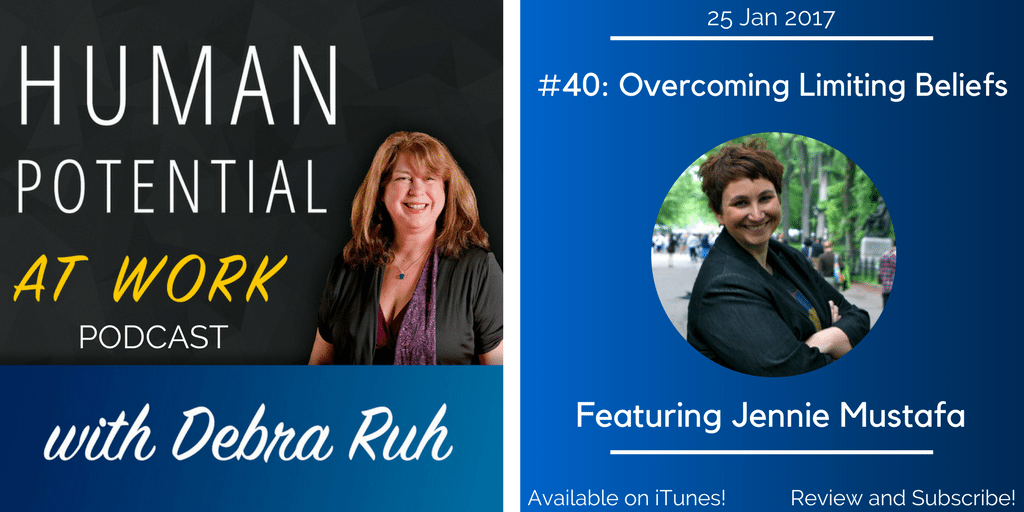
#40: Overcoming Limiting Beliefs

Episode Flyer for EP #40: Overcoming Limiting Beliefs

Jennie Mustafa Julock, AKA “The Audacity Coach” joins the program to talk about her new book “Hilda” and shares tips for how to overcome the negative beliefs that keep us stuck from reaching our full human potential. Discover how to develop a more compassionate relationship with yourself and what to do when you feel stuck in overwhelm or fear.

Button to Download Transcript
Transcript Download Button


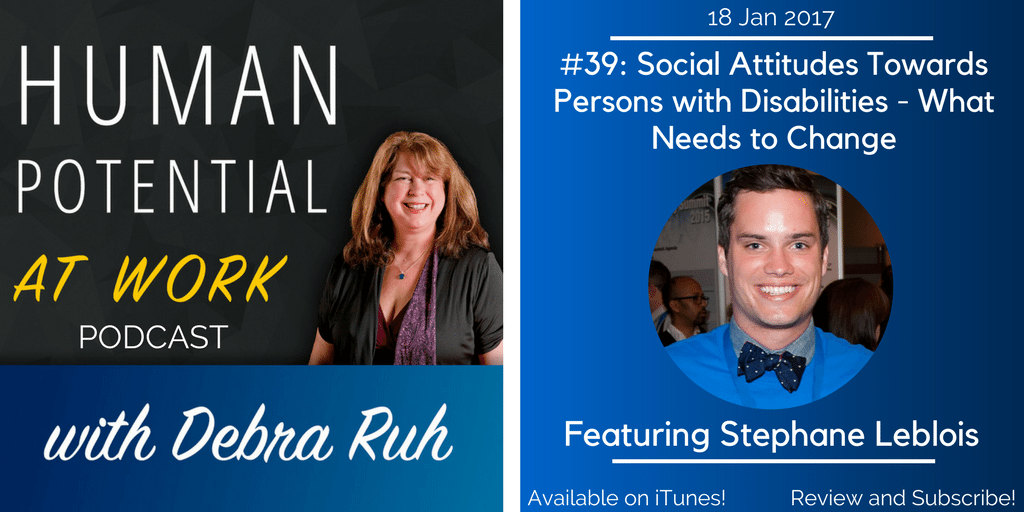
#39: Social Attitudes Towards Persons with Disabilities – What Needs to Change

Disability Advocate Stephane Leblois
Episode Flyer for EP #39: Social Attitudes Towards Persons with Disabilities – What need to change

Disability rights advocate Stephane Leblois joins Debra and producer Doug Foresta as they discuss the difference in attitude towards persons with disabilities between the Boomer, Gen X and Millennial generations, and what still needs to change in terms of social attitudes. 

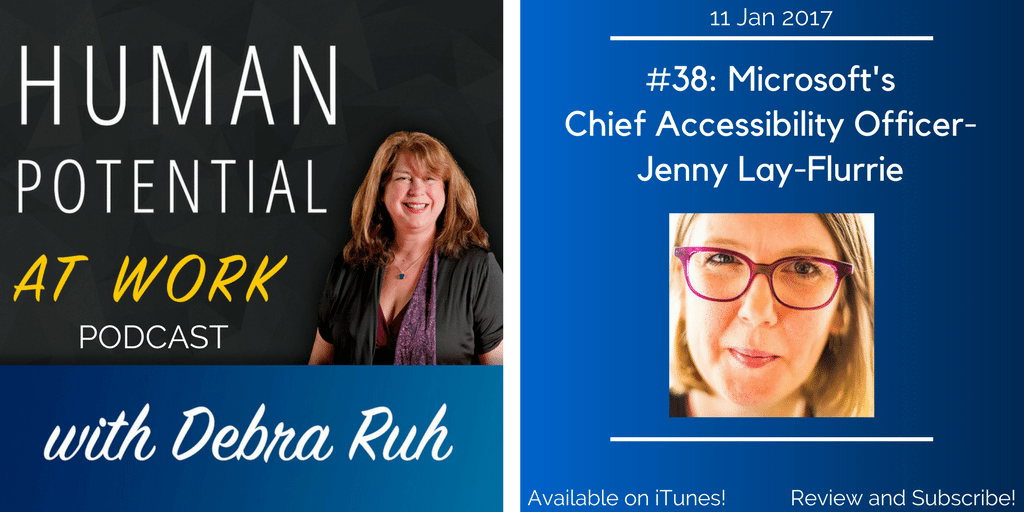
#38: Microsoft’s Chief Accessibility Officer, Jenny Lay-Flurrie

Episode #38: Microsoft's Chief Accessibility Officer- Jenny Lay-Flurrie
Flyer for Episode #38: Microsoft’s Chief Accessibility Officer- Jenny Lay-Flurrie

Jenny LayFlurrie, the Chief Accessibility Officer at Microsoft, discusses how Microsoft creates a culture of accessibility. Jenny shares her own journey of accessibility as someone who has hearing loss and how she uses technology in her personal and professional life. 

Button to Download Transcript
Transcript Download Button