Episode Flyer for #33: Listening More Deeply: A Conversation with Sara Ruh
This episode features an interview between Debra Ruh and her daughter Sara, as they discuss Sara’s feelings about Down syndrome and how society talks about people with Down syndrome. The beginning of the conversation starts with a conversation between Debra Ruh and Doug Foresta as they discuss the takeaways from the conversation between Debra and Sara and their reflections upon the broader implications of that conversation.
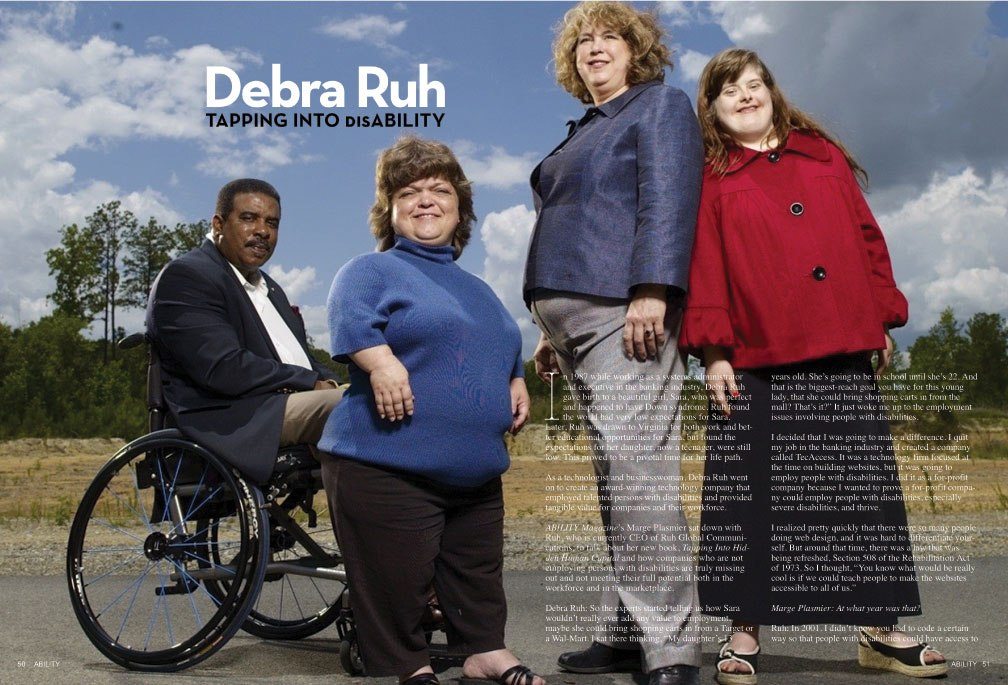
In 1987 while working as a systems administrator and executive in the banking industry, Debra Ruh gave birth to a beautiful girl, Sara, who was perfect and happened to have Down syndrome. Ruh found the world had very low expectations for Sara. Later, Ruh was drawn to Virginia for both work and better educational opportunities for Sara, but found the expectations for her daughter, now a teenager, were still low. This proved to be a pivotal time for her life path.
As a technologist and businesswoman, Debra Ruh went on to create an award-winning technology company that employed talented persons with disabilities and provided tangible value for companies and their workforce.
Marge Plasmier, from abilityJOBS and ABILITY Magazine, sat down with Ruh, who is currently CEO of Ruh Global Communications, to talk about her new book, Tapping Into Hidden Human Capital and how companies who are not employing persons with disabilities are truly missing out and not meeting their full potential both in the workforce and in the marketplace.
Debra Ruh: So the experts started telling us how Sara wouldn’t really ever add any value to employment, maybe she could bring shopping carts in from a Target or a Wal-Mart. I sat there thinking, “My daughter’s 13 years old. She’s going to be in school until she’s 22. And that is the biggest-reach goal you have for this young lady, that she could bring shopping carts in from the mall? That’s it?” It just woke me up to the employment issues involving people with disabilities.
I decided that I was going to make a difference. I quit my job in the banking industry and created a company called TecAccess. It was a technology firm focused at the time on building websites, but it was going to employ people with disabilities. I did it as a for-profit company because I wanted to prove a for-profit company could employ people with disabilities, especially severe disabilities, and thrive.
I realized pretty quickly that there were so many people doing web design, and it was hard to differentiate yourself. But around that time, there was a law that was being refreshed, Section 508 of the Rehabilitation Act of 1973. So I thought, “You know what would be really cool is if we could teach people to make the websites accessible to all of us.”
Marge Plasmier: At what year was that?
Ruh: In 2001. I didn’t know you had to code a certain way so that people with disabilities could have access to the information. So that’s when I thought, “Wow! What a great idea!” And it just unfolded. I built the company to a multimillion-dollar business. Eighty percent of my team were technologists with disabilities.
It was all focused on mainly helping corporations, but we also had government and university clients, making sure their websites were accessible to people with disabilities. And who better to do it than the people who have those types of disabilities and who would know whether it’s successful? At the time, very few of my competitors employed people with disabilities. I just kicked their butts. I did so well.
Plasmier: So in the early 2000s you already had a game plan. What value did people with disabilities bring to your company?
Ruh: They were such amazing employees. It was interesting because I also employed people, a smaller segment, who didn’t have disabilities. But I found that the technologists with disabilities were more productive. They showed up more often than the people without disabilities, they whined less, they were very creative and innovative, and they were really my top performers.
And then I found that the more I involved them with my clients, the clients loved it. And so it became a huge differentiator for us. Our competition—we were just beating them terribly.
Plasmier: You talk about that a lot in your book. That was the big differentiator for your business?
Ruh: Yeah, it was a huge differentiator. And I won so many awards. And I thought, “That is great for my ego, and my mom’s proud of me for winning all these awards, but the only thing I’m doing differently is employing qualified technologists with disabilities.” I hoped for a world some day that wouldn’t think it was so unusual to employ talented people with disabilities who were qualified to do the jobs.
Plasmier: For the people who were working for your company who had disabilities, what did they bring to the table?
Ruh: What they brought to the table was a real understanding of accessibility. Because, at the time we were trying to figure out exactly what it meant to code a website, a mobile app or anything so that it’s accessible to all of us. How can you do it in a way that works for people who are blind, deaf, aging, losing their mobility, etc.?
They brought creativity. “How do you make a website accessible to screen readers in a way that doesn’t change the product?” That’s what everybody was really concerned about at the time… creating something just in text. It was going to be boring, and the rest of the customers aren’t going to like it. So we were able to show that’s not true, and we were able to build real awareness about the value people with disabilities brought not only to my workforce but also to other people’s workforce.
I remember saying, “I know that I’m going to be successful when my clients or others start stealing my employees from me.” When it started happening, I wasn’t happy. I was happy, but I wasn’t happy because I was losing these really talented individuals.
Ruh: Yeah, you probably did. They’re top of the field. They’re the best. And that is what should be happening. We should be creating really amazing jobs for these individuals who are so talented.
Plasmier: Your book, Tapping Into Hidden Human Capital, was a very concise road map for companies. When I finished reading it, my initial thought was, “Why wouldn’t people hire, incorporate or identify more people with disabilities in the workforce?”
Ruh: And I love that comment, because that’s what I tried to do. I wrote it for employers to demystify this issue and take away some of the misinformation.
Plasmier: Why don’t employers hire people with disabilities?
Ruh: Companies are afraid that if their facilities aren’t accessible, even after 26 years of the Americans with Disabilities Act (ADA), they’re going to get sued. They’re afraid that their websites and their intranet, internet and software systems are not accessible to assistive technology that a person might use. They’re afraid the assistive technology might be really expensive. They’re afraid that people with disabilities are going to be out sick more or they’re going to say the wrong thing. Another thing employers are afraid of is that we’re expecting them to hire somebody who’s not qualified to do the job.
Plasmier: What do you say to a company that has these fears?
Ruh: First of all, I say, “I understand you have all these legitimate fears. Let me tell you why they’re not true.” Then I go point by point, and there’s so much great data out there proving it’s not true. And then where we are right now with employment, you do not have a choice if you’re in the U.S. You have to employ people with disabilities in your workforce. If you’re not, you’re probably breaking a law or multiple laws. It’s not, should you do it? You have to do it.
You probably already have people with disabilities working for you, by the way. It’s about retention, too. And people who work for you are acquiring disabilities because we are in these fragile bodies. I don’t mean that as a threat, but as we age and as we live our lives, quite a few of us acquire disabilities.
But any time you’re broaching something new that you don’t understand, instead of just jumping in, why don’t you put a plan together? Understand what you have to do. You can say, ‘Oh, yes, we’re hiring people with disabilities,’ but if your website is not accessible, if the career portion of your website is not accessible, if you don’t know how to accommodate an individual with a visible disability or invisible disability, there are a lot of ways to get in trouble right now in the US with this. ADA lawsuits are up 63 percent from this time a year ago.
Plasmier: Lawsuits are up 63 percent from last year? Why do you think that is?
Ruh: We can do a bunch of lawyer jokes here, but part of the role that lawyers play in US society is pounding out our laws. We’ve had the ADA law on the books for 26 years, and many, many, many businesses are not accessible physically or technologically. And employers are not employing people with disabilities. I’d like employers to do it because they get innovative, creative, talented employees and because we have studies, which I’ve mentioned in the book, that prove customers want companies to do hire people with disabilities, and employees become more productive. If it takes a lawyer suing a company to do it, they have to include us in the workforce no matter what. Period. End of story. I don’t want to hear your excuses any more. Sorry.
Plasmier: Get on your soapbox, by all means!
(laughter)
In comparison to the settlements these companies have to endure and legal fees, what is the cost of making a company accessible?
Ruh: It’s really not very expensive at all. You can even make your company fully accessible without paying one penny outside. There’s so much free information on the internet. WebAIM, for example, gives step-by-step instructions of everything a company needs to do, and there’s W3C. You can join things like AXSChat that we run every Tuesday. We talk about it. You do have to update your policies and processes.
I can’t talk about this topic of employment without talking about accessibility. If you have an individual who gets into a car accident or has a stroke, and they’ve been a great employee and have a lot of good intellectual data, you don’t want to just kick them to the curb. You want to work with people.
Plasmier: That’s the change of our humanity. We’re aging, time passes and we acquire a disability?
Ruh: Right. And a lot of us keep disabilities quiet because we don’t want somebody to look at us and judge us and decide we’re less. A man, who was at the very top of a very large government agency, said, “Well, I have multiple sclerosis, but I haven’t told anybody because if I tell them, they’ll start thinking that I can’t add any value. I think my peers will start thinking it’s time for me to retire. They’ll start pitying me.”
About a year ago, I was diagnosed with ADHD, which made a lot of sense to me. I’ve struggled my whole life with depression, sometimes really bad depression. I believe I’m a better communicator because of the ADHD. I believe that because of the depression I’m more empathetic to others. I think that all of us have abilities and disabilities, and some of us, maybe we have more obvious disabilities than others, but it doesn’t mean that we’re broken and we can’t add value.
I talk about Rosemary Musachio in my book, who’s one of my team members. Since the box isn’t made for her, she’s always outside the box. She’s always thinking so creatively and innovatively.
Plasmier: What about the value people with disabilities bring to that so-called bottom line? That’s a big thing. It’s a way to move the needle with these companies.
Ruh: And that’s the language they understand.
Plasmier: What’s the bottom line, the down-the-line benefit of having people with disabilities in your workforce?
Ruh: One of my favorite stories is about Canon. A few years ago Canon decided they wanted to be more environmentally friendly. So they hired a small team, about 20 people, with intellectual disabilities, outside Chicago in Naperville. They worked with a service provider to bring people in and taught them how to take broken cameras apart. They learned about all of the pieces, which piece was destroyed and needed to be sustainably thrown away, the right way, which pieces could be fixed, and which pieces were still good.
In that one location of about 7,000 employees, the overall productivity across the plant went up by 36 percent. The only thing that was different was the little group of individuals with disabilities who were working for Canon.
Plasmier: That was the only thing they changed?
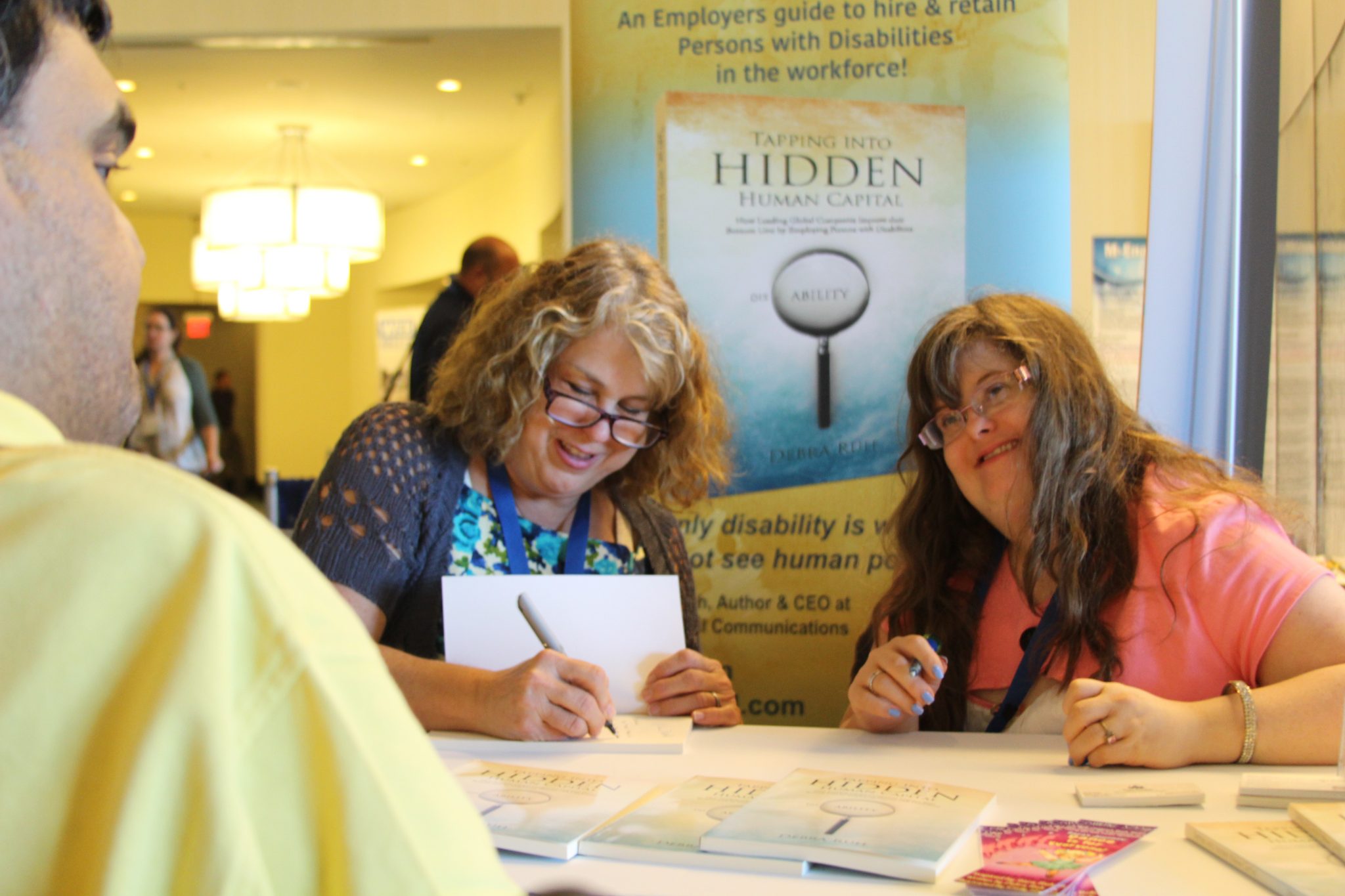
Debra Ruh (L) and daughter, Sara (R) are all smiles while Debra signs her book for a fan — published by G3ict.
Ruh: It was the only thing. And they started interviewing their employees. And the employees said, “I’m very proud to work for Canon. I like going to lunch with Joe, who has Down syndrome, or Donna, who has autism. It makes me proud to work for Canon and to be so socially evolved.” When people are proud to work for a company, they’re more productive.
The employer of choice has become more important than ever. It’s become more important to be a socially responsible company. One way they can prove they’re socially responsible is by employing a diverse workforce that includes qualified people with disabilities and retaining people with disabilities
Plasmier: Not only is it social achievement, but what about the monetary benefit?
Ruh: When you make things accessible to individuals with disabilities, it becomes more usable for everybody, which improves the bottom line. Another bottom-line benefit: why would you build any technology that 20 percent of the population might not be able to use?
A good example is Comcast. They’ve made sure their machines—their DVRs and all of their equipment—are fully accessible to everybody. They have talking remotes, and the different machines will talk to you. The Comcast guy came and was explaining to my mom how to use it. My mom was getting really overwhelmed. He started talking to her about these talking features, where it would talk her through it. I got excited because I knew they had done that for their clients with disabilities, but it benefited older people as well. This man was so proud of this company. Employees need to feel proud about the companies they work for.
Plasmier: Kevin Bradley of the Boeing Company talked about how hiring people with disabilities is not only the right thing to do, it’s the smart thing to do.
Ruh: It is. Why would you ever want to leave people out? If you have two equally qualified people with equal degrees and the same amount of past history, but one is in a wheelchair, I would pick the person in a wheelchair over the other candidate because the person in the wheelchair has had to work harder to get there.
Plasmier: Now we’re talking about affirmative action.
Ruh: We are.
Plasmier: How is that happening? Is it happening?
Ruh: I see it, but I will tell you I’m not as much looking at it from that lens. There are a lot of people looking at it from that lens, such as our Department of Labor, our Equal Employment Opportunity Commission (EEOC), and vocational rehabilitation people. I’m always looking at it from the corporate lens.
Plasmier: Disability Rights activist Emily Ladau is one of your contributors.
Ruh: Oh, yes! She’s a rock star.
Plasmier: She has very strong feelings about herself as a person with a disability and her value.
Ruh: Yeah, she says, ‘Don’t hire me because I’m a person with a disability. Hire me because I’m a rock star, and you’ll be lucky to get me.’
Don’t you want that employee? You do want that employee. If you do not recognize the value of employing people with disabilities, your competitors do. And be prepared to start failing, because you’re going to fail. We’re evolving with or without you…
Continued in Print, PDF or Digital versions. Order Here. Receive a free Digital version ofABILITY Magazine, with full images, videos and text, by clicking“Like” on our Facebook page
Debra Ruh — Hire Talent, Now!
Articles in the Jon Cryer Issue; VOICEYE — It’s Free; Ashley Fiolek — On the Go!: Humor — Dying to Know: Geri Jewell — Sticky Situation: China — The Great Tangshan Earthquake: Part 1: Long Haul Paul — A LifeCycle: Ruderman — A Family with a Strong Foundation: Comcast — Live Olympic Games Audio Description: Hugh Herr — Bionic Innovation: Jon Cryer — Two and a Half Miles for Shane’s Inspiration: Debra Ruh — Hire Talent, Now!: Jennifer Sheehy — Deputy Assistant Secretary of Labor: ABILITY’s Crossword Puzzle; Events and Conferences… subscribe
By Rosemary Musachio, Ruh Global Communications, Chief Accessibility Officer
Government departments, federal agencies, and federal contractors still abide by Section 508 of the 1973 Rehabilitation Act, even though the provisions don’t reflect modern technological advancements or are comparable with international standards. In 2010, the U.S. Access Board realized Section 508 needed to be updated to meet the ever changing technological needs of persons with disabilities. The update is officially called Section 508, or ICT (Information and Communication Technology) Refresh.
Six years later the gleam in the Access Board’s eye is becoming reality. It has gone through four delays, more officially known as Notice of Proposed Rulemaking (NPRM), since then due to further comments on emerging technology and comparability with European accessibility laws. On September 14, 2016, the Access Board finally approved the ICT Refresh. No longer will we have to hold our breath that the Access Board may say “Wait, Apple has launched a sonic version of the ipad. We need comments on it.” The Access Board has handed over the ICT Refresh to The U.S Office of Budget Management (OBM) for approval, which hopefully will occur in six months
Since many U.S. companies want their products to comply both with Section 508 and Worldwide Web Accessibility Guidelines 2.0 (WCAG 2.0), the ICT Refresh is comparable, or harmonizes, with the success criteria of WCAG 2.0. In fact, the latest version of the Refresh refers to WCAG 2.0 many times. For instance, in Section E207.2 the following is stated:
“WCAG Conformance: User interface components and content of platforms and applications shall conform to Level A and Level AA Success Criteria and Conformance Requirements specified for web pages in WCAG 2.0..”
Below are two examples of the harmonization.
Provision 502 of Section 508 Refresh
Sub-guidelines and Techniques of WCAG 2.0 Guidelines
5.2.2.4 Label Relationships. The relationship that a component has as a label for another component, or of being labeled by another component, shall be programmatically determinable.
1.3.1 Info and Relationships: Information, structure, and relationships conveyed through presentation can be programmatically determined or are available in text. (Level A)
502.2.2 Row, Column, and Headers. The row and column an object is in, and the headers for the row and column for that component, if it is in a data table that has row or column headers, shall be programmatically determinable.
H51: Using table markup to present tabular information.
502.2.1 Object Information. The object role, state(s), boundary, name, and description shall be programmatically determinable.
4.1.2 Name, Role, Value: For all user interface components (including but not limited to: form elements, links and components generated by scripts), the name and role can be programmatically determined; states, properties, and values that can be set by the user can be programmatically set; and notification of changes to these items is available to user agents, including assistive technologies. (Level A).
Besides harmonizing with the success criteria of WCAG 2.0, which are geared towards web, software, and mobile applications, the Access Board wanted the ICT Refresh to focus on computers, operating systems, televisions, kiosks, and e-books. This would prevent accessibility auditors and IT managers from asking, “Should I apply the Software sub-provisions of 1194.21 or Web Applications 1194.22 to this product?” With emerging technologies, the 1194.31 Functional Performance sub-provisions have been like the miscellaneous file for everything that doesn’t fit one of the other existing Section 508 sub-provisions.
The ICT Refresh isn’t only an update to Section 508; it also revamps Section 225 that covers telecommunication products and services. For instance, whereas the current version of Section 225 only includes TTYs (telecommunication devices), which are becoming extinct, the ICT Refresh also includes guidelines for real-time text (RTT) and relay services through Internet Providers. The ICT Refresh further resolves overlapping issues between Sections 225 and 508, such as Voice over Internet Protocol (VoIP) devices that have web-based interfaces.
When the ICT Refresh finally becomes official, it will have a positive economic impact. E&IT (electronic and information technology) products that are developed in America could be procured overseas even if they were tested for compliance of Section 508 Refresh only and not European guidelines also since the Refresh standards are based on the worldwide guidelines of WCAG 2.0. Consequently, companies will save money and time by testing a product against only one set of standards instead of two. The same concept would apply to overseas companies who sell their E&IT products to America.
Since the ICT Refresh will increase the accessibility and the quality of accessibility for federal-based products and services, more consumers with disabilities will use them successfully. Consequently, profits will rise and legal complaints will decrease. Additionally, productivity of federal employees with disabilities will improve greatly since they would be able to operate computers and printers, for instance, easier and more efficiently.
Ultimately, the positive effects of the ICT Refresh will influence the American business industry to follow suit. Although the Americans with Disabilities Act (ADA) has been the basis of many lawsuits in recent years, the 26-year law still doesn’t include specifications on how technology can be made accessible. The ICT Refresh hopefully will be interwoven in the ADA so technological accessibility can be clearly addressed not only in the government sector but also throughout America’s business sector.
Learn more about our work at www.RuhGlobal.com or follow us on Social Media @rosemusachio, @debraruh and @ruhglobal on most channels.
#AXSChat: Join Debra Ruh, Neil Milliken, and Antonio Santos for a weekly Twitter Chat on Disability Inclusion, ICT Accessibility, Built Environment, CRPD, Empowerment and Employment. Just search the hashtag #AXSChat at 3pmEST and join the conversation. You can learn more about AXSChat at www.AXSChat.com.
I have the opportunity to work with a lot of talented people, many of whom are individuals with disabilities. A person who I’m very proud of is my Chief Accessibility Officer, Rosemary Musachio. Rosemary was born with Cerebral Palsy as a result of the doctor accidentally hitting her head when assisting in birth. Rosemary is many things, including a college graduate, a writer, a poet, and a world renown accessibility engineer and tester. She also has severe disabilities that impact her mobility and speaking skills. Rosemary uses assistive technology and new technology to communicate with the world.
Rosemary Musachio photographed with a horse
I was delighted when Rosemary agreed to be on my podcast, Human Potential at Work. The episode, titled: “Unlocking Our Gifts and Talents”, discusses her many accomplishments as a technologist and disability advocate, despite having a disability. Rosemary also shares her thoughts about how technology will benefit and change the lives of persons with disabilities and what drives her to succeed.
Human Potential at Work Podcast Show Flyer for the Episode Unlocking Our Gifts and Talents Ft. Rosemary Musachio.
Recently, Rosemary and I have discussed Inspirational Porn. Members of the community of persons with disabilities have been blogging and chatting about Inspirational porn. There are advocates who believe that some portrayals of individuals with disabilities being viewed as inspirational, just for living their lives, is insulting and demeaning. Does society tell the stories of persons like Rosemary, who have overcome so many obstacles to thrive in her life and career? Or is society taking advantage of these individuals? I have read many blogs and comments on social media about this issue which inspired me to interview Rosemary about her thoughts on being an Inspirational Porn Star.
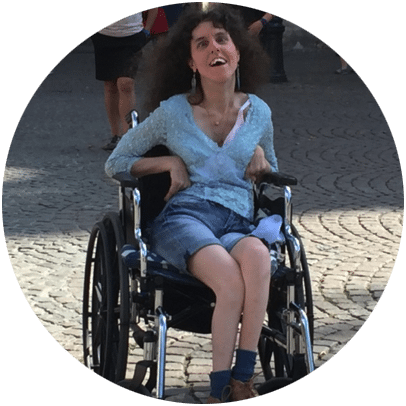
Rosemary photographed at town square in Bruges, Belgium
Debra Ruh’s Interview with Rosemary Musachio
Debra: Rosemary, what do you think about the media telling inspirational stories about individuals with disabilities? Is it Inspirational Porn to you?
Rosemary: Here are my perspectives as an Inspirational Porn Star. My comments will not be X-rated, nor will they be about church officials staring in dirty movies. Instead, the term “inspiration porn” was created by a community who think those without disabilities use the journey’s of persons with disabilities to arouse the spirit or to give them hope.
According to a TEDTalk by Stella Young, she inspires non-disabled person individuals because they can’t see themselves living with disabilities. “I could never do that”, so they are inspired and motivated by those who can. As Young explained, many of us live average lives. We wake up in the morning, go to work, and raise families. Nothing extraordinary about that except that we do it in wheelchairs, without sight, without hearing, or without limbs.
Debra: What do you think about the controversy surrounding Inspirational Porn from Individuals with Disabilities?
Rosemary: We are inspirations because society doesn’t accept us as the social norm yet. So if we do something ordinary- such as work for a living, we’re applauded. Society doesn’t expect us yet to be its productive members. That’s why only 19.8% of American adults with disabilities participate in the workforce force compared to 68.7% of those without disabilities. Not only does Society expect that we cannot work; it also doesn’t anticipate us to be wonderful parents, great athletes, or brilliant scholars. That’s why people become so inspired when they see us performing “great feats” when we’re actually living our lives the best way we can.
Rosemary photographed on a Colorado Dude Ranch
Debra: Do you mind when people say you are an inspiration? I find you very inspiring.
Rosemary: When people say I’m an inspiration to them, my soul radiates. Inspiring other people means I can do something for them. It means my disability has a purpose. God—or whatever higher power— didn’t make me disabled in vain; Call it rationalization or a self-esteem booster. Many people in the disabled community may cringe reading this. They become offended when someone says they’re inspirations for the reasons I described above. While I accept and understand their reaction, I sometimes find refusing people’s admiration arrogant.
Debra: Rosemary, why do some persons with disabilities call these stories inspirational porn? Is it bad to feature and learn from stories of individuals with disabilities?
Rosemary: Maybe confusion arises between being an inspiration and being pitied. The latter means a stranger stopping me in the streets and saying, “I’m sorry this happened to you, I’ll pray for you”, and then putting a cross around my neck (true story). If they really must have prayed for me, I should have asked that they pray I’d win the lottery. What this woman did was show pity. She feels sorry for me because she perceived that I was in a worse condition than she was. I doubt my disability would have a lasting impact on her life.
Instead, inspiring someone does have a positive impact on that person’s life. For example, my high school friend became a special education administrator because I inspired her to help children with disabilities. Another good friend of mine has a lot of pain during the day. Yet, he says when he thinks how I have overcome challenges, it motivates him to wake up in the morning and go to work.
Debra: I understand how we can inspire family and friends. But can we inspire society, businesses, and others?
Rosemary: Yes, I’m proud to be an inspiration to others. However, I don’t want to inspire only my friends. I want to motivate business executives to hire persons with disabilities who are skilled and talented. My disabilities and the way I’ve overcome them must influence others who face the same obstacles to reach goals and realize dreams.
Rosemary Hang Gliding
Debra: Can we continue to inspire without expecting anything else from society?
Rosemary: If some of us refuse to be inspirations, then we may risk pushing social acceptance further away. Nevertheless, while we should accept praise, we also should be vigilant in transforming the admiration and the awe into concrete changes for us. Graciously thank someone when they say to you, “It’s awesome that you work!”. Then add, “You should tweet that companies would benefit from the awesome work we do.”
Debra: Rosemary, thank you for your viewpoint. You have been a teacher and mentor to me since the first day we met. I always value your guidance and wisdom.
Rosemary: Being interviewed by my mentor and friend has been a great honor! I hope we open more minds and hearts.
Learn more about our work at RuhGlobal.com or follow us on Social Media @rosemusachio, @debraruh and @ruhglobal on most channels.
#AXSChat: Join Neil Milliken, Antonio Santos and myself for a weekly Twitter Chat on Disability Inclusion, ICT Accessibility, Built Environment, CRPD, Empowerment and Employment. Just search the hashtag #AXSChat at 3pmEST and join the conversation. You can learn more about AXSChat at www.AXSChat.com.
This article was originally Posted on the Huffington Post
Photograph of Debra and Sara Ruh
My daughter Sara Ruh was born with Down syndrome in 1987. She has worked since she was 16 years old but our reality is that she still needs our financial support. She lives at home and may for the rest of her life. We love having her at home and have built her a space that works for a young woman of 29 years old.
Recently, I interviewed Mary Glanden a Program Specialist for LandAjob. She is an expert with the Ticket To Work Program.
I hope you learn as much as I did about this program that supports persons with disabilities.
Debra: Tell us more about the Ticket to Work Program.
Photograph of Mary Glanden
Mary: If I had a penny for every time someone said, “I can’t live on my disability income,” I’d probably have $8.43. No kidding! The most common thing I hear is that it is hard to live on disability income, however, the biggest fear, and one of the most misunderstood topics, is that I will lose my benefits if I work. I hope through this article, we will be able to dissect the Ticket to Work program and dispel some of the misconceptions about work and its impact on benefits.
Debra: You are right Mary. Many families in the United States including my family are very confused about this program and other social security programs. So what is Ticket to Work?
Mary: The Ticket to Work program (TTW) is a Social Security initiative for individuals with disability who wants to work and move towards economic independence. Anyone ages 18- 64, who receives Social Security Disability Insurance (SSDI) and/or Supplemental Security Income (SSI) benefits because of his or her disability is eligible to participate in the program. The program is voluntary and the services offered are free. The goal of the program is to offer you the support you need to work for the chance of becoming and staying economically independent. By agreeing to participate in the program, you will not be penalized if you do not achieve self-sufficiency, however, you must be willing to make a good faith effort.
Ticket to Work Program Logo
Debra: Thanks for the helpful answer. How does the program work?
Mary: It works in two significant ways. First, it helps you get back to work and second it protects your benefits. Let’s explore both of these topics:
Getting back to work: TTW has contracted many agencies to help you get back to work. These agencies are funded by TTW so their services to you are free! Together they form what TTW calls The Employment Team. (Cue the wind machine and the Avenger’s theme song). First, there is the Vocational Rehabilitation (VR); they’re probably the Captain America of the team in that they are the most well-known. Then there are the lesser well-known Employment Network (EN) and Workforce Employment Network (WF). These 3 Employment Teams help you get back to work. Depending on which stage of employment you are at, each team offers something different so that one will fit your specific needs. For example, if you haven’t been in the workforce for some time, perhaps an agency offering training might be helpful. If you are looking specifically for at-home positions, maybe an agency offering job placement in at-home work might fit your need. If you are already working, an agency offering ongoing employment support and work-reimbursements might be just what you need. And last but not least, there are two special Employment Teams: Work Incentive Planning and Assistance (WIPA) and Protection Advocacy for beneficiaries of Social Security (PABSS). WIPA offers benefits counseling to help you understand how work and earnings impact your benefits, healthcare and other public benefits. They are really the first Team you should talk to when deciding if work is right for you. Finally, there is the PABSS, they are your legal team. They provide the legal support, advocacy and information you need with resolving employment-related concerns. VR, EN, WF, WIPA and PABSS, these 5 types of agencies formyour Employment Team.
Photograph of Mary Glanden
Debra: Mary, another part of this topic includes Work Incentives. That seems to cause a lot of confusion. Can you tell us more about Work Incentives?
Mary: Sure Debra. Work Incentives are the benefits and protections that allow you to keep your cash benefits and healthcare coverage until you achieve self-sufficiency. It allows you to explore work without worry. But different work incentives apply to different benefits. If you are receiving SSDI, your work incentives are vastly different than someone receiving SSI. In order to know which work incentives apply to you, you need to first know the benefits you are receiving. I can’t stress this enough, knowing which benefit you receive is very important! To find out which benefits you receive, please refer to the resources at the end of the article. There are two types of Social Security disability benefits: Social Security Disability Insurance (SSDI) and Supplemental Security Income (SSI). You can receive both SSDI and SSI.
There are several Work Incentives for SSDI, but for brevity sake, we will look at 3:
9 month Trial Work Period
36 months of Extended Period of Eligibility
Expedited Reinstatement
The 9 months Trial Work Period is one of the best work incentives. The 9 months are within a 60 months period (5 years). It is not 9 consecutive months. It is 9 months that could be scattered over a period of 5 years. You use 1 month when you earn Trial Work Level (TWL) $810 in 2016 ($780 2015 and $770 in 2014). You can keep receiving benefits no matter how much you work and earn, even above Substantial Gainful Activity (SGA), until you use up all 9 months.
Debra: Can you give us some examples Mary?
Mary: Sure Debra let’s review the example below.
Example #1:How to calculate TWP
Please contact Mary Glanden or Author for the information in this chart.
For SSDI, income is calculated by pay period (pay beginning and pay ending dates), not paid date (or check date).
After the 9 months Trial Work Period, you enter the 36 months of Extended Period of Eligibility (EPE). For 3 years, for the months your earnings are below SGA $1130 non-blind and $1820 for blind in 2016 ($1090/$1820 2015 and $1070/$1800 2014), you get SSDI. For the months above SGA, you do not get SSDI. During this 3 years, your SSDI benefits are reinstated right away, no application.
Now after your 3 years and 9 months, if you suddenly find yourself unable to work, you can file for Expedited Reinstatement (EXR). You have 60 months (5 years) to use your EXR work incentive. For SSDI, the start date is the first SGA month after the 36th month of EPE. EXR allows you to request to have your benefits reinstated without completing a new application. While Social Security determines your eligibility for reinstatement, you are eligible for temporary benefits up to 6 months (benefits include cash benefits and Medicare and/or Medicaid).
Basically, these 3 work incentives allow SSDI beneficiaries to work and be on the program for 8 years and 9 month. That’s working without worry right?
Now let’s take a look at SSI. SSI is a whole different beast altogether. SSI is extremely complicated and a whole lot of math. The two most important things to know about SSI beneficiaries are Income and Assets.
Debra: Mary, how does a person qualify for SSI?
Mary: To qualify for SSI, your monthly income cannot exceed the Federal Benefit Rate (FBR). The FBR is set by law and is fixed. The FBR for 2016 is $733 per month for individuals. Income can be earned (wages) and unearned (SSDI, pensions, interests, etc.), there’s also deeming (someone else’s income i.e. parent or spouse) and in-kind (shelter or food received free or at reduced cost). There are things not considered as income such as tax refunds, loans spent in the month received, bills paid by 3rd parties directly to the vendor for other than food and shelter, etc. And income can also be considered as assets. Earnings from your job are considered as this month’s income, what is not spent will be counted as next month’s assets. Did I mention SSI is complicated? For more information on SSA’s definition of income, please visit: https://www.ssa.gov/ssi/text-income-ussi.htm.
SSI is a needs-based program, so, in order to qualify for SSI, your assets cannot exceed a certain amount, $2000 for individuals and $3000 for couples (even if only one member is eligible for SSI). An asset is cash or resource that can be converted to cash and used for your support. An asset can be liquid or non-liquid. As with income, there are things not counted as assets by SSA. For more information on SSA’s definition of assets, please visit: https://www.ssa.gov/ssi/text-resources-ussi.htm.
Debra: It seems complicated and I know many parents and individual with disabilities get confused by the math formulas associated with these programs.
Mary: Remember how I said there’s a whole lot of math involved with SSI? Well, here we go: SSA excludes $20 per month of income not from wages (SSDI, pensions, etc.). SSA excludes $65 per month of wages and ½ of wages over $65. Last but not least, income is calculated by pay date (check date). Let’s look at 2 examples:
Example #2:How to calculate unearned income?
Anna receives $520 per month in SSDI, how much will she receive in SSI?
1. $20 is excluded = $520 – $20= $500 ß countable unearned income – SSDI
2. $733 (SSI FBR) – $500 = $233 ß how much SSI she will receive + state supplement.
Example #3:How to calculate work income?
Anna receives $733 (SSI FBR), $520 in SSDI, and decides to take a job paying $885 in gross wages per month, how does work affect her SSI?
4. $885 – $65 ($65 is excluded. $20 if not used on “unearned income” but in Anna’s case, used in SSDI) divided by 2 = $410 ß countable gross monthly income
5. $500 + $410 = $910 ß this $ amount is more than Anna’s SSI FBR ($733), so she is SSI ineligible
6. $885 Anna’s original gross income + $520 (SSDI) = $1405 ß Anna’s total income
Recap:
$20 is excluded from unearned income
$65 is excluded from earned income
Income = gross pay – (minus) exclusions ÷ (divided) by ½
For SSI income is calculated by pay date (check date).
Think all the math is done? Think again, there are more calculations to do. For SSI beneficiaries, the main work incentive is Impairment Related Work Expenses (IRWEs). They are allowable deductions from your earned income. IRWEs can be items or services that enables to you work (ex. Transportation), Impairment related items or services (ex. Personal Care Attendant), things you pay for that is not covered or reimbursed by any other source (ex. Medical equipment). You have to document these costs, so keep your receipts and hopefully you or someone you know is very good at math.
Debra: It seems like you need to be a math major to understand these programs. Can you tell us more about SSI Expedited Reinstatement?
Mary: Of course, SSI beneficiaries are also entitled to Expedited Reinstatement (EXR). For SSI beneficiaries, they also have 60 months (5 years) to file for EXR. The starting date for SSI is 12 months after the first month of financial ineligibility.
Debra: I have heard many people getting confused about SSDI versus SSI? Can you expand on that topic?
Mary: Absolutely Debra and now we are in the home stretch. Some last odds and ends and best practices. If you collect both SSDI and SSI, you need to count your income two different ways: SSDI (pay period) and SSI (pay date), and the $2000 asset rule still applies to your SSI benefits. It is important that you report your income to SSA and make sure you get a receipt. If SSA does not know that you are working, then you could get benefits for months you shouldn’t and end up with an overpayment issue. If SSA isn’t aware of the loss of your job, then you might not receive benefits for the months you are entitled to. It is important to report to SSA anything and everything that might affect your eligibility. It is also important to document and keep copies of everything you provide to SSA. Be educated, be informed, be proactive and be smart.
John Bertram with MA Senator Petruccelli
Debra: Mary, can you give us some resources to help families and individuals understand the programs?
Mary: Sure Debra and I hope you and your readers have gained some insights as to how the Ticket to Work program works and will be able to make an informed decision if work is right for you.
Resources:
It is extremely important to know which benefit you receive so that you know which work incentives apply to you! To find out which benefit you receive is really simple! You can create and use “my Social Security” account on the Social Security website.
To create a new account, you will need: Your Name, Social Security Number, Date of Birth, Home Address and Email Address.
TIP! Avoid calling the 1st and 3rd of the month if possible as that is when Social Security benefits are paid.
The Red Book is another good resource. (The Red Book serves as a general reference source about the employment-related provisions of Social Security Disability Insurance and the Supplemental Security Income Programs for educators, advocates, rehabilitation professionals, and counselors who serve people with disabilities) https://www.ssa.gov/redbook/documents/TheRedBook2016.pdf
Disability 101 – Disability Benefits 101 gives you the tools and information on employment, health coverage and benefits. Currently it is only offered for the following states: Arizona, California, Michigan, Minnesota, Missouri, New Jersey, and Ohio. Kentucky and Hawaii are currently in discussion with World Institute on Disability on the development of DB 101 in their states.
Debra: Mary thanks for taking the time to explain a complicated topic in layman’s terms so we can all understand the program and benefits. How can our audience contact you and your firm?
Mary: I was honored to answer your questions. It is critical that beneficiaries understand their rights and these programs. Here are some emails and numbers from my organization that can help answer more question. It was a pleasure and honor to be working and speaking to you.
TRAILBLAZING 2016 TO TARGET IMPROVING DISABILITY EMPLOYMENT, INCLUSION AND WORKFORCE SUSTAINABILITY DURING ONE-DAY CONFERENCE SEPTEMBER 17, 2016 AT BROWARD CENTER FOR THE PERFORMING ARTS
Jose Velasco, Global Lead at SAP Technologies ‘Autism at Work’ program, speaks for first-time in South Florida as Special Guest Speaker
PEMBROKE PINES, FL, USA August 22, 2016 – Trailblazing 2016 – envisioned by Nelson and Minerva Santiago, co-founders of Picasso Einstein, authorities on entrepreneurial options for individuals with disabilities – is inviting the private sector, tech companies, financial investors and entrepreneurs with disabilities and their families to the table of innovation to discuss the future of disabilities, business and technology leading to economic self-sufficiency. With the support of SAP Technologies and WIX.com, among other leaders in the rising movement to create jobs for people with disabilities, Trailblazing 2016 will take place Saturday, September 17th at the Amaturo Theater at Broward Center for the Performing Arts in downtown Fort Lauderdale.
Marking his South Florida speaking debut, José Velasco, head of SAP’s ‘Autism at Work’ program, is recognized internationally as a leader in business innovation, for the purposes of creating a more inclusive, sustainable and meaningful employment platform for persons on the Autism Spectrum. In 2014, SAP, with guidance and leadership from Jose Velasco, made a groundbreaking commitment to ensure at least 1% of their entire global workforce represented individuals with Autism. “SAP is proud to support Trailblazing 2016 as there is a skill set people on the spectrum are bringing that has business value,” says Mr. Velasco, who also is the father of two autistic children himself. “We’re finding all kinds of skills in all kinds of disciplines.”
-more-
Dr. Michael Alessandri, clinical professor of psychology in the College of Arts and Sciences and Executive Director of the UM-NSU Center for Autism and Related Disabilities (CARD), will serve as master of ceremonies and Special Guest Speaker. He was also awarded a multi-year grant for his proposal, “Awakening the Autism Entrepreneur,” which seeks to help those who are interested in creating businesses that employ people with Autism. Also making a special appearance, Debra Ruh, CEO at Ruh Global Communications and Author of ‘Tapping into Hidden Human Capital: How leading corporations leverage multiple abilities in their workforce’.
Other Keynotes include Shira Galler, Community Outreach Manager for WIX, a leading global web development platform; Dr. Harold “Hackie” Reitman, founder of Different Brains, who is an entrepreneur, philanthropist and children’s activist. Dr. JR Harding, a 2x quadriplegic and International Disability Expert at the Agency for Persons with Disabilities, who has contributed for over 30 years to national, state, and community policy for the independence and self-sufficiency of persons with disabilities.
Trailblazing 2016 is an all inclusive one-day conference including topic presentations on ‘The Benefits of NeuroDiversity in the Workplace,’ ‘The Significance of Job Creation,’ ‘Using Customized Software Platforms to Advance Business,’ ‘How to Start a Business on a Shoe String Budget,’ ‘How Assistive Technologies Breaks Down Barriers,’ and ‘The Quest for Equality.’ There will be presentations by various Entrepreneurs with Disabilities and the newest Tech Inventions to assist people with disabilities.
TICKETS ARE ON-SALE NOW! Tickets are $50 each and include boxed lunch. The conference is from 8:30am – 5pm and attendees are welcome to register starting at 7am. Blazer Exhibitor Booths (people with disabilities running their own businesses) will also be open at this time and at designated times throughout the conference. Individuals with disabilities, their parents, family, caregivers and agency staff; anyone in the private sector, investors or companies creating tech devices helping make people’s life better; anyone interested in learning more about creating businesses to employ adults with disabilities or assisting them to start their own real businesses are encouraged to attend. For more information, buy tickets or register as an exhibitor, please visit www.trailblazing2016.com.
-more-
Stay Connected with Trailblazing 2016
Follow Trailblazing 2016 on Twitter @Trailblazing16. See event news and happenings at #Trailblazing16. Follow Trailblazing 2016 on LinkedIn and like Trailblazing 2016 on Facebook at /Trailblazing16. Download our Sponsor Deck or buy tickets at www.trailblazing2016.com.
ABOUT #TRAILBLAZING16
Trailblazing 2016 is a one-day conference this September 17th at the Amaturo Theater at the Broward Center for the Performing Arts in downtown Fort Lauderdale, FL which focuses on the future of disabilities, business and technology leading to economic self-sufficiency. This conference aims to fuel the progress and innovation needed to improve the state of disability employment, inclusion into the workforce and sustainability across all channels of living. We believe people with disabilities can (and must) participate equally in society by making substantial contributions to economic and social development. Trailblazing 2016 will change the conversation and reveal the future of self-employment as the fastest-growing alternative to traditional employment. For more information or to buy tickets, please visit www.trailblazing2016.com.
ABOUT LEEDD
Part of all proceeds benefit LEEDD, Florida 5019(c)3 Non-Profit Organization, committed to a grassroots approach to educate communities and stakeholders on how self-employment for persons with developmental disabilities (DD) provides an opportunity for persons with DD to participate equally in society and make substantial contributions to economic and social development of our communities.
“TAPPING INTO HIDDEN HUMAN CAPITAL,” A NEWLY RELEASED BOOK BY DEBRA RUH, DEMONSTRATES HOW LEADING GLOBAL COMPANIES IMPROVE THEIR BOTTOM LINE BY EMPLOYING PERSONS WITH DISABILITIES
Atlanta, GA. 07/18/2016 —
G3ict, the Global Initiative for Inclusive Information and Communication Technologies announced today the publication of a new book authored by Debra Ruh, G3ict’s EmployAbility Program Chair.
In this book, Tapping into Hidden Human Capital: How Leading Global Companies Improve their Bottom Line by Employing Persons with Disabilities,” Debra Ruh presents a new, game-changing perspective about the employment of persons with disabilities. By documenting existing practices of some of the largest companies in the world, the author shows that employees with disabilities are proactively recruited for their positive contributions to the competitiveness and financial performance of major businesses.
While Debra Ruh documents case studies that are eye-opening, her detailed analysis of the success factors in recruiting, hiring, and managing persons with disabilities are a must-read for any Human Resources professional and top executive of large organizations operating in highly competitive employment markets, such as those in the field of technology.
Debra Ruh’s book guides global corporations, as well as beginning entrepreneurs on how to integrate persons with disabilities in every aspect of the workforce. It takes the reader through each step, from recruiting and interviewing to employing and retaining persons with disabilities in the organization as vital employees. The book offers insights and strategies on how to accommodate employees with disabilities, how to fully leverage their skills and talents, and transform challenges into successes. Additionally, Debra Ruh includes personal accounts from global leaders about how persons with disabilities have enriched their businesses, increased productivity, and lowered turnover rates.
“This is an outstanding compendium of practical solutions for all employers. From large organizations with a global footprint to entrepreneurs with a few employees, attracting and retaining the right talent is the most critical success factor for their business. This book will definitely be looked upon as a milestone in how companies think about recruiting persons with disabilities,” commented Axel Leblois, G3ict President and Executive Director. “We are very pleased to publish Debra Ruh’s latest work and to make it available through all major book distribution channels worldwide.”
Tapping into Hidden Human Capital is available in paper back on the G3ict website.
About the Author
Debra Ruh is a Global Disability Inclusion Strategist and serves as the EmployAbility Program Chair for G3ict, the Global Initiative for Inclusive ICTs. She is a seasoned entrepreneur having founded three firms including Ruh Global Communications, TecAccess and Strategic Performance Solutions. At TecAccess, more than two third of her employees were persons with disabilities, serving as a best practice for many employers. Her client-centric focus and ability to promote successful disability employment programs has created relationships with many multi-national firms including Accenture, AT&T, ATOS, Avanade, Best Buy, Bloomberg, Canon, Capital One, CSC, CVS, Disney, Dell, Deloitte, E&Y, El Al Israel Airlines, HP, IBM, McDonalds, MCI, Merck, Microsoft, TD Bank, Verizon Communications, Verizon Wireless, VMware, Walgreens, and Wells Fargo and many others including United Nations agencies, international governments, federal, state and local agencies.
About G3ict
G3ict – the Global Initiative for Inclusive Information and Communication Technologies – is an advocacy initiative launched in December 2006 in cooperation with the Secretariat for the Convention on the Rights of Persons with Disabilities at UN DESA. Its mission is to facilitate and support the implementation of the dispositions of the Convention on the Rights of Persons with Disabilities on the accessibility of Information Communication Technologies (ICTs) and assistive technologies. G3ict relies on an international network of ICT accessibility experts to develop and promote good practices, technical resources and benchmarks for ICT accessibility advocates around the world. It is incorporated as a nonprofit organization in the State of Georgia, USA, and headquartered in Atlanta. Visit www.g3ict.org.
– See more at: http://g3ict.org/press/press_releases/press_release/p/id_98#sthash.AUP98R9o.dpuf
Rosemary Musachio, Chief Accessibility Officer, Ruh Global Communications
If you are like me, searching for good code examples when you try to find solutions to accessibility issues can make you pull out your hair. You Google it and you get tons of results. When you finally find something, you go to the site to realize it’s only a forum unanswered question. Your excitement peaks again when you find a blog post that discusses the solution you’ve sought, but it doesn’t show the specific code example. Conversely, the blog post may have the code example without showing the actual component.
To prevent you from going bald, I’d like to share a complied list of websites each month that offer good code examples and the finished products. This month’s list is categorized into ARIA and Form Fields.
ARIA
Ajax Accessibility Examples – A great site for ARIA examples. It has a summary table of code examples and their associated roles, properties, and states. When you go to an example page, it has the actual component, a list of ARIA elements that are used, and the code example. Besides the summary table, you can search for examples by the three ARIA categories mentioned above.
W3C’s Role Model – The site explains everything you wanted to know about ARIA Roles and more. It describes each role in depth, including listing all the properties that are compatible with it. Even though the site offers code examples, it should provide them for every role-property combination. However, it is a must for anyone who wants to learn about ARIA.
ARIA Landmarks in (X)HTML – The webpage describes ARIA landmarks and how to implement them. The descriptions are straightforward. Since the page itself uses landmarks, you can view the code to it.
Form Fields
Accessible Web Form – The page screams simplicity. It is so easy to follow. It shows a form with various types of fields, including field groups (i.e. fieldset). After the form, it shows the code for it. That’s it.
Jim Thatcher’s Accessible Forms – What’s a list of accessible form examples without the father of web accessibility, Jim Thatcher? He explains accessible forms as clear as the mountain air. He presents form elements, including edit fields in a table, and the codes.
Webaim’s Creating Accessible Forms – The webpage offers an organized description of each type of form field, visual examples, and codes. It also describes different types of labeling, such as title attributes and aria-label.
Web Accessibility Tutorials – Form Concepts – The page offers links to different aspects of accessible forms, from firm labeling to custom controls. When you click each link, it shows visual examples and code snippets. W3C did a good job of making these pages concise, a pleasant turn from the norm.
Do you know other sites of great ARIA and Form Field examples? If so, put them in comments for this post. This is a great way to help each other out in making the Web more accessible.
Learn more about our work at www.RuhGlobal.com or follow us on Social Media @rosemusachio, @debraruh and @ruhglobal on most channels.
#AXSChat: Join Debra Ruh, Neil Milliken, and Antonio Santos for a weekly Twitter Chat on Disability Inclusion, ICT Accessibility, Built Environment, CRPD, Empowerment and Employment. Just search the hashtag #AXSChat at 3pmEST and join the conversation. You can learn more about AXSChat at www.AXSChat.com.
Corporate Social Responsibility has become important to many people all over the world. What responsibility does corporations have to society? What role should corporations have to produce robust growth, create innovative and visionary development, especially within the workforce? What responsibilities do corporations have to assure that disenfranchised parts of our society can fully participate in society? Should corporations create strategies that will advance human and resource development in their communities, countries, and global realms?
I have had the pleasure to work in corporations my entire career. I have worked in the Telecommunications, Financial and Banking Industries. I have worked for multi-national firms, corporate America, medium and small businesses. I have also created several firms of my own. Like many other people in the United States, it was important to me to work for a company that cared about the employees and the community.
Sara and Debra Ruh photographed when working at TecAcces, Debra’s first entrepreneurial endeavor.
Corporations that encourage and support local, national and international volunteerism appeal to the workforce, build company loyalty, foster personal and professional development, improve the company brand, and build stronger communities where their employees and customers live, here and around the world. Employees have also made it clear that they expect their employers to hire a diverse workforce.
Rosemary Musachio, Chief Strategy Officer, Ruh Global Communications
Nielsen survey[1] confirming what other studies have also found the majority of consumers today express a general preference for companies making a positive difference in the world. Two thirds (66%) of consumers around the world say they prefer to buy products and services from companies that have implemented programs to give back to society. That preference extends to other matters, too: they prefer to work for these companies (62%) and invest in these companies (59%). A smaller share but still nearly half (46 percent) say they are willing to pay extra for products and services from these companies, the “socially-conscious consumers,” as defined and focused upon in this report.
According to Nielsen’s survey, global, socially-conscious consumers tend to be younger: 63 percent are under the age of 40, compared to 55 percent of all respondents. In general, Nielsen’s survey shows that younger consumers are more likely to spend extra for products and services from socially-responsible companies. Fifty-one percent of all respondents aged 15 to 39 are willing to pay extra for such products and services compared to 37 percent of all respondents over age 40.
This not only applies to consumers. Employees also have expectations from their employers. Millennials state that diversity and inclusion are very important to them and essential for business success. They are defining diversity and inclusion at work. The generation gap between boomers, gen-Xers, and millennials is more like a growing trench, according to a study from Deloitte and the Billie Jean King Leadership Initiative (BJKLI).
The study analyzed 3,726 millennials view of diversity and inclusion and found that it is the blending of different backgrounds, experiences, and perspectives within a team, which is known as cognitive diversity. It also noted that a diverse workforce provides unique traits that allow the organizations to overcome challenges and achieve business goals. 71% of Millennials view cognitive diversity as a necessary element for teamwork and innovation.
Kevin Ruh, Chief Marketing Officer and Emily Ha Chief Creative Officer at Ruh Global Communications
Millennials define inclusion as a collaborative environment that values open participation from individuals with different ideas and perspectives. They view diversity as a representation of fairness and protection to all regardless of disability, gender, race, religion, ethnicity, or sexual orientation.
The study found that diversity and inclusion is also important for the baby boomers and Generation Xers. It is imperative to these workers that the business environment integrates individuals of all demographics into the workforce.
The authors of the study found that “Millennials yearn for acceptance of their thoughts and opinions, but compared to older generations, they feel it’sunnecessary to downplay their differences in order to get ahead,” the survey authors write. “Millennials are refusing to check their identities at the doors of organizations today, and they strongly believe these characteristics bring value to the business outcomes and impact.”[2]
Corporations must take more aggressive steps to become stronger allies for underserved parts of our population like persons with disabilities. They also need to be seen as better corporate citizens to help solve issues that affect the local, national, and global workforce. Corporations need to join forces more aggressively with governments, philanthropic, non-government organizations, and universities to tackle increasingly complex and interconnected problems in our workforce.
Most countries are still struggling to tap into underutilized parts of our society, especially persons with disabilities. Efforts have been made in this area but we have major gaps all over the world, including the United States despite the American with Disabilities Act (ADA) turning 26 years old this year. The United Nations created the Convention on the Rights of Persons with Disabilities (CRPD) and have encouraged countries to sign and ratify the treaty to afford individuals with disabilities the same civil rights as other citizens.
Despite legislative, litigation and philanthropic efforts, persons with disabilities are still not being meaningfully included in the workforce. Persons with disabilities are unemployed or underemployed all over the world. Many people think that we have ‘solved’ these issues in developing countries but this is not the case. As a global expert in this field and a mother of an adult with Down syndrome, I have studied programs all over the world. Often the efforts are being made from a charity perspective instead of the understanding that persons with disabilities can add great value to their workforce.
Sara Ruh, Chief Inspiration Officer at Ruh Global Communications, stands next to her Mother Debra Ruh, CEO at Ruh Global Communications.
I have seen many training programs, internships, and apprentice programs created for persons with disabilities that never lead to paid work. It is discouraging for these talented individuals with disabilities to focus on their education, go to college, participate in internships, yet never be meaningfully included in the workforce. I know of many talented individuals with disabilities that have the same, if not better, credentials as their non-disabled counterparts that cannot find even entry-level positions.
When I first entered this field in 2001, most efforts were being made by governments, non-profits, and non-governmental organizations (NGO). I was surprised that more efforts were not being spent with the employers, especially the corporate employers. I quickly found that their seemed to be a disconnect between the disability service providers and the employers. I attended a meeting once to discuss why employers were not hiring person with disabilities. Many participants complained about employers not wanting to hire them. I asked the group to pretend that I was an employer and start a conversation with me. One man said, “My first question is, Do you have barriers to employment of persons with disabilities?” I looked at him and said the conversation is over. I said, “You just threatened me with many local and national laws like the Americans with Disabilities Act. I am going to politely listen to you and then tell you that we are not hiring. I will say anything to you at this point to get you out of my office”. He quickly said, “Well, that is not really how I start the conversation. I believe that in fact this is how we often start the conversation with employers.”
Many of the systems and service provider programs are struggling. Instead of asking employers about their employment needs, they ask about ”barriers to employment”, or ”can you create new jobs for persons with disabilities” or “can you carve up your existing jobs”?
It is also important to note that this is not the fault of the service providers. Instead, it is a system problem. Many of these programs are judged by number of people they place instead of allowing them to focus on partner with the employer. Employers need to hire a diverse workforce and they need qualified candidates.
I was recently invited to an International Labor Organization (ILO) Expert Meeting on this topic in Geneva, Switzerland. We discussed ways to create employment opportunities for persons with disabilities in the developed and developing world. We listened to best practices and innovative ideas. We also discussed the major gaps and lack of global progress.
We ask motivated, talented, and innovative persons with disabilities to go to college and get degrees, do volunteer work, enroll in training programs, and take unpaid internships and apprenticeships. Despite all their efforts, they still are not offered paid positions.
Why? There are many reasons, but it is because there is a lot of fear and misnomers about hiring people with disabilities in many countries. There are still prevailing notions that people with disabilities:
Will not be qualified for your positions
Take more sick days and are often late
Are not productive or loyal
They cannot be fired due to nonperformance
Are expensive to accommodate
Will not fit into your corporate culture
Or will sue you if your systems, website, or architecture structures are not accessible
Each of these statements have been proven incorrect over and over again. It is also interesting to note that many of these ridiculous and untrue statements were made about women when they first entered the workforce.
The promising news is that we are starting to see corporate employers begin to make efforts to meaningfully include persons with disabilities in their workforce. Most of these efforts appear to be happening in the Diversity and Inclusion (D&I) areas. I recently delivered a webinar for nearly 300 employees at Avanade, a multi-national firm that has more than 27,000 positions all over the world. As a part of their Dialogues on Diversity program, we engaged in an open dialogue about the value of accessibility and disability inclusion. Avanade is a joint venture between Accenture and Microsoft. It is interesting to note that both Microsoft and Accenture also have made efforts to include persons with disabilities in their global workforces.
It is time that corporations create strategic programs to assure they are employing and retaining a diverse workforce that includes employees with disabilities. It is time for corporations to be accessible for all. In the United States there is a major uptick in litigation because of inaccessible workplaces, websites, technology, communications, enterprise systems, mobile apps, training, internal and external communications, marketing, documents, and other ICT.
Lawyers have figured out that most corporations are not making accessibility and employment of persons with disabilities a priority and will quickly settle a demand letter or lawsuit. One lawyer told me, “Debra, this is how we do it in the United States. We create laws that no one follows. So the lawyers sue the companies to make them comply with our laws. So we are doing a service for persons with disabilities.” I predict that we will continue to see a rise in litigation in the United States and other countries as people with disabilities fight for their civil rights to be fully included in the workforce and other parts of society.
A corporation would never dream of building or procuring a system that did not have privacy and security built into the core of the system. Why would you procure or build systems that are not accessible to large numbers of people? Accessible Built Environments, Workspaces, and ICT Accessibility should be considered a normal part of all business processes.
Employers need to create programs to employ persons with disabilities by creating strategic plans and roadmaps with measurements and metrics, building working relationships with program partners, providing thought leadership and executive positioning, and developing strategic communications planning and continued media and stakeholder outreach.
It is also important to include the employment and retention of persons with disabilities as part of your Future of Work efforts. Developments and Innovations with technologies from IoT, Wearables, Smart Cities, 3D Printing, and Robotics will continue to allow persons with disabilities to add tremendous value to the workforce.
I address many of these gaps, issues and strategies to meaningfully include and retain employees with disabilities in your workforce in my latest book: “Tapping Into Hidden Human Capital: How Leading Global Companies Improve their Bottom Line by Employing Persons with Disabilities” publishing by G3ict(www.G3ict.org), which is now available on Amazon
Book Release
Learn more about our work at www.RuhGlobal.com or follow me on most social media channels @debraruh and @ruhglobal.
#AXSChat: Join Neil Milliken, Antonio Santos and myself for a weekly Twitter Chat on Disability Inclusion, ICT Accessibility, Built Environment, CRPD, Empowerment and Employment. Just search the hashtag #AXSChat at 3pmEST and join the conversation. You can learn more about AXSChat at www.AXSChat.com.
ILUNION T.A. in conjunction with Ruh Global Communications is assisting the travel & leisure industry with helping collect valuable insight to providing its customers with the best service and quality experience when traveling either locally or abroad. In line with their commitment to continuous improvement, the travel industry is looking to examine their current performance across a broad range of issues critical in providing the best possible traveler experience. The best way to do this is by asking you, as a travel (either for business or leisure) to participate in this brief Traveler Survey and to provide us with your opinion based on your own travel experiences.
This important traveler survey is being conducted by ILUNION T.A., an independent research consultancy organization. ILUNION T.A. undertakes to keep your responses strictly confidential.
The survey is completed on-line, is anonymous and should take around 5 minutes to complete. We encourage you to complete this survey in a quiet time when you are able to concentrate without interruption. The survey is set out in a number of sections and every statement in each section should be responded to before moving to the next.
Please remember, there are no right or wrong answers. It is only your honest feedback we are seeking.
Should you have any concerns or questions about this survey, please feel free to contact Richard Streitz from Ruh Global Communications at (949) 793-1300.
This customer survey will run from Today, June 24th 2016 until Friday, July 24th 2016. By participating in this survey you will be making an important contribution by providing invaluable information to help the travel industry improve and serve the community better. Your opinion counts!!!
What do you have to do?
The customer survey is web-based and is set out in a number of sections. Please click on the link below to start the customer survey:













(2).jpg "Hidden Human Potential cover") In this book, Tapping into Hidden Human Capital: How Leading Global Companies Improve their Bottom Line by Employing Persons with Disabilities,” Debra Ruh presents a new, game-changing perspective about the employment of persons with disabilities. By documenting existing practices of some of the largest companies in the world, the author shows that employees with disabilities are proactively recruited for their positive contributions to the competitiveness and financial performance of major businesses.
In this book, Tapping into Hidden Human Capital: How Leading Global Companies Improve their Bottom Line by Employing Persons with Disabilities,” Debra Ruh presents a new, game-changing perspective about the employment of persons with disabilities. By documenting existing practices of some of the largest companies in the world, the author shows that employees with disabilities are proactively recruited for their positive contributions to the competitiveness and financial performance of major businesses.


