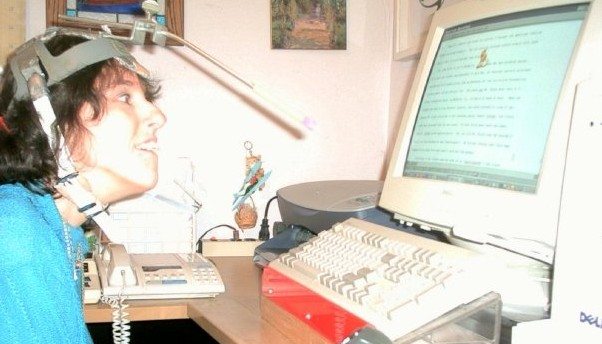
Although I’ve been communicating with a manual communication board with letters and words since I was eight, speech therapists have been trying to help me use electronic augmentative assistive communication (AAC) devices. I had never been thrilled with the idea until recently.
Back in the 1980’s, AAC devices had robotic sounding voices that some people couldn’t even understand. The voice made me sound like a teenager from outer space. Now synthesized voices are much more human sounding. Some voices actually would make me sound as I should sound—a sexy woman speaking.
Additionally, since the idea was to use the AAC device away from home, I didn’t (and still don’t) want to use the headpointer out in public for aesthetic reasons (Wearing a helmet with a protruding stick makes me look like I belong in Star Wars!). So, I used my thumb knuckle, which I use to point on my manual communication board, to access buttons on the first AAC device I tried when I was in grade school. When I targeted a single button, I pressed several others with the rest of my hand.
Rosemary Musachio using a head pointer
The idea of AAC devices went on the back burner until I started attending college. Since I didn’t have aides as I did in grade and high school to voice what I pointed to on my manual board, I had to find a way to communicate independently. The Cleveland Hearing and Speech Center set me up with a Light Talker. Each button on the device could be activated with an infrared light. Because I couldn’t hold and manipulate the infrared light pointer, a rehab engineer created an iron-like object that I would drag across the surface and stop at the icon I wanted. Tapping two picture icons were required to say a phrase. For instance, I had to activate the SUN icon and the ELEPHANT icon to say, “I’m happy to meet you.” The Light Talker required users to have photographic minds to memorize all those combinations.
Light Talker
Often the Light Talker stopped working, sometimes in the middle of my forming a sentence. I would look helplessly at my listener until he or she finally understood that the stupid thing died. This would also happen when the plug came out of the pointing device. I used the Light Talker only at school, not at home. Therefore, my manual communication device still was more effective for my personal interactions.
Over the years I’ve tried other AAC devices without avail. I tried scanning where the cursor goes through words or letters. When I wanted to select something, I’d hit a button with my hand so the cursor would stop on an item. Stephen Hawkins uses this method to communicate and operate the computer. Scanning is not for me, however. Either the cursor went too slow that I would forget what I was trying to say in the first place, or it went too fast so I felt like Lucille Ball, working on an assembly line in an “I Love Lucy” episode.
I’ve also tried the eye gaze method. I became excited about it because I assumed it was easy to use. I mean, you stare at an item to activate it through infrared. Well, it isn’t that simple. Your eyes have to be calibrated first. In other words, the device has a camera that takes an image of your iris position so it knows where the infrared light is reflected. If you move your head a lot—as mine usually does–the device continues to recalibrate, causing you not to activate the correct item. Besides not keeping my head steady, I also have one lazy eye that made calibration difficult. Consequently, practicing to use the eye gaze device made me frustrated and tired. Nevertheless, new eye gaze systems have been developed that supposedly improve calibration. I still may try one soon.
Tobii EyeMobile Eye Gaze. Image from www.slashgear.com
Currently, I’m trying the “dot” system on a ChatFusion device. This device still uses infrared. Instead of using my eyes to activate the device, I use an adhesive dot. You can stick the dot anywhere on your body that has the most control and best target position to activate buttons on ChatFusion. I stick it between my eyes since that position allows me to follow the cursor on the screen in relations to my head movement. If I wrinkle my nose, my target range becomes skewed.
Unlike the other devices I’ve used, ChatFusion using the infrared dot has worked so far. Head movements do not have to be calibrated constantly like eye gaze systems. The device can be set according to how much “dwell time” you need to hover over an item to activate it. The device—and it goes with any device—should be positioned correctly so the user can access any item on the screen. For example, if I sit too close, I may not be able to target items at the bottom of the screen well.
Chat Fusion 10. Image from www.Saltillo.com
ChatFusion works better also because I’m investing more practice time. Practicing with someone who I can use the device with to converse engages my attention more than practicing alone. During my practice sessions, I keep telling myself to relax; otherwise, my head becomes one of those bobbing toys in the back of a car. Additionally, I become conscious of how I approach each item with each movement. If I make the cursor slides onto an item from the bottom rather than targeting it in the middle, my head is steadier. The downside is that I may activate other items that I don’t want in the process.
Learning to use an augmentative device takes patience and practice. You need to pace yourself. If you get too tired or frustrated, you need to stop and restart at another time. After 30 minutes using ChatFusion—or any other AAC device—I start losing concentration and my head movements become more random. At this point, I even compose sentences like someone from another planet.
Clearly, my attitude towards electronic AAC devices has changed. Since AAC technology has advanced from 1970’s, I know I will be using a device that will allow me to communicate independently in business and social situations. It may not be Chatfusion; it may be a better eye gaze system or even a brainwave AAC. Once I find the right AAC device and access method, I probably won’t stop talking.
I was disturbed with some of the recent disparaging comments women were making about other women in regards to voting based on gender. Especially women my age and older talking down to younger women. I believe that women should always support women. However, we fought hard for our feminist rights. We continue to fight for our rights. We need women to have equal pay, a place at the C suite, a seat in the board room and so much more.
My work is focused on disability inclusion, accessibility and empowering persons with disabilities. According to the World Health Organization there are over 1 billion people with disabilities in the world or 1 in 7 people. Some countries like the United States are higher. According to the Census Bureau, 1 in 5 persons with the United States are living with a disability. One in five American adults have at least one kind of disability, according to a report from the Centers for Disease Control and Prevention. Released in July 2015. The study, drawn from 2013 data, says 53 million Americans have a disability. “We know disability types and related challenges can vary,” said Elizabeth Courtney-Long, a health scientist with CDC’s National Center on Birth Defects and Developmental Disabilities. “In order to understand and address their needs, we need to understand their diverse circumstances. This report provides a snapshot into that. 1 The Report can be found here
My son and daughter, Kevin and Sara Ruh who has Down Syndrome
Women and girls with disabilities face even bigger barriers and are the victims of two-fold discrimination: as women and as persons with disabilities. Studies conducted by the United Nations women with disabilities are often invisible “both among those promoting the rights of persons with disabilities, and those promoting gender equality and the advancement of women.” 2
Women with disabilities all over the world are shamed, bullied, raped, murdered and treated as if they do not matter. 3 It is past time for all women to be empowered and to support all genders.
Women with disabilities all over the world are shamed, bullied, raped, murdered and treated as if they do not matter. It is past time for all women to be empowered and to support all genders. I have the honor to work with Rosemary Musachio, a brilliant woman and also the Chief Strategic Officer at Ruh Global Communications. Rosemary happens to have been born with Cerebral Palsy. Rose shared her thoughts on this topic with me recently, this is what she said:
“Steinem’s quote is a generalization, which is often detrimental and even dangerous. Her remark may stereotype younger women in a bad light, not caring about anything except self-gratification. If society acquaints this negative image with women who were born after 1990, they may not receive support from other women. They also may not get opportunities that they deserve.
Being a woman with cerebral palsy, I’ve experienced the repercussions of generalization all of my life. The public still automatically links having a disability with not being a productive member of society or my mind being in a wheelchair. Because of this, I constantly have to fight to prove myself. Now, because of Steinem’s comment, millennial women may have to fight to prove themselves.” – Rosemary Musachio, Chief Strategic Officer at Ruh Global Communications
As an undecided voter, I fought for my feminist right to decide on a candidate based on the issues not based on gender. I am also embarrassed of women my age and older telling younger women they don’t understand the fight for equal rights for women. Once while attending a conference for Women Global Leaders, I was talking with several other attendees. One guest brought up how we should be mentoring the younger generation in business leadership. Maybe we could create a program to help millennial women engage with other women on these issues. Several of the women agreed that they would not want to take part in mentoring millennial women. I recall one woman describing young millennials as spoiled, self centered, socially immature and addicted to their devices. I was shocked and commented, “How can you say that? We have fought so hard for women to have a voice. We still have so much work to do.”
How can we decide this of an entire generation? Younger women are not adding value, contributing to the conversation, understand the past fights and are immature? I am personally hooked on social media and my smart devices. I chatter so much on social media about disability inclusion and accessibility for all, that I sometimes stress myself out. The millennial women that I have met are almost always amazing leaders trying to make a huge impact for our world.
As a woman in my late 50’s I meet and work with millennial women all the time. I see many Millennial women highly engaged in social good, social entrepreneurship and “Be-the-Change” type activities. I have met millennial women, including women with disabilities, all over the world that are sacrificing everything to be included. I believe we did not fight this hard for women’s rights to now decide that millennial women do not care for our rights or past efforts. When I speak to young women, they are proud of those who fought for their rights. They look up to these women and it must have really hurt them to hear these comments. I asked the opinion of my Creative Director, Emily Ha. She is a millennial woman whose opinions I’ve come to value. Here’s what she had to say:
Emily Ha – Chief Creative Officer at Ruh Global Communications
“I am a first generation Burmese-American woman who works in the realm of disability inclusion. I advocate for women with disabilities because we all matter and when I say that I’m talking about millennial women as well. Their viewpoint is very unique and at times overlooked. Giving a voice to those who cannot speak for themselves is what I try to do.
I appreciate the struggles of so many human rights advocates from the past, more than I can express. That being said, I am wary of being quick to side with any blanket statement, and certainly don’t appreciate being labeled for having an opinion that may be different. Everyone of us is unique, our experiences and lives differ. Saying that all of one type is like this or that is reductive thinking. Aiding a stereotypical societal view, and one I don’t support. Understanding one another and where people are coming from is tough, but step one is to simply listen before casting judgments. Wouldn’t you assume the same respect of a stranger meeting you for the first time?
Young women are still having to fight those that would limit their voices, freedoms, and equalities. Some Baby Boomers and Generation X-ers have unfairly awarded millennial’s such epithets as “entitled, naïve, coddled, uninformed, lazy, ungrateful, and attention-crazed”. Some even consider millennials to be Tech Savvy to a fault.. But is the vilification fair? We’ve evolved past this ignorance, and we need to stand by our progress.
We should also remember that generational clashes are nothing new. Many past generations of emerging adults have sparked angst and disdain in their predecessors. Even the Baby Boomers had once been labeled the “Me Generation”. Perhaps it’s time we break this pattern and embrace what we each might uniquely offer. – Emily Ha, Creative Director at Ruh Global Communications
We have so many issues to resolve in our world including civil rights for persons with disabilities, climate change, religious freedoms, discrimination, violence and many more issues. I believe it is critical to mentor, empower and encourage younger generations. My generation should support all women of all ages, especially women with disabilities to help them continue to find their voices and join these empowering conversations. Otherwise we may accidentally send the wrong message to others. For example, what messages are we giving to men of all ages especially millennial men? I asked my son, Kevin Ruh a millennial to voice his opinions on this matter.
Kevin Ruh – Chief Marketing Officer at Ruh Global Communications
“Following the campaign news can be tedious. It seems fraught with needless drama and pandering for pandering’s sake. It is a time when we form opinions on who we would like to see become the leader of this country for four years into the future. There are times when I have made quick leaps of faith that people will think the same way as me. At times I am correct, at others I’m dead wrong. Listening to every word out of every potential candidates mouth is not only impossible, but maddening. When someone comes out and makes a late statement, a defining principle, then it is time to really pay attention. Some lost my vote early on by spreading bigoted ideals. I simply cannot support a candidate who is so close minded to human and race relations. When someone tells me that my vote is set to one candidate based on sex they lose my confidence, I support a woman’s right to chose for herself as much as I support anyone’s self choices.
We need to stop falling back into archaic ways, stay alert and listen when it really matters, support the change you want. – Kevin Ruh, Chief Marketing Officer, at Ruh Global Communications
Women should support each other but never take away the right for another woman to vote for someone that has a different gender or opinion than us. Let’s not bully other women that is so sad to watch. Instead we should encourage younger women to find their voice, to have a place at the podium, to fight for their right to decide for themselves. Everyone matters including people like me that are older but please also understand that the Millennials are an amazing generation and they have the ability to change the world and help us evolve.
I am a woman that supports other women. I am a woman that will decide who to vote for based on the candidate that I feel will best lead our country. I am a woman that values diversity. I am a woman that believes that women with disabilities add great value to the world. I am a woman that can think for herself. I am an older woman that is PROUD to work with Millennials to help make the world a more empowering place for all women including women with disabilities. Join us in helping assure that everyone has an empowering voice in our societies especially women and girls with disabilities.
Debra Ruh, CEO of Ruh Global Communications, Founder of TecAccess
I am often asked in my global travels, – “Why does the United States litigate so much?Why do you always sue each other?”Or I get comments that start like this: “You Americans..” That always make me smile and cringe because I figure the person is going to take a shot at my country. I am proud to be an American, but I also believe that the United States can learn a lot from other countries on many subjects, especially on Disability Inclusion, ICT Accessibility and Accessibility of the Built Environment.So why does the United States litigate so much?
Recently, an accessibility expert from Sweden asked me a question during #AXSChat, a tweet-chat held each Tuesday at 3pm on Twitter about #Disability Inclusion and Accessibility.She said, “Debra, do you think the United States would have made as much progress without litigation?”I have been asked that question many times in my travels.
I answered, “Unfortunately, I do not think we would have had the same progress.Our reality is that in the US we create legislation and then pound out our laws by litigating with each other.Then we refer to the legal cases to determine the best way to follow and strengthen our laws.”
Neil Milliken, Head of Accessibility and Digital Inclusion at Atos and co-founder of #AXSChat, sees litigation for accessibility as a possible solution elsewhere.
Neil Milliken
“In the UK disability legislation has since 2010 been part of the broader Equality Act (EQA2010). Whilst there have been a few cases they have predominantly focused on services and employment the law places a duty on organizations and people not to discriminate and to be proactive in doing so.
Although I am not a fan of the sometimes parasitic model of litigation that we see outlined by Debra in the US, I do feel that accessibility in the UK could benefit from a test case much like some of the early class action cases in the US so that case law can help define and refine the understanding of Digital Accessibility and companies can meet what are currently poorly understood and often ignored legal obligations.”
Although the process took many years to achieve, I will never forget the brave leaders who fought for our rights for so long. Staging protests, rallying, speaking to the press, and organizing events all strongly affected the eventual passage of the ADA. One protest stands out to me. It became known as “the Capital Crawl”. Over 1,000 disability rights activists and protesters left their wheelchairs and mobility devices and crawled up the 83 steps of our Capital Building, simply asking for the same rights and equality any other American had.
These amazing leaders fought for the Civil Rights for Persons with Disabilities. As a result, the
Image Credit. Capital Crawl – American with Disabilities Act of 1990, ADA supporters crawling up the steps of the U.S. Capital building on March 12, 1900
American’s with Disabilities Act (ADA) was signed into law by President George Bush on July 26th, 1990. Our family applauded these leaders knowing that they were fighting for all of our rights, including those of our daughter, Sara Ruh who was born in 1987 with Down syndrome.
Would the United States have made as much progress without laws like the ADA or Rehabilitation Act of 1973, Section 508, 504 and 503?I do not believe we would have made the progress.I also believe that these leaders efforts encouraged other countries to fight and to continue to fight for their rights.Now we have the United Nations Convention for the Rights of Persons with Disabilities. (CRPD).I am hopeful the United States will ratify that convention in 2016.
Could we have made as much progress without these laws and litigation?I do not think we would have.Why?Organizations mean well, -but they have many competing interests.For clarification, -I use the word “organizations” as a placeholder for corporations, nonprofits, universities, local, state and federal agencies.
President George Bush signs the ADA into Law on July 26, 1990 – Surrounding him on the South Lawn of the White House are (left to right, sitting) Evan Kemp, Chairman of the Equal Employment Opportunity Commission, and Justin Dart, Chairman of the President’s Committee on Employment of People with Disabilities; (let to right, standing) Rev. Harold Wilke and Swift Parrino, Chairperson, National Council on Disability. Image from the George H.W. Bush Presidential Library. Photo Credit linked in Image.
Most organizations create an annual strategic plan and update it throughout the year.The organization has to determine their strategic focus by considering many moving parts including changing laws, standards, industry changes, business climate, and risks.
Inclusion of individuals with disabilities has become more of a risk in the last few years.A few years ago a colleague mentioned a conversation with a General Counsel of a Fortune 100 firm.The General Counsel and Chief Compliance Officer noted that he had accessibility on his risk list for many years but it was way down on his list – maybe on the 15th page of things he was worried about. He noted that recently it has moved up to about page 3.Still not the top three things that kept him up at night, but it had moved up significantly on the things that were adding risk to the firm.What is keeping him up at night? These organizations have a lot of risk to worry about- such as privacy, security, globalization, branding, changing technology, and many other items.
For years, the United States has seen ADA complaints and lawsuits about disability discrimination and inaccessible websites.Most of this litigation is settled out of court.The most famous case was the complain against www.Target.com that turned into a class action lawsuit and was eventually settled out of court.It is interesting to note that www.Target.com is now one of the most accessible websites.
A Handicap Symbol with Target Logo within the wheelchair. Image Credits.
There is a troubling trend happening in the United States with a significant uptick in legal complaints and filings.Recently a law office sent a letter out to many major online retailers threatening them with lawsuits because their websites were not compliant or accessible.The letter told the retailers not to reach out to accessibility consultants.Instead, they were told to contact the law office and they would arrange to get them accessibility help with their websites.
A growing group of lawyers seems to realize that they can make a lot of money filing complaints against businesses. Image Credits – Laptop Image created by Emily Ha
Most of these attorneys are conscientious and want to assure that the websites are accessible to individuals with disabilities. However, a growing group of lawyers seems to realize that they can make a lot of money filing complaints against businesses and universities.Why?Well, most websites are still inaccessible to persons with disabilities.They understand that inaccessible websites can be a gold mine if lawsuits are won or settled on the behalf of the plaintiff.
Lady Justice with money tipping the scale.
Some lawyers actually do not care if the website is ever made accessible.They work with clients with disabilities and go to different websites and see if they are accessible.If they are not accessible, the lawyer files a case and hires an accessibility subject matter expert to validate that the site is not accessible.Then the organization being litigated against agree to pay a settlement.The attorney takes the lion share and then pays out the plaintiff.Those law firms keep accessibility experts on retainers and some are getting a large lump sum for each case. Generally, these cases do not go to trial.The problem is that the websites are not made accessible so individuals with disabilities lose.
This also happens with ADA complaints against small businesses because the business was not physically accessible.I understand the ADA is over 25 years old and it is past time that the Built Environment and Internet, Communications and Technology should be accessible.My complaint is directed to lawyers who make money via litigation but there are no expectations of access.
“ADA Requirements” on a laptop’s screen. Image Credits. Laptop ADA Image created by Emily Ha
Universities are also being targeted because of inaccessible websites, student portals, eLearning and other accessibility issues with their ICT.Individuals with disabilities are attending and graduating from universities in record numbers in the United States.It is critical that all students have full access to every aspect of the educational process.
Dr. Christopher Lee
“It’s true that U.S. higher education institutions face liability for inaccessible web content and technologies much like they did in the 1990s with inaccessible buildings. In fact, at last count, we’ve had over 27 higher education accessibility lawsuits, complaints, and settlements in recent times. However, there is very limited advocacy coming from people with disabilities compared to the ‘Capital Crawl’ movement. The driving force for change has been the National Federation of the Blind and the U.S. Department of Labor and their federal agency counterparts.
What can Universities do to protect themselves from legal complaints while still meeting the needs of the students with disabilities? The first and primary step is to develop and implement an information and communication technology (ICT) accessibility institutional policy and procedure.
There are several resources and good examples to draw upon. One helpful resource is the summary web page that has been published by The University of Washington. What we’ve seen is that ensuring compliance, securing the resources and maintaining procedures as technology shifts are usually the primary challenges institutions face.” -Dr. Christopher Lee, Department Head of AMAC Accessibility Solutions and Research Center
Some lawyers are adding a lot of value to these conversations.One of the best recognized attorneys in my opinion is Lainey Feingold.Lainey has become a champion to many in the community of persons with disabilities.
I visited her website, and gathered this information.
Lainey Feingold is a disability rights lawyer who works primarily with the blind and visually impaired community on technology and information access issues. She is nationally recognized for negotiating landmark accessibility agreements and for pioneering the collaborative advocacy and dispute resolution method known as Structured Negotiations.
Structured Negotiation is a collaborative and solution-driven dispute resolution method conducted without litigation. The goal is to help the organization become accessible so that the community of persons with disabilities and many other parts of the population, including aging citizens and non-native speakers, can have access to the content of your website with no ulterior motive.
Structured Negotiation appears to be a win win for everyone because the goal is to reduce the digital divide and provide access to everyone.
What do you think?Are we moving equal rights to technology, employment, transportation, housing and other parts of society forward by litigating in the US?
Join Neil Milliken, Antonio Santos and me on our weekly Twitter Chat. Just search the hashtag #AXSChat at 3pmEST and join the conversation. We chat about disability inclusion, empowerment, employability and accessibility.
Leading journalist Steve Paikin talks with global accessibility consultant, Debra Ruh about how employers can better accommodate persons with disabilities. Debra Ruh is the CEO and founder of Ruh Global Communications, an internationally renowned consulting firm focused on disability inclusion, accessibility of information and accessibility of technology products.
You may also watch the interview with Debra Ruh on TVOntario’s February 2, 2015 edition of The Agenda With Steve Paikin, by visiting here (captioning available).