Although I’ve been communicating with a manual communication board with letters and words since I was eight, speech therapists have been trying to help me use electronic augmentative assistive communication (AAC) devices. I had never been thrilled with the idea until recently.
Back in the 1980’s, AAC devices had robotic sounding voices that some people couldn’t even understand. The voice made me sound like a teenager from outer space. Now synthesized voices are much more human sounding. Some voices actually would make me sound as I should sound—a sexy woman speaking.
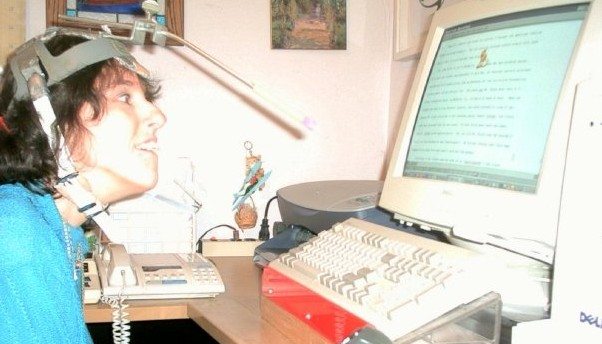
Additionally, since the idea was to use the AAC device away from home, I didn’t (and still don’t) want to use the headpointer out in public for aesthetic reasons (Wearing a helmet with a protruding stick makes me look like I belong in Star Wars!). So, I used my thumb knuckle, which I use to point on my manual communication board, to access buttons on the first AAC device I tried when I was in grade school. When I targeted a single button, I pressed several others with the rest of my hand.
Rosemary Musachio using a head pointer
The idea of AAC devices went on the back burner until I started attending college. Since I didn’t have aides as I did in grade and high school to voice what I pointed to on my manual board, I had to find a way to communicate independently. The Cleveland Hearing and Speech Center set me up with a Light Talker. Each button on the device could be activated with an infrared light. Because I couldn’t hold and manipulate the infrared light pointer, a rehab engineer created an iron-like object that I would drag across the surface and stop at the icon I wanted. Tapping two picture icons were required to say a phrase. For instance, I had to activate the SUN icon and the ELEPHANT icon to say, “I’m happy to meet you.” The Light Talker required users to have photographic minds to memorize all those combinations.
Light Talker
Often the Light Talker stopped working, sometimes in the middle of my forming a sentence. I would look helplessly at my listener until he or she finally understood that the stupid thing died. This would also happen when the plug came out of the pointing device. I used the Light Talker only at school, not at home. Therefore, my manual communication device still was more effective for my personal interactions.
Over the years I’ve tried other AAC devices without avail. I tried scanning where the cursor goes through words or letters. When I wanted to select something, I’d hit a button with my hand so the cursor would stop on an item. Stephen Hawkins uses this method to communicate and operate the computer. Scanning is not for me, however. Either the cursor went too slow that I would forget what I was trying to say in the first place, or it went too fast so I felt like Lucille Ball, working on an assembly line in an “I Love Lucy” episode.
I’ve also tried the eye gaze method. I became excited about it because I assumed it was easy to use. I mean, you stare at an item to activate it through infrared. Well, it isn’t that simple. Your eyes have to be calibrated first. In other words, the device has a camera that takes an image of your iris position so it knows where the infrared light is reflected. If you move your head a lot—as mine usually does–the device continues to recalibrate, causing you not to activate the correct item. Besides not keeping my head steady, I also have one lazy eye that made calibration difficult. Consequently, practicing to use the eye gaze device made me frustrated and tired. Nevertheless, new eye gaze systems have been developed that supposedly improve calibration. I still may try one soon.
Tobii EyeMobile Eye Gaze. Image from www.slashgear.com
Currently, I’m trying the “dot” system on a ChatFusion device. This device still uses infrared. Instead of using my eyes to activate the device, I use an adhesive dot. You can stick the dot anywhere on your body that has the most control and best target position to activate buttons on ChatFusion. I stick it between my eyes since that position allows me to follow the cursor on the screen in relations to my head movement. If I wrinkle my nose, my target range becomes skewed.
Unlike the other devices I’ve used, ChatFusion using the infrared dot has worked so far. Head movements do not have to be calibrated constantly like eye gaze systems. The device can be set according to how much “dwell time” you need to hover over an item to activate it. The device—and it goes with any device—should be positioned correctly so the user can access any item on the screen. For example, if I sit too close, I may not be able to target items at the bottom of the screen well.
Chat Fusion 10. Image from www.Saltillo.com
ChatFusion works better also because I’m investing more practice time. Practicing with someone who I can use the device with to converse engages my attention more than practicing alone. During my practice sessions, I keep telling myself to relax; otherwise, my head becomes one of those bobbing toys in the back of a car. Additionally, I become conscious of how I approach each item with each movement. If I make the cursor slides onto an item from the bottom rather than targeting it in the middle, my head is steadier. The downside is that I may activate other items that I don’t want in the process.
Learning to use an augmentative device takes patience and practice. You need to pace yourself. If you get too tired or frustrated, you need to stop and restart at another time. After 30 minutes using ChatFusion—or any other AAC device—I start losing concentration and my head movements become more random. At this point, I even compose sentences like someone from another planet.
Clearly, my attitude towards electronic AAC devices has changed. Since AAC technology has advanced from 1970’s, I know I will be using a device that will allow me to communicate independently in business and social situations. It may not be Chatfusion; it may be a better eye gaze system or even a brainwave AAC. Once I find the right AAC device and access method, I probably won’t stop talking.
“TAPPING INTO HIDDEN HUMAN CAPITAL,” A NEWLY RELEASED BOOK BY DEBRA RUH, DEMONSTRATES HOW LEADING GLOBAL COMPANIES IMPROVE THEIR BOTTOM LINE BY EMPLOYING PERSONS WITH DISABILITIES
Atlanta, GA. 07/18/2016 —
G3ict, the Global Initiative for Inclusive Information and Communication Technologies announced today the publication of a new book authored by Debra Ruh, G3ict’s EmployAbility Program Chair.
In this book, Tapping into Hidden Human Capital: How Leading Global Companies Improve their Bottom Line by Employing Persons with Disabilities,” Debra Ruh presents a new, game-changing perspective about the employment of persons with disabilities. By documenting existing practices of some of the largest companies in the world, the author shows that employees with disabilities are proactively recruited for their positive contributions to the competitiveness and financial performance of major businesses.
While Debra Ruh documents case studies that are eye-opening, her detailed analysis of the success factors in recruiting, hiring, and managing persons with disabilities are a must-read for any Human Resources professional and top executive of large organizations operating in highly competitive employment markets, such as those in the field of technology.
Debra Ruh’s book guides global corporations, as well as beginning entrepreneurs on how to integrate persons with disabilities in every aspect of the workforce. It takes the reader through each step, from recruiting and interviewing to employing and retaining persons with disabilities in the organization as vital employees. The book offers insights and strategies on how to accommodate employees with disabilities, how to fully leverage their skills and talents, and transform challenges into successes. Additionally, Debra Ruh includes personal accounts from global leaders about how persons with disabilities have enriched their businesses, increased productivity, and lowered turnover rates.
“This is an outstanding compendium of practical solutions for all employers. From large organizations with a global footprint to entrepreneurs with a few employees, attracting and retaining the right talent is the most critical success factor for their business. This book will definitely be looked upon as a milestone in how companies think about recruiting persons with disabilities,” commented Axel Leblois, G3ict President and Executive Director. “We are very pleased to publish Debra Ruh’s latest work and to make it available through all major book distribution channels worldwide.”
Tapping into Hidden Human Capital is available in paper back on the G3ict website.
About the Author
Debra Ruh is a Global Disability Inclusion Strategist and serves as the EmployAbility Program Chair for G3ict, the Global Initiative for Inclusive ICTs. She is a seasoned entrepreneur having founded three firms including Ruh Global Communications, TecAccess and Strategic Performance Solutions. At TecAccess, more than two third of her employees were persons with disabilities, serving as a best practice for many employers. Her client-centric focus and ability to promote successful disability employment programs has created relationships with many multi-national firms including Accenture, AT&T, ATOS, Avanade, Best Buy, Bloomberg, Canon, Capital One, CSC, CVS, Disney, Dell, Deloitte, E&Y, El Al Israel Airlines, HP, IBM, McDonalds, MCI, Merck, Microsoft, TD Bank, Verizon Communications, Verizon Wireless, VMware, Walgreens, and Wells Fargo and many others including United Nations agencies, international governments, federal, state and local agencies.
About G3ict
G3ict – the Global Initiative for Inclusive Information and Communication Technologies – is an advocacy initiative launched in December 2006 in cooperation with the Secretariat for the Convention on the Rights of Persons with Disabilities at UN DESA. Its mission is to facilitate and support the implementation of the dispositions of the Convention on the Rights of Persons with Disabilities on the accessibility of Information Communication Technologies (ICTs) and assistive technologies. G3ict relies on an international network of ICT accessibility experts to develop and promote good practices, technical resources and benchmarks for ICT accessibility advocates around the world. It is incorporated as a nonprofit organization in the State of Georgia, USA, and headquartered in Atlanta. Visit www.g3ict.org.
– See more at: http://g3ict.org/press/press_releases/press_release/p/id_98#sthash.AUP98R9o.dpuf
Rockville, Virginia — Debra Ruh, CEO of Ruh Global Communications Authors Guide Book for Employers on How to Successfully Hire Persons with Disabilities to drive Better Business Results
Debra Ruh – CEO of Ruh Global Communications
Debra Ruh has written her second book entitled Tapping into Hidden Human Capital: How leading corporations leverage multiple abilities in their workforce. Published by G3ict, the book shows how leading corporations successfully hire persons with disabilities to drive better business results. It guides global corporations as well as beginning entrepreneurs on how to integrate persons with disabilities in every aspect of the workforce. It takes the reader through each step, from recruiting and interviewing them to employing and retaining them as vital employees of companies. The book offers insights and strategies on how to accommodate employees with disabilities, reap from their skills and talents, and transform challenges into successes. Additionally, Mrs. Ruh includes personal accounts from global leaders about how persons with disabilities have enriched their businesses, increased productivity, and lowered turnover rates.
Axel Leblois, G3ict, Executive Director
“This is an outstanding compendium of practical solutions for all employers… From large organizations with a global footprint to entrepreneurs with a few employees, attracting and retaining the right talent is the most critical success factor for their business.”— Axel Leblois, President and Executive Director at G3ict
In a few weeks, an e-book version will be available at Amazon, Apple, and other major e-book vendors.
Ruh Global Logo
About Ruh Global Communications: Founded in March 2013, Ruh Global Communications is a strategic digital marketing firm that helps businesses and government entities include persons with disabilities within every level of an infrastructure, from interviewing and hiring to job training and retention. We help countries implement of the United Nations (UN) Convention on the Rights of Persons with Disabilities (CRPD). We also work with national and multi-national firms to help them include persons with disabilities in their workforce and developing accessibility and social media programs, providing outreach and training, and helping companies procure assistive technology. Ruh Global has presented at conferences throughout the world about accessibility and disability inclusion.
About G3ict:
G3ict (Global Initiative for Inclusive Information and Communication Technologies) is an advocacy organization established by the United Nations Global Alliance for ICT and Development in cooperation with Secretariat for the Convention on the Rights of Persons with Disabilities at UN DESA. Its mission is to help implement and support the Convention of Persons with Disabilities regarding ICTs. G3ict raises awareness of public policies of ICT. It also provides information on ICT policies and solutions on its website www.g3ict.org, an electronic newsletter, worldwide databases on country achievements, companies ICT accessibility policies, and case studies, books and white papers from leading authors and institutions on specific areas of technology or public policy. Additionally, G3ict has developed accessibility toolkits and progress reports.
Author: Rosemary Musachio, Chief Accessibility Officer at Ruh Global Communications
Recently, Ruh Global Communications appointed me its Chief Accessibility Officer (CAO). In my role, I will manage internal and external accessibility projects. I will ensure that accessibility best practices will be followed within the company and help clients meet their accessibility needs, including website and product accessibility. I will consult on accessibility and inclusion issues that clients face from the employee to the customer level.
Every business needs to include accessibility in its fabric to become stronger. Otherwise, it will rip and create big gaps. Making every aspect of a company accessible and inclusive increases productivity, embraces diversity with common goals, and promotes more of a positive image to the public. According to Frances West, CAO of IBM, “Today, it affects everyone’s use of a product or service and helps deliver information in the most consumable way possible. Organizations that have embraced and embedded accessibility throughout the enterprise are better connecting with customers, expanding their market reach and creating an inclusive workplace environment where everyone has the best chance of success.”
Since I have cerebral palsy, I bring a personal perspective to my role as CAO. I know what a company needs to do for employees with disabilities to feel accepted and purposeful, and what a business must do to serve customers with disabilities with consideration and respect. Other persons with disabilities have held CAO or similar positions. For example, Microsoft recently hired Jenny Lay-Flurrie as its new Accessibility Director. Becoming deaf from an ear infection during childhood, Jenny will integrate her personal experiences into her new position. As it’s inferred in the article Talk to the Hand, Lay-Flurrie’s motto “You can do anything” is helping Microsoft execute programs to assist persons with disabilities with technologies. For instance, she helped plan Ability Summit, a showcase of products and services to empower them for the future.
Another accessibility executive who has a disability is Jonathan Avila. His vision impairment has brought a personal perspective to his job also. Who else better than a person who cannot see can develop solutions and innovations for users with vision, as well as other, impairments? Avila also serves on WCAG working group and mobility accessibility task force.
You can be skilled at accessibility testing and know all about best practices and guidelines. But the first-hand experience of facing accessibility barriers gives a CAO an extra edge. It brings empathy to the role, making the CAO passionate about helping businesses bulldoze those barriers that other persons with disabilities have encountered.
If a company even creates a COA or a Director of Accessibility position, it is taking a smart business move. With 15% of the world’s population having a disability and $1 trillion in aggregated spending by consumers with disabilities, appointing a skilled COA will allow a business to be more profitable and reputable. If the skilled COA has a disability, it makes the company more credible, sending a strong message to the public that it is serious about accessibility.
Learn more about our work at www.RuhGlobal.com or follow us on Social Media @rosemusachio, @debraruh and @ruhglobal on most channels.
I was disturbed with some of the recent disparaging comments women were making about other women in regards to voting based on gender. Especially women my age and older talking down to younger women. I believe that women should always support women. However, we fought hard for our feminist rights. We continue to fight for our rights. We need women to have equal pay, a place at the C suite, a seat in the board room and so much more.
My work is focused on disability inclusion, accessibility and empowering persons with disabilities. According to the World Health Organization there are over 1 billion people with disabilities in the world or 1 in 7 people. Some countries like the United States are higher. According to the Census Bureau, 1 in 5 persons with the United States are living with a disability. One in five American adults have at least one kind of disability, according to a report from the Centers for Disease Control and Prevention. Released in July 2015. The study, drawn from 2013 data, says 53 million Americans have a disability. “We know disability types and related challenges can vary,” said Elizabeth Courtney-Long, a health scientist with CDC’s National Center on Birth Defects and Developmental Disabilities. “In order to understand and address their needs, we need to understand their diverse circumstances. This report provides a snapshot into that. 1 The Report can be found here
My son and daughter, Kevin and Sara Ruh who has Down Syndrome
Women and girls with disabilities face even bigger barriers and are the victims of two-fold discrimination: as women and as persons with disabilities. Studies conducted by the United Nations women with disabilities are often invisible “both among those promoting the rights of persons with disabilities, and those promoting gender equality and the advancement of women.” 2
Women with disabilities all over the world are shamed, bullied, raped, murdered and treated as if they do not matter. 3 It is past time for all women to be empowered and to support all genders.
Women with disabilities all over the world are shamed, bullied, raped, murdered and treated as if they do not matter. It is past time for all women to be empowered and to support all genders. I have the honor to work with Rosemary Musachio, a brilliant woman and also the Chief Strategic Officer at Ruh Global Communications. Rosemary happens to have been born with Cerebral Palsy. Rose shared her thoughts on this topic with me recently, this is what she said:
“Steinem’s quote is a generalization, which is often detrimental and even dangerous. Her remark may stereotype younger women in a bad light, not caring about anything except self-gratification. If society acquaints this negative image with women who were born after 1990, they may not receive support from other women. They also may not get opportunities that they deserve.
Being a woman with cerebral palsy, I’ve experienced the repercussions of generalization all of my life. The public still automatically links having a disability with not being a productive member of society or my mind being in a wheelchair. Because of this, I constantly have to fight to prove myself. Now, because of Steinem’s comment, millennial women may have to fight to prove themselves.” – Rosemary Musachio, Chief Strategic Officer at Ruh Global Communications
As an undecided voter, I fought for my feminist right to decide on a candidate based on the issues not based on gender. I am also embarrassed of women my age and older telling younger women they don’t understand the fight for equal rights for women. Once while attending a conference for Women Global Leaders, I was talking with several other attendees. One guest brought up how we should be mentoring the younger generation in business leadership. Maybe we could create a program to help millennial women engage with other women on these issues. Several of the women agreed that they would not want to take part in mentoring millennial women. I recall one woman describing young millennials as spoiled, self centered, socially immature and addicted to their devices. I was shocked and commented, “How can you say that? We have fought so hard for women to have a voice. We still have so much work to do.”
How can we decide this of an entire generation? Younger women are not adding value, contributing to the conversation, understand the past fights and are immature? I am personally hooked on social media and my smart devices. I chatter so much on social media about disability inclusion and accessibility for all, that I sometimes stress myself out. The millennial women that I have met are almost always amazing leaders trying to make a huge impact for our world.
As a woman in my late 50’s I meet and work with millennial women all the time. I see many Millennial women highly engaged in social good, social entrepreneurship and “Be-the-Change” type activities. I have met millennial women, including women with disabilities, all over the world that are sacrificing everything to be included. I believe we did not fight this hard for women’s rights to now decide that millennial women do not care for our rights or past efforts. When I speak to young women, they are proud of those who fought for their rights. They look up to these women and it must have really hurt them to hear these comments. I asked the opinion of my Creative Director, Emily Ha. She is a millennial woman whose opinions I’ve come to value. Here’s what she had to say:
Emily Ha – Chief Creative Officer at Ruh Global Communications
“I am a first generation Burmese-American woman who works in the realm of disability inclusion. I advocate for women with disabilities because we all matter and when I say that I’m talking about millennial women as well. Their viewpoint is very unique and at times overlooked. Giving a voice to those who cannot speak for themselves is what I try to do.
I appreciate the struggles of so many human rights advocates from the past, more than I can express. That being said, I am wary of being quick to side with any blanket statement, and certainly don’t appreciate being labeled for having an opinion that may be different. Everyone of us is unique, our experiences and lives differ. Saying that all of one type is like this or that is reductive thinking. Aiding a stereotypical societal view, and one I don’t support. Understanding one another and where people are coming from is tough, but step one is to simply listen before casting judgments. Wouldn’t you assume the same respect of a stranger meeting you for the first time?
Young women are still having to fight those that would limit their voices, freedoms, and equalities. Some Baby Boomers and Generation X-ers have unfairly awarded millennial’s such epithets as “entitled, naïve, coddled, uninformed, lazy, ungrateful, and attention-crazed”. Some even consider millennials to be Tech Savvy to a fault.. But is the vilification fair? We’ve evolved past this ignorance, and we need to stand by our progress.
We should also remember that generational clashes are nothing new. Many past generations of emerging adults have sparked angst and disdain in their predecessors. Even the Baby Boomers had once been labeled the “Me Generation”. Perhaps it’s time we break this pattern and embrace what we each might uniquely offer. – Emily Ha, Creative Director at Ruh Global Communications
We have so many issues to resolve in our world including civil rights for persons with disabilities, climate change, religious freedoms, discrimination, violence and many more issues. I believe it is critical to mentor, empower and encourage younger generations. My generation should support all women of all ages, especially women with disabilities to help them continue to find their voices and join these empowering conversations. Otherwise we may accidentally send the wrong message to others. For example, what messages are we giving to men of all ages especially millennial men? I asked my son, Kevin Ruh a millennial to voice his opinions on this matter.
Kevin Ruh – Chief Marketing Officer at Ruh Global Communications
“Following the campaign news can be tedious. It seems fraught with needless drama and pandering for pandering’s sake. It is a time when we form opinions on who we would like to see become the leader of this country for four years into the future. There are times when I have made quick leaps of faith that people will think the same way as me. At times I am correct, at others I’m dead wrong. Listening to every word out of every potential candidates mouth is not only impossible, but maddening. When someone comes out and makes a late statement, a defining principle, then it is time to really pay attention. Some lost my vote early on by spreading bigoted ideals. I simply cannot support a candidate who is so close minded to human and race relations. When someone tells me that my vote is set to one candidate based on sex they lose my confidence, I support a woman’s right to chose for herself as much as I support anyone’s self choices.
We need to stop falling back into archaic ways, stay alert and listen when it really matters, support the change you want. – Kevin Ruh, Chief Marketing Officer, at Ruh Global Communications
Women should support each other but never take away the right for another woman to vote for someone that has a different gender or opinion than us. Let’s not bully other women that is so sad to watch. Instead we should encourage younger women to find their voice, to have a place at the podium, to fight for their right to decide for themselves. Everyone matters including people like me that are older but please also understand that the Millennials are an amazing generation and they have the ability to change the world and help us evolve.
I am a woman that supports other women. I am a woman that will decide who to vote for based on the candidate that I feel will best lead our country. I am a woman that values diversity. I am a woman that believes that women with disabilities add great value to the world. I am a woman that can think for herself. I am an older woman that is PROUD to work with Millennials to help make the world a more empowering place for all women including women with disabilities. Join us in helping assure that everyone has an empowering voice in our societies especially women and girls with disabilities.
Ruh Global Communications Logo designed by Emily HaDebra Ruh, CEO of Ruh Global Communications, Founder of TecAccess
Many people are surprised to learn just how much of the world’s population is affected by a disability, and how valuable accessible design of electronic and information technology (E&IT) also known as Internet, Communications and Technology (ICT) is to local, state, federal and government, private industry, and educational institutions across the globe.
Making technology usable for all has become imperative for unleashing the potential of all and is critical for any organization wishing to remain relevant in the 21st century. Technology is accessible if it can be used just as effectively by people with disabilities – including the elderly and veterans with disabilities – as it can by those without. Half of the world’s population is impacted by a disability in some fashion, making accessible design critical to private industry, government, and educational institutions.
To understand the impact one has to look no further than the World Health Organization which indicates that people with disabilities are the world’s largest and fastest growing minority group. With the population of the United States aging, and the likelihood of developing a disability or other mobility limitations increasing with age, the growth in the number of people with disabilities can be expected to rise dramatically. Also impacting this formula is the growing population of veterans with disabilities.
The World Health Organization (WHO, 2003) indicates that people with disabilities are one of the largest and fastest growing minority groups. Public and private entities that make their technology accessible can reach and better serve an untapped and underserved market, a demographic that represents both spending and voting power, a population that exhibits a strong desire to learn and improve despite facing physical and developmental challenges (The Solution Marketing Group, 2007).
Around the world more than 750 million people with disabilities are gaining recognition as a significant and growing market for products and services, and they are making their needs and expectations known to governmental bodies, organizations, and businesses. Using information and communication technology that is accessible is the fastest way in which to reach and serve people with disabilities and the elderly in an equal fashion as those without disabilities.
A “Digital Native” image by Raminta Zebrauskas of AMAC Accessibility
Millions of people with disabilities regularly travel, shop, go to school, and eat out with family and friends. A study by the U.S. Department of Education found that one in three households in the U.S. is affected by a disability. The 2000 U.S. Census reported that almost 42% of older adults (65+ years) have one or more disabilities. In fact, in the US the percentage of people with disabilities is larger than any single ethnic, racial, or cultural group. At 19.3%, the number of people with disabilities exceeds the next largest group — Hispanic people (14.9%) — by a fairly wide margin (U.S. Department of Justice, 2005).
Harmonization of state, federal and international accessibility legislation, regulations and standards offers the promise of constraining the cost to vendors to test and certify E&IT product compliance to diverse sets of otherwise similar accessibility guidelines. Consumers of all abilities benefit from the reduced cost of bringing accessible E&IT products to market when harmonization of accessibility laws, regulations and standards is embraced.
An inclusive and universal design approach to technology is critical to both government agencies and private industry wishing to anticipate future needs of this growing population. By recognizing the importance of the protection and promotion of the rights and dignity of persons with disabilities through assistive technology, the world is just beginning to strengthen policies, strategies, and programs along with an increase in awareness of the public at large of the importance of the issue of disability and assistive technology.
Where environmental and privacy issues are more homogenous, issues around E&IT tend to be more disparate. Due to the many types of disabilities and age-related impairments, one size accessible product solution does not fit all.
Providing accessible E&IT products, web and non-web-based information and services also benefits the growing population affected by age-related impairments, in addition to people with disabilities.
“Underlying the legal and practical realities of the ‘information age’ is the recognition of the vast capacity of accessible technology to unlock human potential, to tap into great reservoirs of intellect and ability that have gone largely untapped until now, and to maximize productivity and performance for all,” says John Kemp, a leading disability law expert and CEO of Abilities! A NY based non-profit that supports people with disabilities. www.abilitiesonline.org
Nations across the world are currently adopting new laws prohibiting discrimination on the basis of disability, as well as increasing the protection of civil rights for people with disabilities and expanding freedoms for all.
Demand for accessible technology and services will continue to rise as well as the public’s understanding of, and requirement for, technology that is usable by every citizen. (Forrester Research 2003.)
To comply with guidelines and to include this valuable group of consumers, it is important that all diversity and HR processes, information, communications and technology (ICT), product development and service touch points are fully accessible to everyone. This includes mobile technology, kiosk, software, documents, social media (Facebook, Twitter, blogs, etc.), websites, and other forms of communications. The need to be accessible grows as our reliance on technology and use of social networks increases.
For further information about TecAccess and their current endeavors, visit their website at SSB Bart Group
To follow up on Debra Ruh’s current endeavors, follow her on social media: @DebraRuh or visit Ruh Global Communications
TecAccess, Making the world of technology accessible
Abstract: Technology is accessible if it can be used just as effectively by people with disabilities as it can by those without. Many people are surprised to learn just how much of the world’s population is affected by a disability, and how valuable accessible design is to government, private industry, and educational institutions.
Rosemary Musachio using a head-pointer, which is simply a pointing stick mounted on a head strap that she uses to interact with a keyboard or a touchscreen.
To understand the impact one has to look no further than the World Health Organization which indicates that people with disabilities are the world’s fastest growing minority group. With the world’s population aging and the likelihood of developing a disability or other mobility limitations increasing with age, the growth in the number of people with disabilities can be expected to rise dramatically.
An inclusive and universal design approach to technology is critical to organizations wishing to serve the disabled population, and to tap into the many possibilities now made available through advancements in assistive technology.
The purpose of this paper is to review current and pending Worldwide Electronic and Information Technology (E&IT) Accessibility trends, regulation, standards and guidelines and understand their impact on the end user. The objective is to identify and analyze significant issues, risks and opportunities and to develop recommendations to assist E&IT decision makers in planning and positioning so that to take advantage of opportunities.
This paper will provide a baseline for monitoring trends in each of these areas and a repository of legislation, regulation, standards, guidelines and best practices to guide E&IT researchers in making decisions with regard to the accessibility of E&IT products, programs, services and information.
1. Introduction
Accessibility Key, image from AMAC Accessibility Solutions www.amacusg.org
Yet many people are still surprised to learn just how much of the world’s population is affected by a disability, and how valuable accessible design is to private industry, government, and educational institutions.
To understand the impact, one has to look no further than the World Health Organization (WHO) (2003) which indicates that people with disabilities are one of the largest and fastest growing minority groups. It is becoming clear that public and private entities who make their technology accessible can reach a largely untapped and underserved market, a demographic that represents both spending and voting power, a population that exhibits a strong desire to learn and improve despite facing physical and cognitive challenges (The Solution Marketing Group, 2007).
Approximately 750 million people live with disabilities of various types, says the World Health Organization (2003), and the number is increasing due to the rise of chronic diseases, injuries, war, car crashes, falls, violence and aging.
In recent years the international community has recognized the importance of reliable information on various aspects of disability prevention, rehabilitation and care, and most importantly the need to invest in assistive technology services that can ensure equality of opportunities and good quality of life for persons with disabilities.
As an example, the United Nations’ Millennium Declaration; the United Nations’ Standard Rules on the Equalization of Opportunities for Persons with Disabilities; International Classification of Functioning, Disability, and Health officially endorsed at the Fifty-fourth World Health Assembly in 2001; the United Nations World Programme of Action concerning Disabled Persons; the African Decade of Disabled Persons, 2000-2009; the Asian and Pacific Decade of Disabled Persons, 1993-2002; the New Asian Pacific Decade of Disabled Persons, 2003-2012; and the European Year of People with Disabilities, 2003 (United Nations Statistics Division, 2007).
An inclusive and universal design approach to technology is critical to both government agencies and private industry wishing to anticipate future needs of this growing population. By recognizing the importance of the protection and promotion of the rights and dignity of persons with disabilities through assistive technology, the world is just beginning to strengthen national policies, strategies, and programs along with an increase in awareness of the public at large of the importance of the issue of disability and assistive technology.
2. Findings
There are many types of disabilities:
Debra Ruh, Founder of TecAccess and CEO & Founder of Ruh Global with her daughter and inspiration, Sara Ruh who was born with Down Syndrome
Blindness and visual limitations
Deafness and hearing limitations
Speech limitations
Mobility limitations
Multiple limitations
A person with any one – or even all – of these disabilities can still enjoy the many benefits of goods, products, business, governmental services, and education when organizations take into consideration a few key points (National Institute on Disability and Rehabilitation Research, 2004).
Often times some of the most simple and cost effective solutions are ignored or overlooked, a mistake that organizations can no longer make when trying to attract, serve, and retain this loyal consumer base.
Many related laws, regulations and standards (LRS) for accessibility of electronic and information technology (E&IT) currently exist and are gaining significant recognition.
Most notably:
World Wide Web Consortium (W3C) Web Guidelines
Section 508 of the Rehabilitation Act of 1973, as amended
Section 255 of the Telecommunications Act of 1996
Americans with Disabilities Act of 1990
The Disability Discrimination Act (DDA) of the United Kingdom
The Federal Disability Discrimination Act of Australia (1992)
Canadian Human Rights Act of 1977
World Wide Web Consortium (W3C) Web Guidelines.
There is an increase of new accessibility laws, regulations, and standards being developed across most geographic regions of the world, in particular EMEA and Japan. However, it is widely publicized that these efforts are not being developed in a unified and consistent manner and therefore reports of fragmentation of these standards has become a major issue (United Nations Statistics Division, 2007).
Fragmentation of accessible E&IT laws, regulations, and standards is prevalent across all geographic regions, countries, and states. As a result, fragmentation has driven up costs due to E&IT vendors needing to develop and test their products to multiple standards, creating longer lead times for industry and consumers, and establishing a need for global standards harmonization.
Formalization of standards or efforts to create a “certification of compliance” vs. a “self declaration of conformance” for accessible E&IT products and services may continue to guide standards towards fragmentation. Risks associated with formalization of certification include; restricted innovation, increased costs, and delayed time to market.
Individuals and consumer groups are using non-E&IT legislation; Americans with Disabilities Act of 1990, the Disability Discrimination Act (DDA) of the United Kingdom and the Federal Disability Discrimination Act of Australia (1992), to satisfy E&IT accessibility-related grievances. These initiatives drive the momentum of E&IT accessibility standards.
Identification of key “players” to monitor, for example, governments and organizations whose efforts may realize the greatest impact on the adoption of common E&IT accessibility laws and standards.
Where environmental and privacy issues are more homogenous, issues around E&IT tend to be more disparate. Due to the many types of disabilities and age-related impairments, one size accessible product solution does not fit all.
Providing accessible E&IT products and services also benefits the growing population affected by age related impairments in addition to people with disabilities.
3. Opportunities
“Digital Native” image by Raminta Zebrauskas of AMAC Accessibility
Demand for accessible technology and services will continue to rise as governments move to meet the needs of citizens. According to Forrester Research (2003), there are several notable opportunities currently available for those successfully involved in this endeavor:
Provide and market accessible E&IT products and services as a market differentiator.
Leverage the growing global population of aging users of technology – E&IT as a separate market segment by providing accessible products and solutions.
Leverage accessibility solutions for the growing needs of mobile computing, i.e. PDAs, cell phones, low-bandwidth areas.
Sale of third party Assistive Technology products.
Gain loyalty of users of accessible products and features.
Working with enterprises that need to provide accommodations for their employees.
Web and Software Accessibility consulting opportunities which include provisions for design, remediation and services with specific public sectors.
Accessibility consulting opportunities which include provisions for design, remediation and services.
Partner with other 3rd party web consulting services.
Provide an all inclusive E&IT/Web Accessibility “solution package” to include standard products bundled with assistive technology products, and provides for installation, training, and support.
Improve efficiency and ease of use for all end users.
4. Defining the Market
Now that accessibility is evolving into a sound organizational practice for private industry and an efficient method of service delivery for governments, it is critical to be able define the growing market, and most important – understand how to reach this untapped consumer base.
Around the world more than 750 million people with disabilities are gaining recognition as a significant and growing market for products and services, and they are making their needs and expectations known. Using information and communication technology that is accessible is the fastest way in which to reach people with disabilities and the elderly.
A person with a guide dog after boarding a plane. Image from www.transportation.gov
Millions of people with disabilities regularly travel, shop, go to school, and eat out with family and friends. A study by the U.S. Department of Education found that one in five households in the U.S. is affected by a disability (US Census Bureau, 2003). The 2000 U.S. Census (nd) reported that almost 42% of older adults (65+ years) have one or more disabilities. In fact, in the US the percentage of people with disabilities is larger than any single ethnic, racial, or cultural group. At 19.3%, the number of people with disabilities exceeds the next largest group — Hispanic people (14.9%) — by a fairly wide margin (U.S. Department of Justice, 2005).
In the UK, CSR Europe (n.d.) estimates that 8.6 million people (aged 16 and over) self-indentify as having a disability, which translates into 15% of the population. By the year 2010, 40% of the UK population will be over 45 – the age at which incidence of disability increases. Those over 50 years of age currently account for one fifth of the UK population, and they own more than 80 percent of the country’s asset wealth and are the group most likely to vote in general elections. Surprising to some, 33% of 50-60 year olds now have a disability.
A Man with a disability receiving aid from an assistive canine while shopping . Image from: http://millennialmagazine.com
As pointed out by the U.S. Department of Justice (2005), as these numbers continue to grow, so does the spending and voting power of persons with disabilities. Examples of the global spending power of people with disabilities include:
United Kingdom: The Institute of Employment Studies reported that in 1999, Britons with disabilities had a disposable income total of £80 billion.
United States: The President’s Executive Committee on Employment of People with Disabilities says individuals with disabilities control well over $220 billion in discretionary income.
Australia: The Australian Bureau of Statistics estimated that Australians with disabilities have a discretionary income of at least AUS $26 billion.
Canada: The Conference Board of Canada reported that the combined annual disposable income of working-aged Canadians with disabilities was a minimum CAN $25 billion.
This growing demographic now represents additional business and profit for private enterprise, and a swelling consumer base for government agencies. Accessibility attracts not only people with disabilities, but also their families and friends. Like anyone else, people with disabilities often visit stores, restaurants, movie theaters, and other businesses accompanied by family or friends. This expands the potential market exponentially (The Solutions Marketing Group, 2007).
Recent trends demonstrate that everyone – people with and without disabilities — benefit when businesses give customers with disabilities an equal opportunity to obtain their goods, and governments provide equal access to services. By positively recognizing people of all ability levels — businesses, schools, and government agencies can make it easier for people with disabilities, as well as others, to more easily access and purchase the services or products they have to offer. In other words, accessibility pays dividends and makes good business and organizational sense.
Making it possible for customers with disabilities to access your goods and services is not only an important part of complying with international accessibility standards, but is also an important part of any organizational management plan.
A historical perspective of the advancements in accessibility shows that in the past we have built ramps and elevators in lieu of stairs for people with disabilities to better access goods and services. As the online landscape becomes a more critical aspect of daily life, it is now time that we build ramps to technology as well.
5. Perspectives from the Field
TecAccess, an international accessibility consultancy, recently conducted a brief survey to sample the opinions of people with disabilities when working with businesses, government agencies, and schools.
A sample of the responses included:
“There is a general lack of awareness about how people with disabilities function,” was the most common statement.
“There is little knowledge about how to write and speak with and about people with disabilities” was another.
“Most people are deficient in knowledge about assistive technologies.”
“There is a lack of patience in interacting with people with disabilities.”
“People don’t listen” or are “Too quick to try to reach a solution without understanding the problem.”
“No assistance for on-hand staff to answer questions and walk you to a specific area.”
“There are typically a lack of shopper assistants, mobility devices, and bar code scanners for people who are blind.”
“There is a deficiency in employee training with regard to disability awareness.”
“Some organizations don’t accept relay calls for people who are deaf or hard of hearing.”
“There is a lack of knowledgeable about accessibility features and devices.”
Moving forward, it is important to understand such responses in order to truly comprehend this audience. A key element to this critical step is to know the basic functionality of standard assistive technologies used by people with disabilities.
In its most general form, “assistive technologies” refers to variety of technology used by people with disabilities such as screen readers, speech recognition, and Telecommunication Devices for the Deaf (TDD) or TTY. By becoming familiar with these devices organizations can better understand how people with disabilities access and use programs, products, and services.
There are many types of assistive technology used by people with disabilities.
Examples include:
Augmented Output Devices
Screen readers (JAWS, Window Eyes)
Screen Magnification (MAGic, ZoomTEXT)
Braille displays
Visual representation of auditory information for people who are deaf or hard of hearing
Augmented Input Devices
Voice recognition (Dragon Naturally Speaking)
Student with headset using Dragon Naturally Speaking on a Laptop Image from www.setbc.org
Alternative keyboards
Alternative pointing devices
There are as many accommodations and assistive devices as there are forms of disabilities. It is therefore important not to forget that limitations come in many forms and organizations should be prepared to confront the many possibilities.
Its assistive technology examples such as these that demonstrate how services, programs, and products are not truly accessible until they are usable by everyone—this includes people with and without disabilities, many of whom use assistive devices. Best of all, accessibility aids more than those with disabilities.
It also aids:
Seniors using Social Media. Image from blog.sysomos.com
an active aging population
people who speak another language
people with low vision
people with learning disabilities
people with low bandwidth
In other words, accessibility assists everyone.
It is therefore critical for businesses, government agencies, and schools to understand the common problems encountered by people with disabilities. For example, if an organization is web-based or uses an IT component as part of sales management and customer outreach, then they should integrate all systems by configuring requirements and issues between assistive technologies used by consumers with disabilities (National Telecommunications and Information Administration, 2000).
This is actually much simpler than it sounds. There are numerous easy-to-implement and cost effective solutions that allow people with disabilities to easily navigate IT systems. This holds true naturally for all manners of communicating with individuals with disabilities – whether it is over the phone, in person, by mail or onsite. Most, if not all of potential issues, can be eliminated or improved upon by proper training of employees and staff that interact with people with disabilities, as well as marketing and sales teams that address consumers. This goes back to simply knowing your audience, their needs, and their challenges (NCI, nd).
6. Who’s Doing it Right?
Bart Simpson writing on a chalkboard- “I will adopt Best Practices”. Image from www.seeksafely.org
Best Practice Examples:
Hewlett Packard’s goal is to develop technology that can meet the growing demand and expectations of consumers worldwide, including people with disabilities and age-related issues.
HP provides extensive Executive Support:
For example, accessibility has become “proceduralized” at all levels of HP – from management to marketing – which maximizes the company’s potential to develop truly accessible electronic and information technology products.
HP uses what they call the “Total Customer Experience” or TCE. HP looks at all of the touch points, from how a customer selects their product, to how the customer will use their product.
HP also stresses Self Conformance – though not required by law, HP designs all products and websites towards Section 508 and W3C guidelines.
HP provides detailed VPATs/Supports the Buy Accessible Wizard – HP provides summary-level and detailed VPATs for all products through an online VPAT Database, and provides accessibility/VPAT information for all products through the GSA Buy Accessible Wizard (BAW).
HP logo. Image from www.hp.com
HP’s AT Partner Program – HP partners with over 50 AT vendors to develop assistive technology on HP technology (desktops, notebooks, handhelds, printers, scanners, etc). HP tests AT products and includes those results in their VPATs, and HP supports Microsoft and AT vendors in reporting their applications to next generation operating systems.
Similar to HP, IBM has also invested years in research to better understand the needs of people who experience a wide range of physical impairments or other difficulties that can affect their computer use and they continue to do so.
IBM logo. Image from www.ibm.com
IBM is an industry leader, serving as a best practice:
IBM’s slogan – Innovation for everyone. Enough Talk. Let’s Make it Happen. IBM has demonstrated an understanding of the wide range of differences and abilities of computer users, and has turned questions of accessibility upside down. “Instead of creating a world of ideal forms to which we then find ways for people to adapt themselves,” IBM asks, “Shouldn’t we be adapting the world to the people.”
IBM has pioneered the cause to open the world of information technology (IT) to more people, regardless of ability or disability. IBM’s long-standing commitment to people with disabilities began in 1914 when IBM hired its first employee with a disability, 76-years before the Americans with Disabilities Act (ADA). From its fair hiring practices, to its dedication to making products and services accessible, to its commitment to research, IBM has been an industry leader in the accessibility arena for more than 50 years.
For these efforts, IBM is the winner of the 21st Century Business Partner Award by Goodwill International. In addition, IBM is the winner of the Helen Keller Award, and countless Disability Employment Awareness Awards and Business Awards for Partnership Programs with People with Disabilities. Employees such as IBM’s Sr. Project Manager have received such distinctions as the National People with Disabilities Professional Achievers Award from the President of India.
What began early on as a philanthropic effort has evolved into a business transformation effort for IBM and its clients. IBM, along with all of private industry, is now seeing both the public and private sectors driving accessibility adoption.
In 2000, IBM merged existing accessibility groups to form a worldwide Accessibility Center with locations in the United States, Europe, Japan and Australia. The Accessibility Center fosters product accessibility, works toward the harmonization of worldwide standards, applies research technologies to solve problems experienced by people with disabilities, creates industry-focused solutions and generates accessibility awareness.
Helping people with disabilities access IT requires innovative technology. As part of the IBM Research organization, the Accessibility Center has a direct line to the scientists developing new technology. After promising ideas emerge from IBM Research, the Accessibility Center works with influencers, advocacy groups and clients to pilot these technologies. Successful pilot programs are turned into offerings that help more people access IT – regardless of ability or disability.
As accessibility has evolved into a business transformation effort, IBM has remained dedicated to recruiting and hiring people with disabilities and helping them to be successful in the workplace. IBM advocates for people who have disabilities by instituting and maintaining favorable hiring practices and sponsoring education and employment programs.
Similar to the success of IBM and HP, there are plenty of other best practices to be found within the U.S. Federal Government. The U.S. Patent and Trademark Office is one such accessibility success story. In fact, the USPTO has hired over 60 federal employees with disabilities due to their success.
The USPTO and its skilled employees today train vendors that do business with the government so that they too can “procedualrize” Section 508 and other accessibility law into their agency or business.
To assist in this process, the USPTO hosts hundreds of free training courses each year.
In 2005, over 2,000 participants – government employees as well as private contractors – received training in everything from accessible software and web development, to telecommunications and PDAs.
As a result, the contractors and vendors that participated in the accessibility trainings produced products faster, better, and cheaper than those that did not learn the benefits of accessible design.
The end result – accessibility is the law; but it also saves money, increases productivity, and improves the quality of the end product.
USPTO believes that the accessibility process should start from DAY 1. As a vendor begins to create their product, the USPTO will evaluate the progress so that there are no surprises when the product is finally tested.
The “evaluation team” keeps vendors on schedule, saving them time and money, so that the product is compliant before testing – opposed to other federal agencies that evaluate after testing, causing vendors to have to retrofit later.
Because of the USPTO’s standardized approach, private industry and government are more productive and fiscally efficient.
In fact, because of their ability to “standardize” Section 508 compliancy, the USPTO saves $19,000 per person a year, proving that it pays to make reasonable accommodations.
The USPTO calculates their cost savings now that they are building compliance up front and don’t have to pay for remediation and retrofitting. They have embraced Section 508 and other accessibility law from the beginning.
For these efforts, the USPTO earned the “Federal Government Best Practice for Outstanding Individual Federal Team,” and its E&IT Coordinator received the “Change Agent” Award by the Office of Civil Rights.
7. Results
By implementing some of these very simple and cost effective strategies, organizations can anticipate setting themselves apart – creating a market differentiator.
Organizations can increase government services and sales by demonstrating and documenting product accessibility.
Organizations can leverage a new market segment by demonstrating their leadership in the growing accessibility movement, and therefore capture a valuable consumer base that is currently up for grabs.
Organizations can increase their public image and socially conscious standing by demonstrating their embrace of all people – those with disabilities, those without disabilities, as well as those who may be aging and acquiring a disability for the first time in their lives.
Enables organizations to use accessible products to recruit and hire from an untapped, qualified labor pool.
Organizations will also gain loyalty of users and positive brand recognition from those who rely on their accessible products and services.
8. Recommendations
In carrying forward this message; there are key factors in developing a successful plan to promote your dedicated accessibility efforts.
First, you must promote your accessibility solution up front. Use it to set your organization apart, leverage the steps that you’ve taken, be proud of them, and make sure others are aware of your efforts.
Get the “right” people involved. Create an accessibility team, or host of experts on the topic. Partner with experts in the field, and whenever possible, ask a person with a disability how you’re doing – using a person with a disability to test the accessibility and usability of your product will allow your organization to use a firsthand perspective as to what does and does not work.
Become a trusted advisor, set yourself apart as experts on this topic, and leverage this knowledge to attract new customers, new employees, and new partners.
Understand the end user’s motivations and requirements. Understand that this market is no different from the rest of us.
There is also an increasing need to educate everyone from front line staff up to top level management in disability awareness and in some of the difficulties people with disabilities might encounter with your program, products, and services. It is important to educate these employees with such information so that they become more efficient, more comfortable, and more sympathetic to the concerns of people with disabilities.
Many issues relating to disability awareness and accessible technology can be fixed by properly training your employees and staff that interface with consumers. Topics should include:
Understanding the different types of disabilities and common issues relating to each area.
Be aware of hardware and software used to support these disabilities.
Understand system requirements and configuration issues between assistive technology and IT.
Present troubleshooting tips, checklists, and process for problem escalation.
Provide disability awareness training – for example, disability awareness training that uses simulation exercises works best, (such as putting people in wheelchairs or blindfolding them) in order to allow non-disabled people to have an idea of what having a specific disability may be like.
Lastly, it is important to remember that an organization’s accessibility efforts represent a unique selling proposition and proof point. It is therefore beneficial to promote your “disability-friendly story” based on your successful accessibility history and commitments. Promote your knowledge regarding disabilities and accessibility, emphasize your awareness of international disability movements, and publicize your accessible product knowledge.
9. Summary
In order to improve services and interaction with people with disabilities, it critical to understand and have the data in place that is representative of today’s market. The changing landscape of our current marketplace has resulted in a dramatic increase in the number of people who have disabilities and those acquiring disabilities for the first time in their lives as our population ages (Siegel, 1996).
It is now imperative that organizations understand and utilize assistive technologies while providing disability-friendly services, accessible solutions, and universally designed options for consumers and potential new consumers with disabilities and those with age-related limitations.
The advantages of effectively reaching people with disabilities are clear. If your goods and services prove to be functional and adaptable, and your support staff are familiar with and able to work with people with disabilities, then your organization stands to gain a tremendous marketplace advantage as this population continues to boom. In turn, organizations will increase loyalty to their goods and services, and ultimately their brand. Investing in relationships increasingly requires understanding of how to connect to consumers – with and without disabilities, as well as those who self-identify with having a disability, and those who do not. The benefits of attracting and maintaining consumers with disabilities extends beyond a niche audience, and moves firmly into supporting the needs of all people.
As people with disabilities drive the creation of new communities, they are forever changing the way we live, learn, work, and play. Increasingly, organizations are expanding their presence into emerging markets. Organizations are now serving populations that they have never before served. Every consumer is different. No two people have the same exact set of learning-styles, abilities, experiences, or educational background.
Good organizational management practices dictate that schools, businesses, and governments avoid unintentionally excluding large groups of consumers from accessing and using their product and service. Therefore, designing your goods and services with people with disabilities in mind can significantly increase the size of your audience, as well as the way in which you treat and manage your audience.
In conclusion, it is recommended that the reader remember and implement these examples and success stories, and to look within their respective organizational environments. Think about what you can do to better reach people with disabilities, and find creative ways to make it happen through accessible technology.
For further information about TecAccess and their current endeavors, visit their website at SSB Bart Group
To follow up on Debra Ruh’s current endeavors, follow her on social media: @DebraRuh or visit Ruh Global Communications
References
CSR Europe, (N.D.), Disability: Facts and figures, Retrieved March 1, 2007, from http://www.csreurope.org/csrinfo/csrdisability/DisabilityFactsandfigures/Forrester Research, (2003). The Market for Accessible Technology, Retrieved March 1, 2007, from http://www.microsoft.com/enable/research/phase1.aspx
National Telecommunications and Information Administration, (2000, October). Falling Through the Net: Toward Digital Inclusion, Retrieved March 1, from http://www.ntia.doc.gov/ntiahome/fttn00/Falling.htm#61
National Institute on Disability and Rehabilitation Research, (2004). NIDRR Chartbook, Retrieved March 1, 2007, from http://www.infouse.com/disabilitydata/workdisability.html
The Solutions Marketing Group, (2007). Benefits of disability marketing, Retrieved March 1, 2007, from http://disability-marketing.com/facts/
United Nations Statistics Division, (2007). Human Function and Disability, Retrieved March 1, 2007, from http://unstats.un.org/unsd/demographic/sconcerns/disability/disab2.asp
U.S. Census Bureau (2003). Anniversary of Americans with Disabilities Act, Retrieved March 1, 2007, from http://www.census.gov/Press-Release/www/2003/cb03ff-10.html
US Census Bureau (n.d.). American Fact Finder – Disability Data, Retrieved March 1, 2007, from http://factfinder.census.gov/home/saff/main.html?_lang=en
U.S. Department of Justice, (2005). Expanding Your Market: Customers with Disabilities Mean Business, Retrieved March 1, 2007, from http://www.usdoj.gov/crt/ada/buisstat.htm
World Health Organization, (2003). “Access to Rehabilitation for the 600 Million People Living with Disabilities,” Retrieved March 1, 2007, from http://www.who.int/mediacentre/notes/2003/np24/en




(2).jpg "Hidden Human Potential cover") In this book, Tapping into Hidden Human Capital: How Leading Global Companies Improve their Bottom Line by Employing Persons with Disabilities,” Debra Ruh presents a new, game-changing perspective about the employment of persons with disabilities. By documenting existing practices of some of the largest companies in the world, the author shows that employees with disabilities are proactively recruited for their positive contributions to the competitiveness and financial performance of major businesses.
In this book, Tapping into Hidden Human Capital: How Leading Global Companies Improve their Bottom Line by Employing Persons with Disabilities,” Debra Ruh presents a new, game-changing perspective about the employment of persons with disabilities. By documenting existing practices of some of the largest companies in the world, the author shows that employees with disabilities are proactively recruited for their positive contributions to the competitiveness and financial performance of major businesses.


