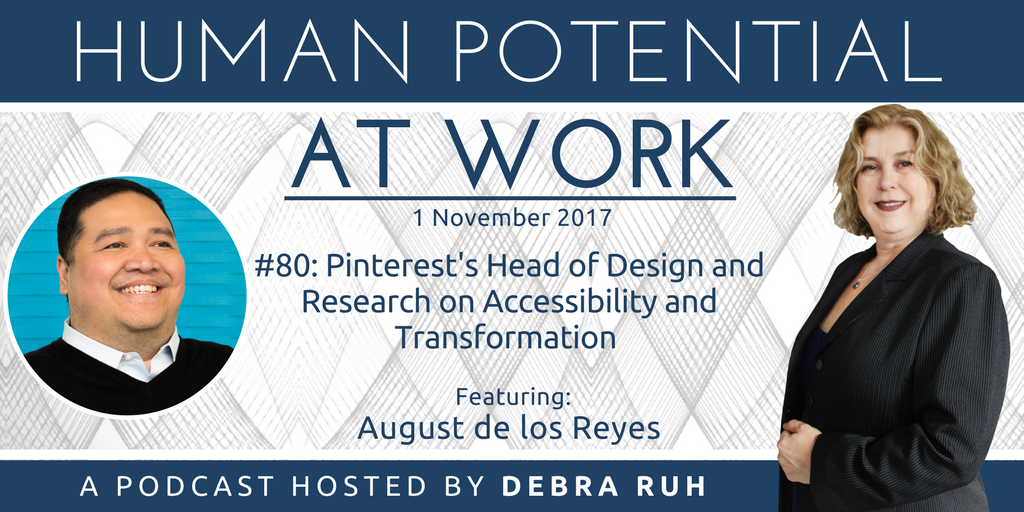
Episode Flyer for #80: Pinterest’s Head of Design and Research on Accessibility and Transformation
August de los Reyes, head of design and research at Pinterest, discusses accessibility through better design, and why he left his position as the lead designer of XBox to work at Pinterest. August discusses the ways in which Pinterest empowers its users, and shares real world examples and stories that illustrate the transformative power of Pinterest. August also discusses disability as a design problem and why better design benefits everyone.
Episode Flyer for #81: Realizing your full Human Potential
Leadership coach and speaker Kelly Meerbott joins the program to discuss how she helps her clients grow and become the best version of themselves. Kelly also shares the practices that she uses for her own personal growth and discusses her work with Ken’s Krew, an organization that helps persons with disabilities to successfully enter the workforce and find meaningful employment.
The media always has had a tremendous impact on molding public view about persons with disabilities (PWD). Until twenty years ago, the media portrayed us as helpless, heroic, or mean. It did not show us as people who held jobs, were in romantic relationships, or raised families. These portrayals are based on Dark Ages perceptions of us. PWDs were institutionalized or hidden away in the back room. If a PWD managed to overcome obstacles, such as FDR, they did not publicize that they were disabled.
Elephant Man Poster
For example, such films as “The Elephant Man”, “Born on the Fourth of July”, “The Glass Menagerie”, and “The Waterdance” all depict characters with disabilities who are down on themselves, who are programmed to think they are worthless in society’s eyes. Their negative self-images cast shadows over the viewing audience’s perspective towards us. Scenes of the poor helpless disabled resonate in a viewer’s mind if it is not open. These types of movies run the risk of making employers ask themselves “Why would I want to hire someone like that?”. They dissuade other persons to interact with us.
At the other extreme, movies like “Rain Man”, “My Left Foot”, and “Rear Window” show persons with disabilities as heroic, as having some kind of God-given power to solve problems that nobody else or to be renown for some great feat. While this may boost our egos, the hero concept can place pressure on us. I’ve experienced this throughout my life. I’ve been expected to be the Wonder Woman of the Intellect because I’m intelligent with disabilities, not just because I’m an intelligent person. Being looked upon as a hero also gives the false assumption that we don’t need assistance or accommodations.
Persons with disabilities also have been portrayed as ill-spirited. Mr. Potter in “It’s A Wonderful Life”, for instance, is a banker in a wheelchair who is greedy and mean. Another example is Peter Sellers’ “Dr. Strangelove, an evil scientist who also is in a wheelchair. The stereotypical role gives the perception of being disabled makes someone mean or unfriendly. Again, this perception may seep into people’s subconscious, especially those of children. They may see mean fictional characters with disabilities, such as Captain Hook in “Peter Pan”, Quasimodo in the “Hunchback of Notre Dame”, and Darth Vadar in “Star Wars”; and then they may be frightened to approach real persons with disabilities.
Yet, the media finally emerged from the dark ages. Movies and television shows have started
Reasonable Doubts Cast
portraying us in a much more positive light in the last twenty years. For example, an actual actress who is deaf (Marlee Martlin) played an assistant district attorney who is deaf in “Reasonable Doubts”. Other examples include a policeman who is in a wheelchair in “Cagney and Lacey”, a doctor who walks with a cane in “House”, and a paralyzed professor in “Professor X”, just to name a few. The movie “Intouchables” even portrays a rich quadriplegic who ends up paragliding and getting a girlfriend.
Nowadays actors with disabilities also are earning awards for television and movie roles. At the recent Emmy Awards, Peter Linkage won the Best Supporting Actor Award for Games of Thrones. Dinklage has dwarfism, yet his disability actually helped land his role. Marlee Marlin, mentioned above, earned an Oscar and Golden Globe for Best Actress for “Children of A Lesser God”, where she portrays a deaf cleaning woman whose intelligence is discovered by a special education teacher.
Although no scientific studies have been conducted between public perspective of persons with disabilities and their portrayals in the movies, seeing positive images of us in the media can only foster further integration in society. Businesses are more motivated to employ us if they view us as doctors and lawyers on the movie and T.V. More beauty and sex appeal are attributed to us if more we are shown as caring, loving, and sexual on the small and big screen. If the entertainment industry wouldn’t focus on the disability but on the characters who just happens to be disabled, then society would follow suit.
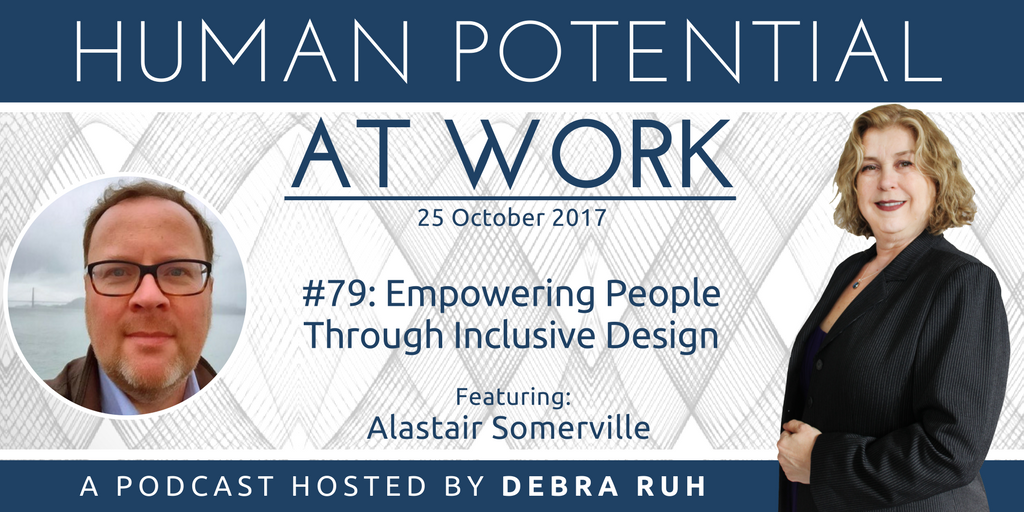
Episode Flyer for #79: Empowering People Through Inclusive Design
Sensory design consultant and workshop facilitator Alastair Somerville, joins the program to discuss how inclusive design benefits everyone, not only persons with disabilities. Alastair shares his thoughts about how to improve design and make it more responsive for all, as shares stories from his own design projects.
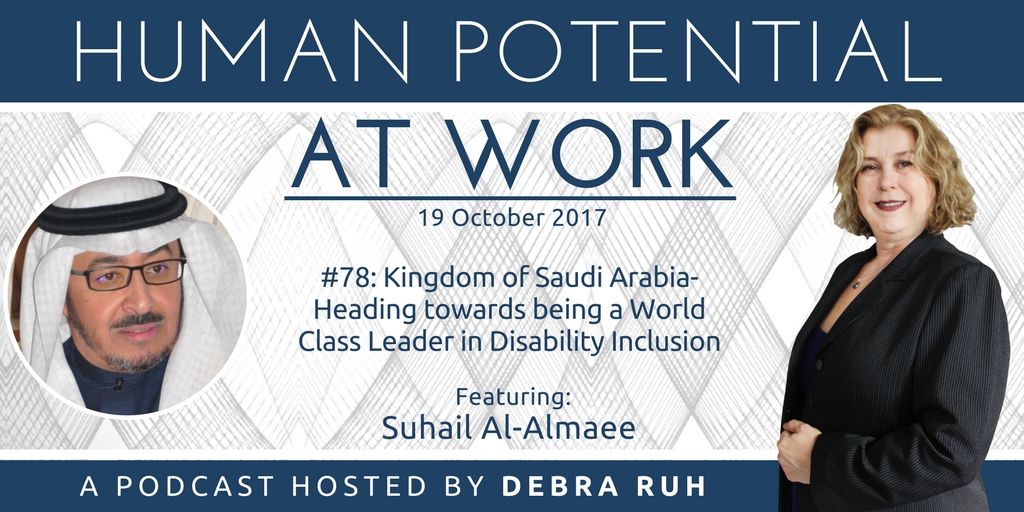
In this special episode, recorded live in The Kingdom of Saudi Arabia, Debra speaks with Engineer Suhail Al-Almaee as he discusses the efforts that his country is making to become a world-class leader in disability inclusion.
Human Potential at Work Podcast Show Flyer for Episode #77: Should we work with “Bad” Brands
Doug and Debra discuss the idea of working with “bad” brands who may have corporate practices that others have disagreed with, but are now tackling social change and social good initiatives, and the pros and cons of doing so.
Human Potential at Work Podcast Show Flyer for Episode 69: Educating, Employing and Empowering Persons With Disabilities
John Kemp, President and CEO of The Viscardi Center, discusses how he has was able to flourish despite being born with a disability and losing his mother at a young age. John shares how his father was able to help him become more resilient, and discusses what needs to change when it comes to improving employment outcomes for persons with disabilities. John also discusses the success rate that the Viscardi Center has when it comes to educating, employing and empowering persons with disabilities.
Human Potential at Work Podcast Show Flyer for Episode #76: How Achilles International Empowers Persons With Disabilities
Dick Traum, founder of Achilles International, shares his inspirational story of becoming the first above the knee amputee to complete the New York City Marathon, and how running and completing marathons can be an empowering experience. He also shares how Achilles has developed specialized programs for children, teens, adults and veterans.
David Pérez Rueda is the Chief Global Strategist of Ruh Global Communications
By David Pérez Rueda
“In the year 2000, 189 countries came together to face the future.”[1] This phrase references the Millenium Summit where civil society, advocates, and state representatives came together to produce a set of goals that could help the world overcome perennial problems such as famines, droughts, wars, plagues, and poverty.
The most important outcome of the summit was a fifteen-year plan that was called the Millenium Development Goals. This plan is a set of 8 goals that imagined a future that no hunger or poverty would exist. According to The United Nations Development Program, during those 15 years, progress was tremendous as hunger was cut in half and extreme poverty was down nearly to half of what it was at the beginning. In 2015, more kids were going to school, and fewer were dying.
The countries that were involved in the process saw their development indicators rise dramatically and understood the importance of the process. When the time came to finalize the Millenium Development Goals, they were more than ready to start setting a new pathway to build on the successes of the past 15 years and answer some of the unsolved issues.
That is why a very intricate process was designed to come up with a proposal for the post-2015 framework for international development with special task forces[2] assigned by the United Nations to develop them on the background, analyzing the situation and technological advancements brought on by globalization as soon as 2012.
On September 2015, the 194 countries of the United Nations General Assembly adopted the 2030 Development Agenda titled “the 2030 Agenda for Sustainable Development”, which was comprised of 17 goals and 169 targets associated with them. Before we dive deeper into the Sustainable Development Goals, it is important to understand the premise of this article. For the last couple of months, Ruh Global Communications has been conducting research to understand the situation of Disability and Inclusion in Latin America and published an article on July 21st that analyzes how inclusion and equal opportunities reality is lagging far behind, even though the legal framework has strengthened when it comes to disabilities.
Even though the reality is far from ideal in Latin America, the existence of these laws has become a great tool for organizations in civil society that are dedicated to helping those with disabilities achieve their true potential. The most important realization of this research was that most of the laws were developed and approved during the early 90’s, which correlates directly to the time United Nations was leading the charge on inclusion with the publication of The UN Standard Rules on the Equalization of Opportunities for Persons with Disabilities.
What this means is that developing countries in Latin America are very susceptible to ideas and projects led by United Nations and looking at the Millenium Development Goals. This claim is ratified not only by Latin America but by developing countries all over the world. Governments have been accomplishing what United Nations have been asking for. There is an easy explanation for their compliance.
International Cooperation is a very intricate process that varies from country to country, but the premise is always the same. It is usually done vertically where developed countries decide where they want to allocate the available funds. Therefore, to have a better chance to receive cooperation, a good international standing is fundamental. Reputation is crucial when cooperation, international relations, and goal achievements are involved. Such as the ones brought forward by the United Nations. These premises are secure ways to promote a country’s commitment to Human Rights and development so developed countries feel that their investment is not going to be wasted.
The Sustainable Development Goals (SDGs) are an opportunity for development in developing countries. Without a doubt, they set the table for meaningful change with the idea of ending poverty, protecting the planet, and ensuring prosperity for all as key elements.[3] Of the new development agenda, we can be confident that significant changes and successes similar to those achieved with the Millenium Development Goals will happen.
However, where is Inclusion and Disability in all of this? Well, that is exactly where the Golden Opportunity lies for developing countries regarding accessibility and inclusion. Disability is referenced in various parts of the SDGs and specifically in parts related to education growth and employment, inequality, accessibility of human settlements, as well as data collection and monitoring.
Out of the 17 goals, disability and inclusion are linked to at least five as follows: [4]
Goal 4. On inclusive and equitable quality education and promotion of life-long learning opportunities for all focuses on eliminating gender disparities in education and ensuring equal access to all levels of education and vocational training for the vulnerable, including persons with disabilities. In addition, the proposal calls for building and upgrading education facilities that are child, disability, and gender sensitive.
Goal 8. To promote sustained, inclusive and sustainable economic growth, full and productive employment and decent work for all, the international community aims to achieve full and productive employment and decent work for all women and men, including for persons with disabilities, and equal pay for work of equal value.
Goal 10. Strives to reduce inequality within and among countries by empowering and promoting the social, economic and political inclusion of all, including persons with disabilities.
Goal 11. Would work to make cities and human settlements inclusive, safe and sustainable.
Goal 17. Stresses that in order to strengthen the means of implementation and revitalize the global partnership for sustainable development, the collection of data and monitoring and accountability of the SDGs are crucial.
As you can see, the real opportunity for much-needed change for people with disabilities exists worldwide. If countries want to achieve the SDGs, they need to start making real strides and taking real steps to actually become more inclusive, not only on paper but in reality.
That is where you and Civil Society enter. If you are part of an organization that advocates or promotes the rights of PWD, you need to start approaching your government officials and offer help to achieve the goals. Initiatives are necessary, and no one understands how to answer the needs of the community better than the community itself. That is why governments need your help and will greatly appreciate that citizens are helping them make a better world.
I find that working with the governments, not against them, is fundamental. We should always monitor government actions. Yet, when the opportunity to make changes with the government arises, it is necessary to work with them, guide them, approach them in a friendly way, and try to help them. In this scenario, we have a win-win opportunity to build real change for people with disabilities worldwide.
If you or your organization have been working on the matter for a long time, your experience will be welcomed with open arms. I have personally talked with local government officials, and they feel lost in the issue. Our responsibility is to take advantage of the current situation. If we understand that governments need to work on accessibility and inclusion to achieve their goals, our path is clear to work with them to approve projects and laws that directly affect future generations and that make the world a better place for all.
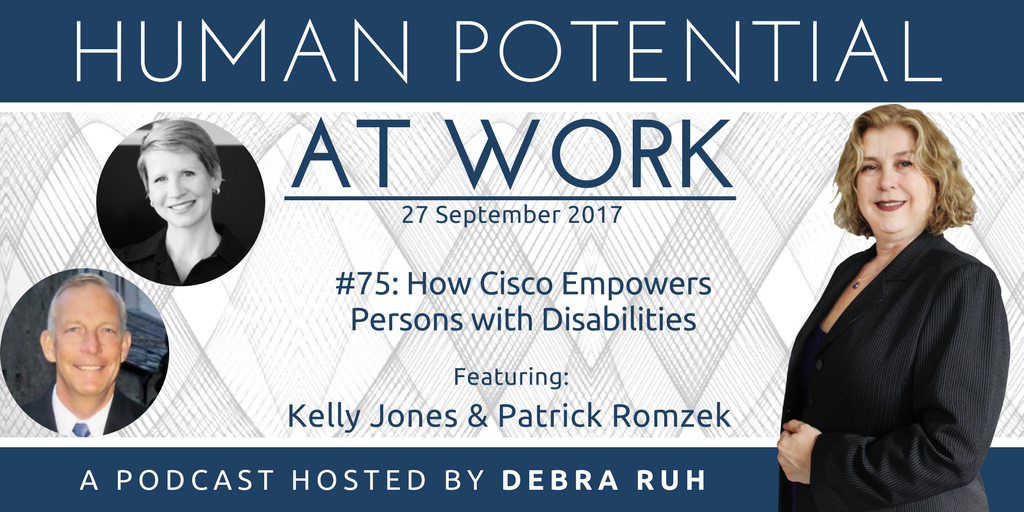
Human Potential at Work Podcast Show Flyer for Episode #75: How Cisco Empowers Persons with Disabilities
Patrick J Romzek, LifeChanger Executive Consultant, and Kelly Jones, Talent Acquisition Leader for Cisco Systems, discuss the employment challenges that face people with disabilities and the work that Cisco is doing to employ, empower and transform the lives of persons with disabilities. They also their innovative LifeChanger program and the positive results they are achieving.





 The countries that were involved in the process saw their development indicators rise dramatically and understood the importance of the process. When the time came to finalize the Millenium Development Goals, they were more than ready to start setting a new pathway to build on the successes of the past 15 years and answer some of the unsolved issues.
 doubt, they set the table for meaningful change with the idea of ending poverty, protecting the planet, and ensuring prosperity for all as key elements.