I am one of the 74% of people with disabilities that have an invisible disability[1]. But I wasn’t even aware that I had a disability until I was filling out paperwork for a state identification card at the DMV. One of the last questions on the form read: “Do you have a disability? A disability is defined as a physical or mental impairment that substantially limits one or more major life activities.” I was dumbfounded- of course I do. The reason why I was getting my state identification card was because my epilepsy prevented me from obtaining my driver’s license. However, this was the first time I had ever considered myself as having a disability because others can’t see my epilepsy unless I have a seizure.
Invisible disabilities can range from an immensely diverse range of conditions such as chronic pain, chronic fatigue, epilepsy, mental health issues, etc. All of these conditions require some sort of adaptation to continue on living life as that individual sees fit- just like any other disability. However, the social barriers are very different. Although people with invisible disabilities don’t have to deal with the perpetual stigma of being incapable of doing something that they are completely capable of doing, people with invisible disabilities face the opposite stigma. People with invisible disabilities are often perceived to be dishonest about what they can and cannot do or feel uncomfortable asking for accommodation because “they look fine”. This can create hostile work environments where the person with an invisible disability is accused of lying or told to “Just suck it up.”
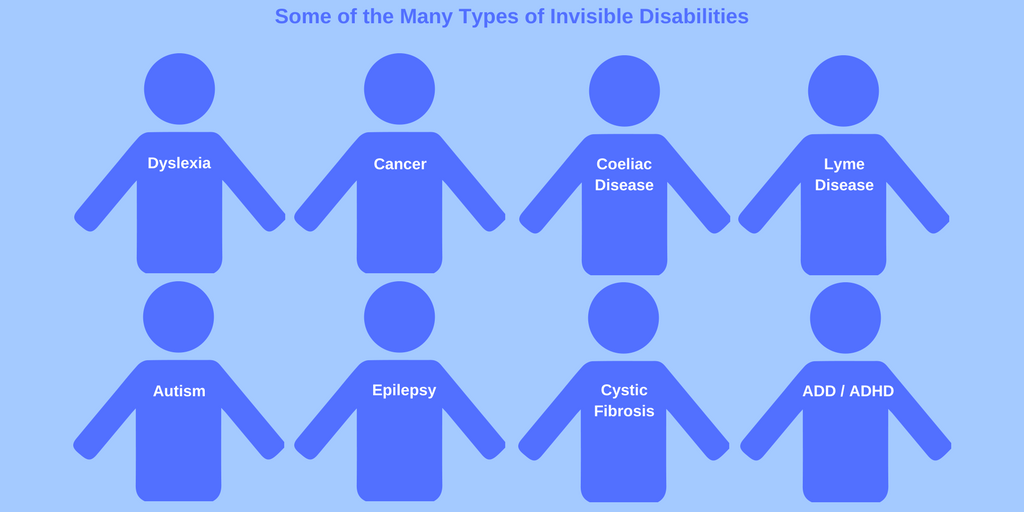
Some of the Many Invisible Disabilities
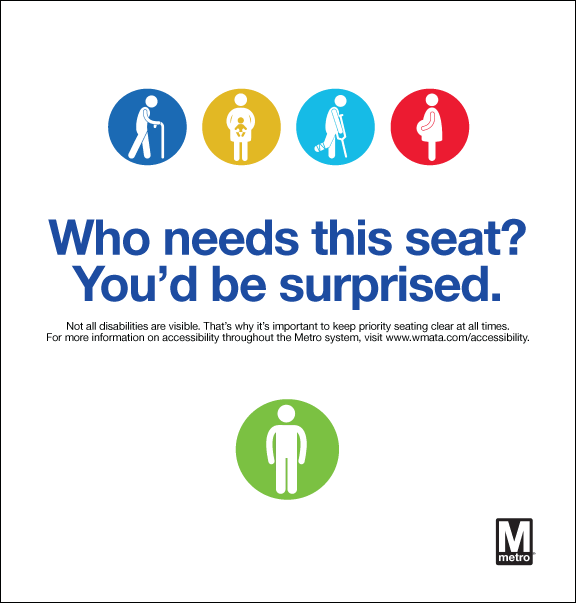
This stigma is not tethered to the workplace and is carried with them throughout the day. While trying to understand the idea of invisible disabilities, I scoured reddit for the personal, day-to-day experience of what it meant to have an invisible disability. One reddit user described having a chronic fatigue condition that caused him to faint if he stood for extended periods of time. Having just gotten off work to catch the bus, he was desperate to sit down because he felt himself on the verge of fainting. He asked a woman for a seat with a lot of reservation and shame because of the expectation that a man should stand for a woman. Despite this, he asked anyway and explained that he had a condition that required him to sit down. She replied, “You look fine to me. A young man should have some manners.” He explained that he had to beg her for the seat until she ultimately forfeited it with a large display of irritation. This anecdote was followed by an extensive thread where many other reddit users vented their frustrations about experiencing similar situations.
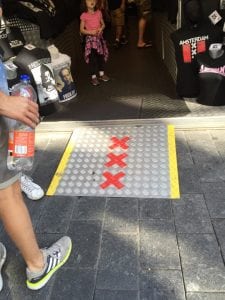
Who needs this seat? You’d be Surprised – Metro Ad That Spreads Awareness of Invisible Disabilities
I think it’s incredibly important to understand invisible disabilities because it has the potential to change someone’s understanding of the PwD community as well as society at large. Visible or not, the expectations of what people can and cannot do is a very nuanced topic for PwD, a community of about 53 million people that is growing[2]. However, this extends itself to society at large. Invisible disabilities reinforce the idea that someone’s appearance should never be used as evidence of any definitive qualities they have. Appearance should never be how you define another person- be it their use of an assistive device or their skin color or their gender presentation. Once everyone realizes that anyone could have a disability, perhaps the average stranger will be more open-minded and understanding. With increased awareness and visibility, this could very well be the case.
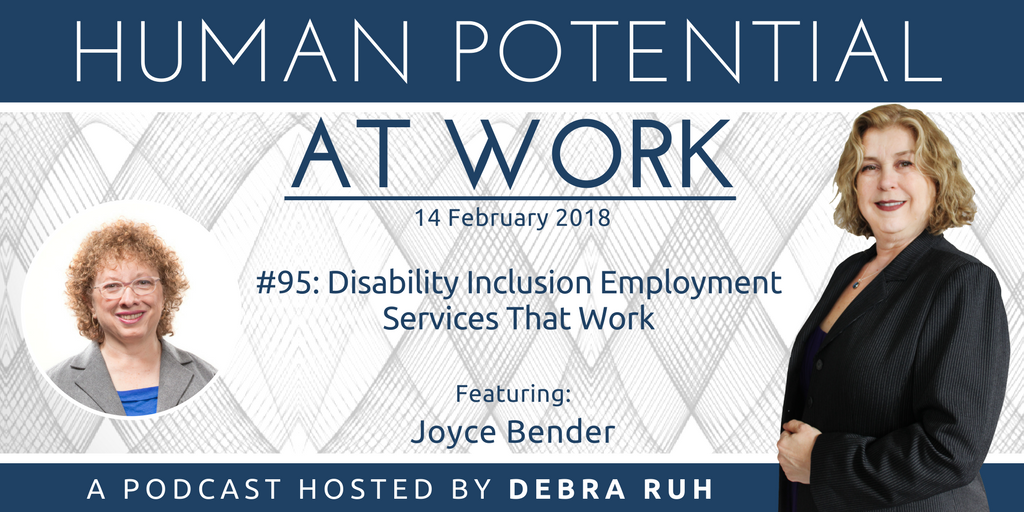
Flyer for episode 95: Disability Inclusion Employment Services That Work
Joyce Bender from Bender Consulting Services discusses the efforts that she has made in providing employers with reliable talent, as well as giving well-trained individuals with disabilities the chance to display their abilities and enhance their lives through solid careers. Joyce also shares how she is using her program “Disability Matters” to document the history of the disability community.
Written by Rosemary Musachio, Chief Accessibility Officer (CAO) at Ruh Global Communications
Ever since I was a little girl, I wanted to travel. In fact, I expressed this desire in a line from the first poem I wrote: “If I was a bird, I’d fly to every country I could find”. Although I’ve always been in a wheelchair, I didn’t think of the possible barriers I’d encounter. When I actually started traveling, however, barriers paved the way for adventure and compassion.
I quickly learned how adventurous traveling with a wheelchair was on my first trip to Germany and Austria. The adventure began at the baggage area of the Munich airport where following the baggage carousel made us dizzy. Our luggage and my chair weren’t appearing after many revolutions, making one of my friends a chicken with his head cut off. He paced around the airport asking anyone who looked like an official about my AWOL chair. Hysteria gripped him so that he wanted to return home. My girlfriend reacted completely the opposite, remaining calm and optimistic. I tried to adhere to her philosophy, though the airport wheelchair in which I sat made my body feel anything but calm and comfortable. An hour later my chair, along with our suitcases, arrived on another flight.
Yet, there was more wheelchair adventure on that trip. Let’s say I went bungie jumping without a rope while we were touring the Residence Museum in Munich. My chair wasn’t locked on a subtly slanted floor, so I rolled down four steps. This time my friend became two chickens with their heads cut off, blaming himself while trying to get help. I worried more about his distress than my chin flowing like the Red River. The ambulance ride wasn’t that bad since the blonde, blue-eyed paramedics were delicious eye candy.
Steps that have continued to be obstacles throughout my travels over the years have proven to be compassion and kindness extractors. In Austria and Germany, we encountered many steps to churches and museums. My friends dragged me in my wheelchair, or carried it and me separately, up and down those stairs. Even strangers have offered help when I toured the ancient streets of Rome or the busy cobblestone alleys of Napoli. The fact that many of these strangers were handsome Italians made me grateful momentarily for steps or high curbs.
Metal Ramps for Stores.
Many European storekeepers also have recognized steps or high entrances to their businesses as barriers. When I went to Belgium and Holland two years ago, aluminum and wooden ramps were at the entrances of many stores. Most were little shops, not major department stores. If a ramp wasn’t there, the shop owner laid one down if we wanted to enter their place. I thought I was in an accessible fairyland where every structure I encountered became barrier-free. These shopkeepers were adhering to the Act of Equal Treatment on the Grounds of Handicap or Chronic Illness, which was established in December 2003. They also were following the United Nations Convention on the Rights of Persons with Disabilities (CRPD) Treaty, which was ratified by both Belgium and the Netherlands.
When I also was in the Netherlands, I also had the most accessible bathroom ever! It was something that came out of Accessible Homes if such a magazine existed! The room could fit five wheelchairs. Not only did it have a shower chair, it had a shower where I could take a shower right in my wheelchair. If the shower chair had sturdier rests and a belt, I’d have used it more. The toilet was raised high so my friend could sit me on it without straining her back and making us both fall. Of course, it also had grab bars. The only problem was the toilet seat was hard. Twisting a towel around its rim helped.
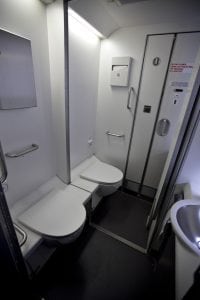
Airplane Bathroom
A hard toilet seat has been the least of my problems on airplanes. A bathroom on the airplane requires both you and the caregiver to be contortionists and involuntary exhibitionists if the flight attendants aren’t kind enough to block the interesting view from others while helping with the wheelchair. Accomplishing your goal can be quite difficult with the awkward logistics. Getting to the bathroom also can be quite a feat. Passengers’ eyes followed, some gawking and others staring admiringly as the airline attendant pushed me down the aisle in a narrow chair. I have felt like keeping my arms outstretched so I could palm everyone as athletes do when they emerge from the locker room onto the playing venue.
Not only is going to the bathroom on an airplane a challenge when you’re a wheelchair user, sitting in a plane seat also can be one. Because I have to readjust myself, especially if I slide down often, I have had to use the back of the seat in front of me or the airplane side panel for foot leverage to push myself up. If someone was sitting in front of me, using their seat as a foot stool could create Exorcist head turns. I gave apologetic expressions. Nine times out of ten, they understood. At times, they had to call the flight attendant to settle the matter, usually by moving either one of us to a different seat. Of course, since people now have the option of selecting seats when they book online, I try to select exit row seats that have no one in front.
Sure, traveling in a wheelchair can have trying moments. Yet, you need to look at those trials and tribulations as adventurous and humorous, as an opportunity for others to empathize and show compassion. That’s what makes a trip more meaningful and enjoyable.
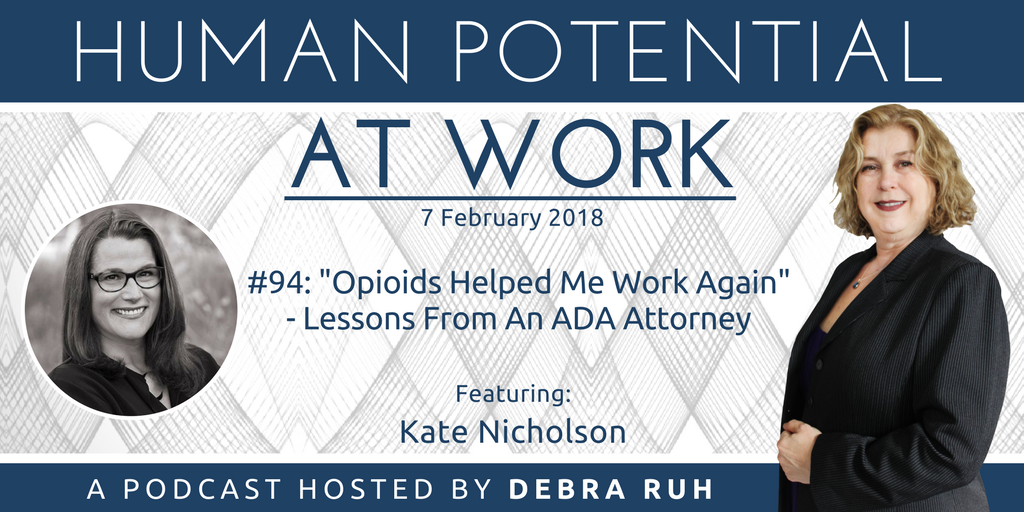
Flyer for Episode #94: “Opioids Helped Me Work Again”- Lessons From An ADA Attorney
TEDx speaker and ADA attorney Kate Nicholson discusses her journey with chronic pain, and how opioid treatment helped her in her healing process. Kate discusses how, on the right dose of pain medicine, she drafted the current regulations under the ADA, coordinated with the White House and supervised thousands of cases by hundreds of attorneys across the country from a screen and well-camouflaged bed. Kate shares her thoughts on opioid treatment for chronic pain and the need to factor in the needs of those with chronic pain in the conversation around opioids and addiction.
Flyer for Episode #93: Parenting In The Digital Age: Challenges and Opportunities
This episode features a 3-way conversation with Debra, her producer Doug Foresta, and Paige Mayer from Eturi as they discuss the challenges and opportunities that arise from parenting in the digital age. Paige discusses the benefits of Eturi’s parental control app “Our Pact” which allows users to locate their children and block screen time on mobile devices. Doug shares stories from his experience with his 12-year-old son, and Debra reveals the challenges she has had negotiating mobile phone usage with her daughter. Discover why these digital challenges are ones that we all face, and how we can both enjoy the benefits of technology and set healthy limits to ensure that we are living a full life.
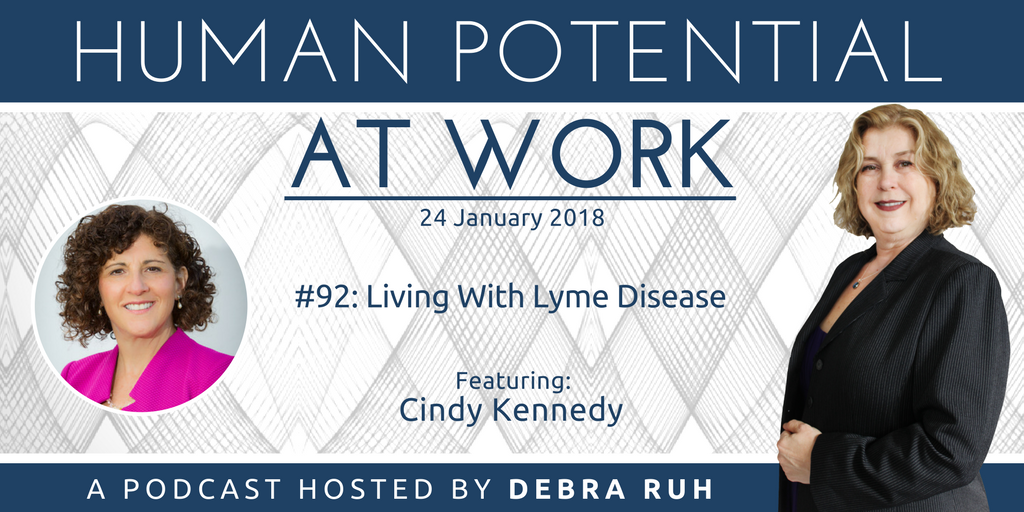
Family Nurse Practitioner and podcaster Cindy Kennedy joins the program to discuss her journey of living with chronic Lyme Disease and the challenges that she had to overcome in getting diagnosed and finding the appropriate treatment. Cindy shares tips for diagnosis and treatment, and shares advise for those who may be experiencing disabling symptoms as a result of the disease.
Episode Flyer for #E91: Fitness for Everyone- Making Health and Wellness Accessible For Persons Of All Abilities
Guest: Ryan Eder Guest Title: CEO
Date: January 12, 2018 Guest Company: IncludeFitness
[Intro music]
Debra: Hello everyone. This is Debra Ruh, and you are listening to “Human Potential At Work”, or you might be watching us on Facebook Live, which is always exciting. So, my guest today has a very interesting story, it is Ryan Eder, and he’s coming to us from Ohio, and he has been on a 12 year journey to really improve the lives of people with disabilities. So, welcome to the program, Ryan.
Ryan: Thank you, Debra. I appreciate the opportunity. It’s great to chat with you.
Debra: Yeah, I know that one of our other guests introduced you to us. August, with Pinterest, had said, “Debra, you want a good story, you gotta talk to Ryan!”, so I was totally, I was totally on board. So, I know, Doug, yeah, we were very impressed with your story. So, Ryan, tell us a little bit more. You know, I know that I read an article about you that said that you went from being a student, to a CEO, from design student to CEO. So, tell us more, about you know, how you became the CEO and what you’re doing?
Ryan: Sure, sure. Yeah, as you mentioned, this is a 12 year journey for me, so my background, like August’s, is in part design, industrial design. And so, I’m from Cincinnati. I went to the University of Cincinnati to help design, architectural art and planning. And, that’s really where this all started. So, I graduated in 2006, and right after school, I moved up to Columbus and started working for a design firm, called Priority Designs.
But, this started while I was a senior at UC, and I always liked working out, and just happened to be going to my gym, that I’d been a member there for like five years, and I was working out one day, and saw a guy in a wheelchair enter the facility. And I hadn’t seen a guy in a chair, at this gym before, so I was instantly intrigued. So, I just kind of sat back, and just kind of observed. And, quickly noticed that he had a bag full of homemade accessories attached to the back of his chair to help him adapt and transfer to the various equipment.
And, so watching that, and then watching him struggle trying to get into position, and try to work with this equipment. And in my mind, I’m thinking, “You know, it’s hard enough, for any of us to try and stay healthy and active, let alone if you’re dealing with equipment that doesn’t even consider your needs,” right, so, I wasn’t sure of this was just my gym, or something larger.
So, part of my vetting process or my thesis, was I called about 100 clubs across the country, and I told them that I was a wheelchair user, and I’m not, but I told them I was a wheelchair user. I asked them what accommodations they had, and that amount of time I spent doing that, I got insanely frustrated. Because, the responses were, “Sir,” went everything from offering equipment that didn’t even consider individual needs, down to like, “Well we wouldn’t even know how a wheelchair user would enter our facility”. So, I’m like, wow, okay, right. So, I’m like okay this is a problem, so let me try to tackle it. In my thesis, I had ten weeks to tackle this, okay.
So, I decided, you know, I’m a big believer in collaboration, and connecting the dots, and working with people. So, I just reached out to the local community of [inaudible 00:03:43]. And it’s hard to just connect. And so, I would like, rent a wheelchair, went to local facilities, I tested out equipment. I joined a wheelchair football league, for the month of May and played wheelchair football with the group. And, my whole goal was to get as immersive as I can and try to understand, not just the physical side of things, but the cognitive and emotional side as well. You know, down to the subtleties of, okay, I’m in a chair, I’m entering the facility, well, it’s really hard for me to get that threshold to even get into this gym, so I’m already irritated, right? So, like …
Debra: And also, Ryan, this is the United States, so we’ve had the Americans with Disabilities Act for 27 years, so what do you mean, that you can’t get in the facility?
Ryan: Exactly.
Debra: Sorry, sorry.
Ryan: Exactly. Exactly.
Debra: Yes.
Ryan: So, I’m going through that, and you know, I’m getting frustrated and all, but I’m working with these groups and these folks, and trying to tackle different issues. And starting to look at a variety of things, like dexterity issues, looking at stabilizing the user standing, seated, or in a wheelchair. Looking at being versatile, and making sure people can reach it from a seated position and it’s never, it’s almost independently addressable right?
It’s a variety of different things, and when I was working with this group, two things came, come to the forefront really quickly. That anyone in a chair, that I talked to, said, that, “I want to work out, with everyone else. I don’t want a wheelchair only machine”…
Debra: Right, right.
Ryan: And as a young … because I’m sitting here like well, that makes a lot of sense, and so this is going to be universal. And then, on top of that, basically, everyone I talked to hated existing equipment. It was, just regardless of demographic, it’s like it’s very cumbersome, it’s confusing, it’s intimidating, I don’t know what I’m doing, and so that kind of set the groundwork, to where the goal of my thesis was a piece of accessible, inclusive, fitness equipment that catered to people of all ages and abilities.
And, so, I came up with a concept, and I got a good grade. And I moved up as a designer, and with about six months into it, I decided to enter my project into the International Design Excellence Exhibition. At the time it was hosted by Business Week Magazine, it has a couple different co-hosts now. Global competition, design firms, corporations, submit their latest and greatest product designs, it has a little student category. [inaudible 00:06:27] it, put it in there. Got a phone call, saying, “Hey, Ryan, you won gold in the student category.” And that was like the holy grail for me, right, and so I was just like, on cloud nine, I’m running around, and they’re like, “Wait, wait, Ryan, there’s more” … talking about it and they go, “Well out of 1700 entries, from 35 countries, you also won Best in Show.”
Debra: Wow.
Ryan: And there’s literally an e-mail chain the next day, that goes, “Just to clarify, Best in Show, is like for students category, right?” And you know, Matt’s like, “No, Ryan, you’re it, the whole thing.”
Debra: Wow, wow, congrats.
Ryan: Thanks, and so it like rocks my world, right, so, I’m going to, traveling across the country, I’m going overseas, and being invited to share this concept. I’m getting floods of phone calls and e-mails from people seeing it and saying, “Hey, this could really help me, and where can I get it?” And so then I felt this inherent guilt, because, I was reaping the benefits of these awards, I’m not doing anything to solve this problem or push this further, right? So I thought maybe, I could use this as a catalyst to start raising some money, and push this further.
And so, you know, like as the years kind of progressed, I started to really slow drip this process and started to build this. And so, I went back to UC, had an opportunity to present to the collaborative, called the Live Well Collaborative, and I had [inaudible 00:07:54] build it. And said, “Look, I want to help people, I need help, helping people”, and I had no idea, what that meant, and actually at the end of that meeting I left with about 60,000 dollars from …
Debra: Wow, Good job.
Ryan: Yeah, right, it was a big moment. And so, like, Proctor and Gamble actually gave me some initial money to work back with UC, and work with engineering students to develop some prototypes. And then, a local [inaudible 00:08:21] technology investment company, CincyTech, gave me some money to start looking at the true business opportunity. And so, I moonlit, include fitness, for seven years, and just nights and weekends, again, I call it a slow drip build.
And I would work with the engineers out at UC and we’d build like really rude and crude prototypes, that like I’d joke, when you’d see pictures of them, they kind of look like poking devices and so, [inaudible 00:08:53] … was proving out the individual mechanisms, and then pulling it together in kind of one system, of prototypes.
Got to a point where we were able to raise another half million to build a looks like, works like model of this. And really to take things further, and along the way, I got invited to be part of the ASTM investment committees, put together specifically for the ASTM standpoint, looking at the lack of accessibility, inclusivity in fitness equipment, because of this work. So, we start laying out all of these different things looking at you know, left/right arm biases, minimum force requirements, visual contrast, audio feedback, all of these things … I think there’s like 120 different guides. Okay? And it’s with all the country’s researchers and all, and beyond. This is by the time I got the funding, and I go, “You know what? I gotta come in and fuse all these into my [inaudible 00:09:48].” And so, took all those in, and we kind of bunkered down and redesigned the entire thing.
So after it won, kind of the Oscars of the awards, I said I think I can make it better, I hope I don’t make it worse. So, pretty much redesigned the entire thing. And then we built a looks like, works like model, and took it on tour. So I had like a mobile show room that I built, and we took it to like the VA and VC, and the National Rehab Hospital, Lakeshore Foundation where we tried pairing with the athletes … we went to a variety of places and did these demos. Actually, our first demo was with the late Michael Graves at his design studio in Detroit.
Debra: Oh, that’s cool.
Ryan: Yeah, and so …
Debra: He’s a legend in our industry.
Ryan: He is a legend.
Debra: In our community, in our community.
Ryan: My industry, product design … you know, just engineering, you name it. So, had that opportunity and we were doing these demos, and we had people with a variety of different abilities come in and be able to interact with it. I mean, we had folks with CP, we had amputees, I actually had a quadruple UVT and was able to adjust the entire system with his elbows.
Debra: Wow.
Ryan: People are getting emotional interacting with it, I’m getting emotional, right, it’s just kind of a mess, this demo. And it’s really exciting. So we’re like, “All right, we’ve got to take this further.” We’re kind of halfway through though, so in context, this was 2013 at this point.
Debra: Okay, all right.
Ryan: So, at that time, we start talking about data, digital health, quantified self. And so I’m looking at this, you know, at this demo, and realizing, “Okay, it seems like we’ve solved physical accessibility. Now that people can use it independently, how do you know what to do, how much to do, and keep track of stuff?” Quantitative side of things. So that’s where I started to get the idea about accompanying software. I was like, “Okay, use software and then maybe you could browse through and download and look at libraries of exercises that had standing/seating wheelchair modes. And you could download these and the machine would guide you through and record your data.” So I started to float this idea out, kind of halfway through these demos, and people’s eyes got pretty big. They were like, “Oh, that’d be great!”
Okay, so I came back and instead of just launching the machine as it was, I raised another 700,000 and was able to build one that was connected and had the software. So it was part of this whole collaborative process, I started to loop in trainers, then therapists, then physicians, then payers. And really started understanding the landscape within healthcare, right? And understanding an opportunity to not just inclusivize the space, but digitize it. And so now you’re looking at ways of automating documentation. You’re looking at data sets we’ve never had before which is really exciting. We’re working with physicians and neurologists that want to map data produced from our systems to patients of … with mapping benefits of physical activity to Parkinson’s patients, Alzheimer’s patients … understanding just a variety of different conditions, right? So, kind of through this process, what started as purely accessible fitness equipment evolved into an inclusive, digital health platform. And, so just a much bigger picture, right?
So, we then … just fast forwarding through stuff to where … in 2016 we debuted the IF platform and … what we call it, and we decided to enter it back into the design awards that we’d won back in 2007, right? Like, am I going to get disqualified? I don’t know. And we won “Best in Show” again.
Debra: Wow.
Ryan: For context, like the companies that won in between us were Apple for the iPhone, Microsoft, and Tesla.
Debra: Whoa.
Ryan: So …
Debra: Wow. That’s very cool.
Ryan: It’s extremely exciting.
Debra: Good company, good company.
Ryan: Right? And so through that process, we actually now have 16 in our national design and innovation health [inaudible 00:14:04] in all, but to date now we’ve raised a little over six million dollars to develop this entire system. We are in production right now, and we will start shipping Q1 of 18, finally.
Debra: Wow. Exciting.
Ryan: Yeah, we’re shipping to a variety of different places. Looking at spinal cord injury centers, the VA, neurological rehabilitation facilities, pediatric care, aging care, traditional orthopedics, right? So, by infusing inclusivity in this entire thing, it’s applicable in all these different places. And so … with the data that we have, we’re able to just drive deeper insights into getting people of all ages as healthy as they can be for as long as they can be. So that’s really our goal. So, that’s my story.
Debra: Okay. So I have a ton of questions. So, but first of all, I really do want to congratulate you on following your hunches and just staying with it to make the world a better place. So, kudos to you for that. Your tenacity is very impressive. So, I … you and I talked about this a little bit before we started the interview, but there are some people that don’t understand why we would even need to do this.
Now, I have a daughter with Down syndrome, and I’m a big exerciser. And my daughter has always exercised too because we do it as a family. And I’ve seen articles where there was a family where they brought their daughter in … in Texas to a gym and the gym said that she couldn’t exercise in the gym. Which, by the way, it’s the United States, excuse me? And so after they were publicly embarrassed and [inaudible 00:16:11] and everything else, and at the time … I believe in rewarding as opposed to, you know, slapping. So, I just was bragging about my gym in Richmond, Virginia, American Family Fitness … that it’s for the entire family, and my daughter is part of our family.
But, I think a lot of people sometimes don’t realize that people with disabilities need to exercise just like everybody else, because you know, they’re like human beings.
Ryan: Right. And if not, more so, right?
Debra: Right, right. And so I think it’s interesting how you connected dots like aging and neurodiversity and all of these different things. And that you’ve looked at it from a global perspective. I think that’s very, very smart and astute of you. But what kind of barriers have you had to get past with just silly things like “Is this even needed?” Which, is ridiculously, because obviously it is needed. But how about barriers like that?
Ryan: Yeah, very real barriers. I’ve had … I call them three moments that I was basically brushing up with death right through this process of trying to get myself [inaudible 00:17:27]. And it is a challenge because … to commercialize something, you need to have the business case around it, right? And when someone first thinks of accessibility, they think “small market, not a lot of dollars, I’m not putting any resources into it.”
Debra: Right, right. Not really needed.
Ryan: Not a big enough piece of pie for me to care. Right, which is ridiculous. So you had to overcome that. So, you start to … I’m a big believer in empathy from all angles. And so even emphasizing with the investors looking at this sort of feedback that has that mindset … you’re saying, “Okay, here’s how they’re looking at it, how can I bridge this gap?” Right, so I think if we had [inaudible 00:18:17] just as the equipment alone, it wouldn’t have had the commercial viability without the software and data. Because the software and data can do things from a service standpoint, business standpoint, that really take things to the next level and offer value props beyond inclusivity, right? So for me, a lot of it is listening and trying to understand the perspective of everybody in the room. And once I feel like I have a grasp on that, just connecting the dots, right?
Debra: Right, right.
Ryan: It’s like okay, here’s a [inaudible 00:18:51] how do we evolve this together? And it’s not easy, but if you listen closely enough you can hear it.
Debra: Well, you know, and it’s not easy saving the world, but we all have to try.
Ryan: Yeah.
Debra: So Ryan, so … you told us, you know, some of the facilities and stuff that the equipment is going to go in. I didn’t hear you mention the mainstream gyms and so I am certainly very curious of that. I’m also curious about … at some point I want you to describe more about what this is, because I think that it’s hard to visualize.
Ryan: Sure, yeah, absolutely. So mainstream fitness is definitely somewhere where we want to be. We have community centers that have ordered this.
Debra: Okay.
Ryan: We’re looking for fitness partners that kind of want to be thought leaders in this space, right, there’s the thought leadership in inclusivity, there’s a thought leadership in connecting to healthcare in different ways, right? And we have some good conversations going. But we’re a little bit of a different beast than what they’re used to, so it takes a little bit more working with them, right?
Debra: And I’ll also say, Ryan, before you move on, I would love to connect you to some of the people. And the first place I’d love to connect you with the gym that I’ve been part of for years, just as one of their consumers, but also would love to connect you with some of the players that I’m dealing with in healthcare. There’s a … what I’m calling a tribe of people that really want healthcare to be better for all of us called PinkSocks. And just people really want to make a difference. And so I’d love to connect you with some of them and some of the people in Washington D.C. … some of our viewers and listeners might also be very interested in getting involved and making sure that we’re helping you get the word out to the people … connecting you to the right people as well.
Ryan: That’d be fantastic. I mean, that’s what it’s all about. It’s the power of collaboration, right? And being able to make things better. So, I really appreciate that. To your earlier question about describing the system, so … I’m a very visual person, so I’m just going to be waving my hands here, but you can go to our site includefitness.com, and get to our videos, testimonies, and all so that you can see us in action. But to kind of give you just a basic description of it is that … our machine is called the Access Strength. And it’s an inclusive functional trainer, so it’s got pulleys, cables, and weight stacks, the same stuff that’s been in machines for decades, right? But it’s been redesigned and engineered to give us a tremendous amount of versatility and inclusivity.
So, essentially, it’s very anthropomorphic. So, it’s got a center tower, and it’s got these two arms that basically wave. And then on those arms, it has carts that move in and out. So essentially, you can place a handle or these carts anywhere in each hemisphere, and that essentially lets us do hundreds of upper body, lower body exercises on one machine. We strategically place the interaction points to where it’s 100% independently addressable regardless if you’re standing, seated, or in a wheelchair. It can never be put in a position that you can’t reach from a wheelchair. It’s not then just about versatility of course, it’s inclusivity.
So, taking things a layer deeper, we want to remove all the barriers surrounding traditional equipment. One of the biggest things, our spring loaded pins that require a lot of dexterity (two hands to adjust), and we so said, “Got to get rid of all of those.” And we have patented dexterity for handles, or these bright green handles, bright green for the audio and visual contrast, right? So you can easily recognize them, but you can take a single arm with a closed fist and just rotate that handle. And it will disengage a pin like a spring loaded pin would, and you can do this next position, and it pops back in place. So it’s … we put those throughout the entire system so you’re not going ten different rows to adjust something.
We have an integrated seat that again can be pulled out with a simple rotation of a handle. A closed fist can pull it out. It has a transfer handle and a height adjustment right on the center there, to transfer in and out of a wheelchair or any assisted device. It comes with a stability pad, essentially move in and out, up and down. So that can help stabilize someone standing, seated, or in a wheelchair.
I should mention anything that we have is counterbalanced, so you’re never applying anything more than like seven pounds of force to adjust anything on here. And then one of the biggest things on fitness equipment is the weight stack. Usually it’s down low, it’s hard to see, it’s hard to reach, fingers get pinched, things get lost, you name it. So we still have a weight stack, but we’ve pushed it inside the machine and changed the interaction to a dial. And so the dial displays the weight that’s currently selected in green at all times, and it has a paddle sticking off a dial, again, single on, closed fist … you can go up to the dial and just rotate it and it selects the weight for you.
And it gives us a tremendous resolution, with two and a half pound increments the whole way through the stack. So, like a lot of equipment, you hit a certain level and the next jump is fifteen pounds, and that creates an artificial threshold barrier for your progress. You’re not ready to jump fifteen pounds. Right? You put everything inside … you hide all the stuff that no one cares about. The pulleys, the cables, the weight stacks, the nuts and bolts … make something that’s far more approachable. Something you want to interact with, you want to touch. And then it also has a portal into the software through there. You can go on through any computer or tablet, [inaudible 00:24:41], libraries of exercises and workouts … you can have your therapist or your trainer assign workouts to you. You can go up to any of our equipment with an RF ID tag and it pulls up your profile.
So it’d say, “Hi Debra, welcome to your workout.” It’d pull up a list of workouts that you saved or your therapist/trainer scheduled for you and guide you through the whole thing. So it says, “Exercise one is chest press.” Shows you a picture of how to do it. By the way, the picture is demographic specific to you. So I feel like if there’s a teenage girl in the system, they should see a teenage girl. If there is a 50+ male, we should see a 50+ male, right? So we go that extra length for all of this. But that’s how it should be. And then it tells you how to set up the machine, we have sensors and then you set it up, selects the weight for you automatically, and then it of course counts your reps. But we’re tracking velocity, force, power, tempo, range of motion, symmetry. All of this data that you can pull in … it pulls it automatically and you can log in and see how your progress was on one workout or progress over six weeks, a year, whatever it may be. And then you can slice and dice that data as you’d like, share it with a therapist, you name it.
So again, it’s inclusivizing, digitizing in front of this whole space.
Debra: What I was thinking about when you were saying all of that … I have used the exercise equipment … tried to use the exercise equipment at my gym for years. I get very confused, I don’t know … I get so confused on the settings, is this too high? Is this too much? Do I have it? Sometimes gym personnel will walk by and say “You really shouldn’t be arching your back like that.” You know, so I mean they’re kind, but there just seems to be a lot of ways where you can make mistakes with these different exercise equipments. And so it sounds to me like you’ve solved some of the problems that we have with the mainstream equipment. And that the things that you’ve done … it’s going to benefit everyone, even if … you know, all over. So I think that’s very exciting.
Ryan: Yeah, I mean, we’re talking to pro sports teams about having this as a way to log the progress of their athletes.
Debra: Yeah, that’s really cool.
Ryan: I was at a pediatric hospital talking about … you know, early teens with CP. And how they can benefit from this. Just that’s the power of a universal design and inclusivity, right? So …
Debra: Yes.
Ryan: When you do it right, there’s better options.
Debra: And I’ll tell you also … and I’ve talked about this in speeches that I’ve done around the world, but it’s always exciting to see the changes that have taken place in the world because of people like you that have designed something starting with people with disabilities, and we wind up all benefiting from it. Examples are text to speech, captioning, we’re all using captioning now, even though it was designed specifically for individuals that were deaf or hard of hearing. And so … it’s very exciting to see, you know, the progress that’s being made. Because you saw an opportunity. Did you … at the time when you saw the gentleman in the wheelchair, did you go and talk to him? Does he know what he has inspired?
Ryan: Yeah, I did talk to him, and then we were disconnected for maybe eight or nine years, and actually we reconnected on Facebook.
Debra: Oh, great.
Ryan: Yeah, so that’s been fantastic. And it’s just continued to evolve, right? And to your point though about just the power of inclusivity and how many things have stemmed from that … so one of my mentors is Dr. Patricia Mora. And so she came up to me right after the awards and said we could work together and all of this. And her involvement with [inaudible 00:28:39] groups. You know, everyone has these kitchen utensils now, and they’re just ubiquitous.
Debra: Right, I know. They’re a wonderful example.
Ryan: Yeah, right? That was started to address … from his wife’s need … her arthritic needs.
Debra: Right, right.
Ryan: So, it just makes sense that when you’re designing and creating something, that you need to help people in the process and that you should help as many people as possible.
Debra: Yeah, it is really, really exciting. So, I have a feeling I could talk to you for days and days and days, but one thing I want to make sure that we do before we end the program … I want to tell people how they can find you, Ryan. Because we want to support you. I will be e-mailing you saying, “Ryan, what can I do to help you?” Besides with this. And so … tell us first of all how to find you. Are you on social media? I assume you have websites. Tell us about all of that.
Ryan: All that. For the company, includefitness.com is our website. We’re on all the social media, so you can find us there for IncludeFitness. For me personally, just Ryan.Eder@includefitness.com is my e-mail address, but you know, I’m on personally on Twitter and everything as well. Ryan_Eder. And so just … I love to connect, I love to collaborate. That’s what it’s all about. I hope to hear from many of this network and be able to do that.
Debra: Yeah, so and the people that are following, they know I’m really good about turning the volume up. So I think it’s really exciting to learn about young designers like you that are just changing the world … for all of us. It’s very exciting. And I hope any … I’m hoping if there’s any big gyms listening … QVCs of the world … because I think that you also … and I don’t know your business, but it seems like there’s also an opportunity for in-home purchases as well. I know the Nordic track has done tons of business like that.
Ryan: Sure. Yeah, I mean you know, people stay healthy in a multitude of locations. To provide the right opportunities in all those different types of places is what we’re all about.
Debra: Well, we want you to be widely, widely, successful. So, for anyone that’s listening, please go on to their website includefitness.com to learn more about it. Anything you can suggest to Ryan, anybody you can connect him with, let’s help Ryan change the world because that’s why we’re all in this together. And so Ryan, thank you so much for being on the program today. We really appreciate it.
Ryan: I really appreciate the opportunity.
Debra: And we will talk again.
Ryan: Sounds good.
Debra: Okay, bye everyone!
[outro music]
You’ve been listening to Human Potential at Work with Debra Ruh. To learn more about Debra and how she can help your organization visit RuhGlobal.com. If you’ve enjoyed today’s episode and you want to make sure that you don’t miss any future epsiodes, go to itunes and subscribe to Human Potential at Work. Thanks so much for listening and we’ll be back next week with a new episode.
Episode Flyer for #E91: Fitness for Everyone- Making Health and Wellness Accessible For Persons Of All Abilities
Ryan Eder, Founder and CEO of IncludeFitness™, shares the work that his company is doing digitizing physical medicine, rehabilitation and wellness to achieve better outcomes at lower costs.
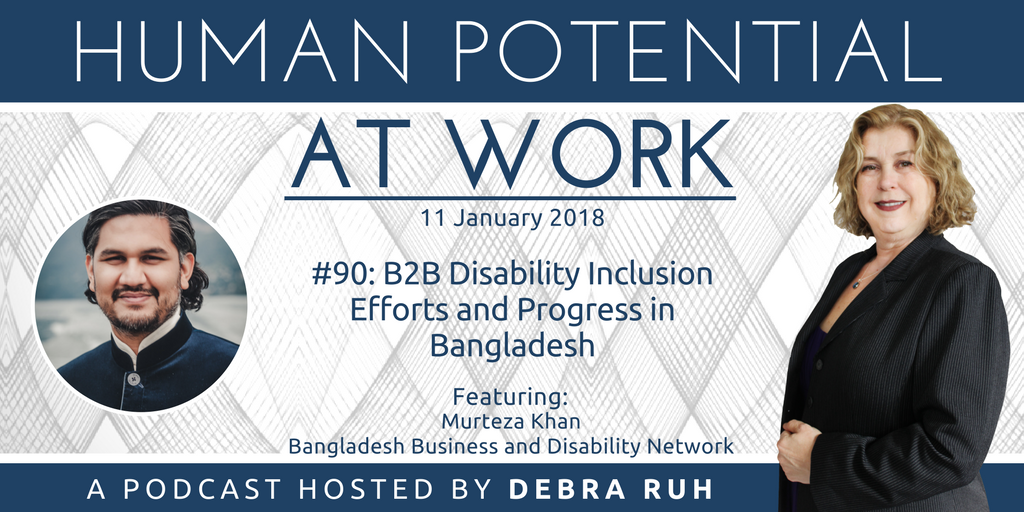
Episode Flyer for #90: B2B Disability Inclusion Efforts and Progress in Bangladesh
Murteza Khan from the Bangladesh Business and Disability Network discusses the efforts the organization is making in bringing together employers who are committed to developing a more disability inclusive workforce in Bangladesh.
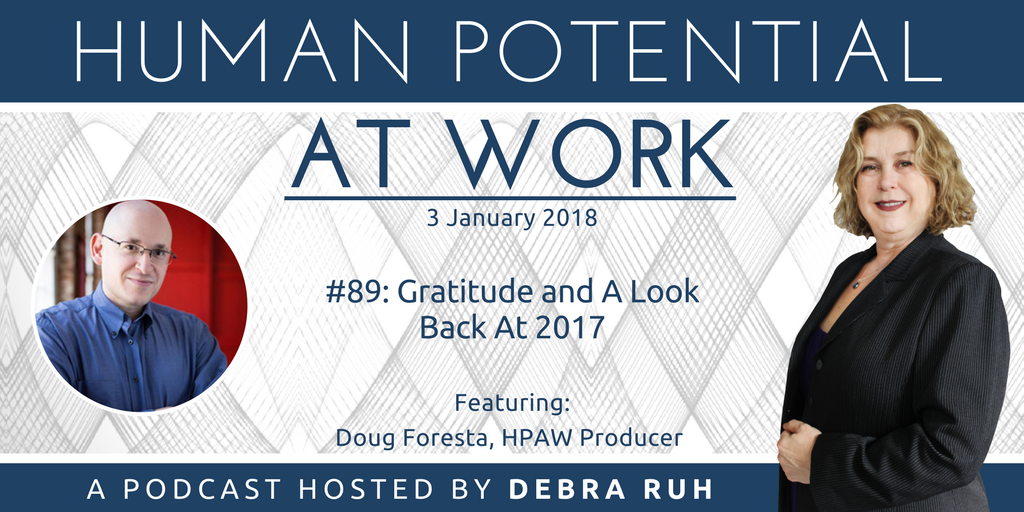
Episode Flyer for #89: Gratitude and A Look Back At 2017
Debra is joined by Doug Foresta, producer of Human Potential at Work, as they reflect on what they are most grateful for over the past year. Doug and Debra also discuss the evolution of the show, and where they see the program heading over the next year. Discover some of the biggest takeaways from the past year’s episodes and topics.