David Pérez Rueda is the Chief Global Strategist of Ruh Global Communications
By David Pérez Rueda
On the year 2011, the Economic Commission for Latin America and the Caribbean (ECLAC) published a study titled “People with Disabilities in Latin America: From legal recognition to real inequality.” In this document, the author Maria Fernanda Stang shows how even though People With Disabilities in Latin America are being included in both national and regional agendas, inequity is still preeminent with significant socioeconomic gaps that place PWD in a condition of social vulnerability that demands action.
ECLAC´s study shows that in the early 90s international organizations and governments in Latin America started paying more attention to the issue of People with Disabilities, not at an ideal level but at least there was a space in their discourse and planning for policies regarding the matter. The early 90s is also a significant period because as Mujica and Calle stated in 2006, it marked a significant shift in the approach and language going from considering people with disabilities as victims, and objects of charity or beneficiaries of social assistance into subjects of law, participants and actors, recognizing the contributions to society of PWD and demanding their integration.
Cover of the UN Standard Rules on the Equalization of Opportunities for PWD.
This shift and the creation of a robust legal framework can be analyzed as the result of a systemic international effort carried out by the United Nations and its organs. With the declaration between 1983 and 1992 of the decade of People with Disabilities and the publication of a declaration titled “Standard Rules on the Equalization of Opportunities for Persons with Disabilities,” the laws that were approved after this period were both more politically correct and focused on equality of opportunity rather than social assistance.
Most countries have made reforms to their legal framework to adjust the terminology utilized to refer to the issue of People with Disabilities. To this day almost every country has a law regarding the matter. Moreover, when analyzing the rights guaranteed by these statutes, we realize that they are very complete texts addressing topics in most cases like Health, Accessibility, Employment and Social Security. However, one essential aspect is mostly lacking, and that is political participation.
According to the World Bank,[1] there are at least 50 million people with disabilities in Latin America and the Caribbean, the equivalent of 10% of the region´s population. Although these numbers are not precise due to data collection methods; it is estimated that:
Only between 20 and 30 percent of children with disabilities have access to education.
Between 80 and 90 percent of people with disabilities are unemployed, and those who have jobs are underpaid or receive no monetary compensation.
Less than 20% of people with disabilities in the region have social security.
Although these numbers might be shocking considering that we have talked mostly about positive things, strong legislation and a paradigm shift in the way governments have approached these issues has not benefited people living with disabilities in any real way. I could sit here stating more and more numbers that show that the title of the text published by ECLAC is more than accurate. There is no equality, even though there is legal recognition.
Latin America is a very complex region composed of 20 countries, 20 different realities, 20 different governments, 20 different economies, 20 diverse cultures and many other factors, it has not been, and it will not be, an easy task to address this issue. Nevertheless, there is hope that If these countries have decided to take the first step and make legislation, no doubt rests in my mind that real access to opportunities at all levels can be achieved.
One of the first stages of this process comes from genuine political participation and real political communication. There is only one way to produce “Public Policy” that has a real impact on any group of people and that is by following the slogan proposed by the International Caucus on Disability “Nihil de Nobis, sine Nobis,” which means nothing about us without us. The inclusion of persons with disabilities in the conversation is going to be a crucial factor in the development of Public Policy because it assures that the laws created will allow them to have equal access to opportunities, healthcare, employment and personal realization.
Having worked with the UN Education, Science, and Culture Organization (UNESCO), I can guarantee that the International Organizations commanded by United Nations are leading this effort. The efforts made by UNESCO and the International Labor Organization (ILO) through the Global Business and Disability Network (GBDN) and many others are starting to make a difference. Every day we can find new social organizations being created all over Latin America addressing these issues. People with disabilities in Latin America want a voice. They want their place. They want to be heard.
The most emphasized aspect in the Sustainable Development Goals[2] (SDG) regarding people with disabilities in Latin America is without a doubt the need for hard numbers on their real situation. Government officials understand that the problem is not going to be solved by numbers. However, they realize that to develop Public Policy that helps them achieve the goals they have set out to achieve, they need to understand where we stand and how many people need help. To solve this issue, methods have been developed to help countries gather the information.
The Sustainable Development Goals are seeking among other things to eliminate disparities and ensure equal access to all levels of education, to achieve productive and decent employment for persons with disabilities, promote social, economic and political inclusion; and access to secure and sustainable transportations for them. If we take into consideration the vast amount of influence that the efforts made in the 90s had over Latin America, these goals will help directly to bring real change for persons with disabilities in Latin America.
How can developed countries help? Well, the answer is simple: include Latin America in the conversations. Information is going to be a decisive factor in the success of the SDG, and the efforts to go from legal Recognition to real equality, knowing where the world is moving in ICTs and accessibility is going to be essential for this process as Hellen Keller said “We live by each other and for each other. Alone we can do so little. Together we can do so much. Only love can break down the walls that stand between us and our happiness.” Together developed countries and developing countries can create a future where happiness is accessible for all.
If you want to join the conversation follow the group Human Potential at Work on Facebook, we would love to hear your opinions about this issue and many others that we are tackling in Human Potential at Work.
If you would like to learn more about David Pérez and his work with Ruh Global Communications look for episode #64: INCLUSION IN CENTRAL AND LATIN AMERICA of our Podcast Human Potential at Work hosted by Debra Ruh.
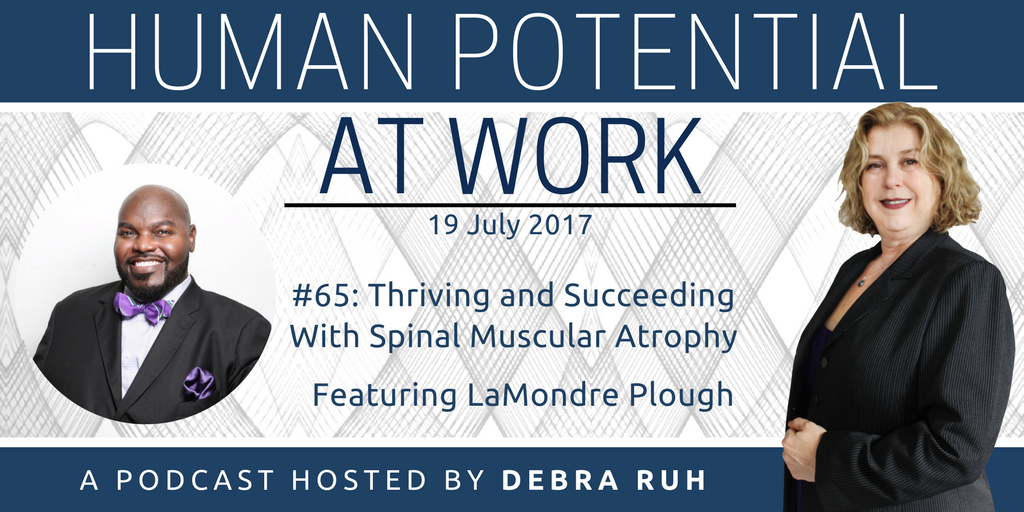
Episode Flyer for #65: Thriving and Succeeding With Spinal Muscular Atrophy
Guest: LaMondré Pough Guest Title: CEO and Founder
Date: July 19, 2017 Guest Company: LaMondré Pough Unlimited
[Intro Music]
Debra Ruh: Hello everyone, this is Debra Ruh and you’re listening to Human Potential at Work or watching us ’cause we are live on FaceBook. I’m really excited, I’m always excited about our shows, but I think it’s such a blessing to get to talk about these topics.
Today I have a very old amazing good friend, LaMondre Pough. LaMondre and I actually worked together at my old company Tech Access and LaMondre and I we worked together for many years. Before LaMondre had joined Tech Access he was doing a radio program and wait til you hear his voice you’re going to get so, you’re going to be spellbound by this man. He’s amazing. He has continued to do the work that he feels very led to do and what we’re going to talk about today, is we’re going to talk about finding your purpose and we’re going to talk about being grateful.
So LaMondre, welcome to the program my friend.
LaMondre Pough: Well thank you so much Debra, I’m so excited to be here.
Debra Ruh: Well you’re such an amazing man and I want to gush but …
LaMondre Pough: Thank you.
Debra Ruh: I want to gush when I talk to you. LaMondre, you identify as a man with a disability and I was wondering if you could just take a little time to tell our audience about your walk with disabilities.
LaMondre Pough: Absolutely. I have spinal muscular atrophy which is a form of muscular dystrophy. When I was born my mother noticed that when I was walking, and I was probably about, I started walking at nine months old. She noticed that when I would walk that whenever I would fall down I wouldn’t get back up and I never ran. She thought this was peculiar so she took me to the doctor and the first thing they said was, “Oh he’s just being lazy.” I don’t know what a nine month old knows about being lazy, but this is what they said. Of course this was not an acceptable answer so after months and months and months of dealing with this and noticing that didn’t get any better, I finally got an appointment with the Medical University in Charleston and that’s when they did the muscle biopsy. I was about 18 months old by this time and they discovered that I had spinal muscular atrophy.
At the time of the diagnosis they said that I would not live to be five years old and that if I did live beyond that point, and these are their words, that I would be a complete vegetable. Their words again, their words again. And so the prognosis was that I would not be able to do things in life. I would not be able to talk, I would not be able to get married, I wouldn’t be able to go to school, I wouldn’t have any of those things that we all want in life. The advice given to my then teenage mom, was to put me in a home, go on with her life and just allow me to die.
Debra Ruh: That’s what us mothers want to hear.
LaMondre Pough: Absolutely.
Debra Ruh: That our babies are so broken, well lazy first.
LaMondre Pough: Exactly. I was a lazy broken baby. That’s wonderful.
Debra Ruh: Throw him away and then try again as they say.
LaMondre Pough: And the thing about that was my mom, I have an older sister and my sister had some health challenges, nothing like spinal muscular atrophy, but she had some health challenges as well. So for the experts to say that to her, it seemed on the surface to them like a good thing. But I tell you, there is a time when you should not listen to the experts.
Debra Ruh: I so agree with that.
LaMondre Pough: I’m so thankful that my mom did not do that. Her attitude was, I don’t care how much time I have. I don’t care what the prognosis is, I’m going to take him home, I’m going to love him and I’m going to instill the things that any parent would instill in their children and however much time I have that’s the time that I’ll be grateful for. She took me home and she loved me and she loved me to a point, where at five I felt unstoppable, absolutely unstoppable.
Debra Ruh: You know it’s interesting, they said you’re only going to live to five. But you sort of look older than five to me.
LaMondre Pough: I’m a big four year old. I am a huge four year old.
Debra Ruh: Making fun of the experts. Is your mom still alive?
LaMondre Pough: She is, she is. She is as spunky and as spry as ever. I often say that my mom was, your parents are always your first support mechanism and she was incredible. She was a single parent so everything revolved around my mom, my sister and me and it was the three of us.
Debra Ruh: Three musketeers.
LaMondre Pough: Exactly. And my mom she never looked at my disability as a problem. She looked at my disability as this is just who we are. This is just, this is a part of LaMondre and that’s all it is. With that perspective she never treated me as if I were special. In fact she was the one who told me when I was nine years old, she told me, “No one cares about you or this disability,” she said, “they will pat you on top of your head, they’ll tell you how cute you are but in the end they won’t respect you as a man if you lead with the disability. So there’s something that you want in life you better go after it and you better allow your genius to be seen because that’s the only way that you’re really going to impact the world.”
Honestly hearing that from my mom and not only hearing her words but seeing how she actually implemented those things in my life, that informed my perspective of the world and that changed everything for me.
Debra Ruh: So LaMondre, when for the viewers that can see you, in just looking at you, you don’t look like you have a disability whatever that means. Tell us more about this disability, I know it doesn’t define you.
LaMondre Pough: Right.
Debra Ruh: Your spirit defines you.
LaMondre Pough: Absolutely.
Debra Ruh: You had a real champion in your mother. But tell us more about a typical day in the life of LaMondre.
LaMondre Pough: Well I’m a full time wheelchair user. The limitations that I have as far as physically are concerned, I can’t use my hands. I have very little movement in my hands. I can’t walk, I can’t bathe myself, I can’t feed myself. I use a computer for the most part as far as interacting with the world because I have very little movement in my right hand. But the beautiful part about that is that I do everything that I want to do. I’m not interested in mountain climbing but I’m certainly interested in moving mountains and that’s what we do. That is the thing that we do. That’s what it is. The limitations that I have physically are very similar to a quadriplegic. While I don’t have any paralysis, I have full feeling but I just don’t have the movement that’s there. But I have a beautiful wife who makes those movements happen for me.
Debra Ruh: How many years?
LaMondre Pough: This year will be 15 years. August the 3rd, 15 years.
Debra Ruh: And I have met her and she’s a beautiful soul. Beautiful inside and out. She’s an amazing woman.
LaMondre Pough: Absolutely. Those are the physical limitations that I have and it’s so interesting because as I told you when I was first born they said I wouldn’t live to be five. Well I’m 44 now. But what’s interesting is that every time I pass a milestone they’ve set a new milestone. Oh by the time you’re 20, it’s over, it’s done. Oh 30’s it’s a done deal. Well I’m getting to the point where if I were, if something were to happen and I were to leave this earth, I am too old to die young now.
Debra Ruh: Good one.
LaMondre Pough: So here we are.
Debra Ruh: That’s a tweetable moment right there. LaMondre I know that I first saw you on stage and when I saw you on stage when I was, had my company Tech Access I was so blown away by your spirit, your enthusiasm, your voice, your everything about you. And I know that we then started working together and then you wanted to really focus more on your ministry and your work and so you went off and you did that. The other day I was thinking about, I’m really excited because we’re creating a new network at Ruh Global where we’re going to have, besides my shows, Human Potential at Work, we’re going to invite other people to also have their shows.
Of course I know and remember you and everything, I had had a really busy day and I thought, I just gotta go on FaceBook just once Debra and so I went out there and who was out there? You were out there doing a FaceBook live and I sat and listened to it and I thought, “Oh, well duh. LaMondre needs to come on and do a show because you have a very powerful voice and it’s a voice that talks about that, is life perfect, there’s going to be some stuff that comes at us, are we going to be challenged? Is life going to really get difficult sometimes? Absolutely.” I know that you lost two good friends this year. Two mentors.
LaMondre Pough: Absolutely.
Debra Ruh: And it hurts. It hurt and I know you’re still walking the path of grief.
LaMondre Pough: Yeah.
Debra Ruh: But I have a feeling that those two gentlemen were tapping on shoulder saying, “Debra, you need to look at LaMondre, talk about this experience.” Do you mind just talking a little bit about that walk?
LaMondre Pough: Absolutely. I sure will. The mentors that I lost this year, one was my great uncle and the other was his son my cousin. To give you some perspective on what these men meant to me, my great uncle he was a bishop in a church. He started a church and he was a bishop. When I was about 14 years old, just like all teenagers do, I was dealing with identity. I was dealing with who am I and how do I fit into this world? And especially how do I fit into this world with a disability? Now understand, my mom always gave me the feeling that I could anything that I wanted to do and she always gave me this incredible sense of confidence but let’s face it, that’s my mom. That’s what your mothers do. It doesn’t matter, you could be the goofiest, ugliest kid in the block and your mother’s going to say, “You’re the coolest most beautiful thing in the world.”
At 14 I was dealing with this identity issue and I was speaking to my uncle. This was before we were having bible study one day and it was just he and I in the sanctuary and I was talking to him and he stopped me. He said, “Son let me tell you something. Your disability is not your problem. If it’s anybody’s problem, it’s God’s problem. So you let Him handle it. What you are to do is to go into this world and be what you were created to be. Anything other than that let somebody else handle it.” That was the first time someone outside of my immediate family gave me that kind of message. I want you to understand something. My uncle to me was the person that I looked up to more than anyone else. He was the only person I ever said that I wanted to be just like when I grew up. For him to say that to me, was incredible. When he passed away, earlier this year, that shook me because he was the main father figure that I had.
His son was also a very important mentor to me as well. He like his father was a bishop in the church but he was also an advocate. He was an advocate for children, he was an advocate for vulnerable adults. In fact he started a program here in South Carolina through the state attorney general’s office that really worked with at risk youth. At any rate, he poured in so much. He was the one who got me into radio. He was the one who taught me how to do an interview. He was the one who let me know that my voice could be heard and reach thousands. Two weeks after my uncle passed away, he passed away.
Debra Ruh: I feel so bad for the family.
LaMondre Pough: It was hard. It was really, really hard. But the things that those men imparted. The things that those men instilled. Not only in me but in so many other people. Their legacy will live on far beyond my existence, far beyond anything that’s physically established because their impact changed people’s lives. That’s one of the reasons that I am so pressed to get this message out because I believe that they deposited those things in me so that we can share them with others to say we can do better, we can have better, we can be better and we are enough.
Debra Ruh: Yes. And you know LaMondre, there’s so many directions that I can go with this interview and I’m just really excited about you joining our network and having your own program because you have a very powerful voice that needs to be heard.
LaMondre Pough: Thank you.
Debra Ruh: I agree, we are enough, we are really are enough. We often don’t think that. I do, I know you and I were talking about Tommy Hilfiger and what that brand is doing to really make sure that we all are included and they have a really amazing adaptive clothing line that they’ve done for children and now they’re expanding it to adults. I was telling you that and you immediately started telling me about all the clothes that you owned from Tommy Hilfiger and I think you’re wearing one of their ties today. Why is important to, why is image and things like that important to all of us but certainly to people with disabilities and certainly people with severe disabilities that can be seen?
LaMondre Pough: Absolutely. Let’s face it, your appearance is the first representation to the world that people have of you. It is the calling card without you saying anything. The way that you present yourself, which is a choice, the way that you present yourself is something that’s very unique, it’s something that’s very personal. I am a tie buff. I love ties. I have hundreds of ties, a lot of them are Tommy Hilfiger. The reason that I like Tommy Hilfiger clothing is because they are stylish. It’s because they look good, they pop. My thing is, I want to make disability sexy. I want that to be a part of when you see, yeah, you see the chair and you see that but the thing you think is, “Wow, that looks good.”
Debra Ruh: He looks fine. I’ve always been very impressed with the way that you dress.
LaMondre Pough: Thank you.
Debra Ruh: You light up the room. It’s important though.
LaMondre Pough: It is, it’s very important. And here’s the thing. It doesn’t necessarily matter what other people think about the way you look. It’s about how you feel about the way that you look. Because this is the representation that I’m giving to the world of who I am, of what I am, my energy level, whatever it is, this is what I want to put out there. And what happens is because many people with disabilities, we don’t have very many options as far as stylish accessible clothing. So you end up with just some basic khakis or some nondescript kinds of things. But when you have a company like Tommy Hilfiger that’s saying, “Hey we want to make our clothes accessible because we want people to have the same access that everyone else does.”
Debra Ruh: Right.
LaMondre Pough: That’s amazing.
Debra Ruh: I agree. When I was talking to the CEO, Gary Sheinbaum, who is an amazing, amazing man, he was saying, “Yeah well this is an opportunity to really change the fashion industry.”
LaMondre Pough: Absolutely.
Debra Ruh: The last time they changed, really the fashion industry was whenever they started including full figure women. The plus sized models and that’s been years back. When we were talking about it, the adaptive clothing line which has been created by Mindy who is the CEO of Runway of Dreams for the Tommy line, they were saying, adaptive clothing is so important and for people with severe disabilities which I agree, but the reality is, brands like Tommy are accessible for all of us like you said.
LaMondre Pough: Absolutely.
Debra Ruh: Disabilities goes through all economic lines, it’s a global. It’s interesting and I remember when Tommy’s line first came out, some people said it’s expensive. Well don’t miss the points is, here is a really important global brand that wants to make sure that finally the disability community is really truly included and empowered.
LaMondre Pough: The thing to think about is it expands their customer base.
Debra Ruh: Right.
LaMondre Pough: It makes sense for business. They sell clothes. They want to put clothing on your back. They want to put ties around my neck so why not do this, it expands the customer base. And what it does, it further binds that customer to that brand because I know that I can get something that will look good on me, that will fit well on me, that I’m not ashamed to put on.
Debra Ruh: Right. And also what was interesting, and of course, we knew this, but how wonderful to have such a powerful case story. Whenever they put this brand out, not only did this line sell out faster than any other online brand but guess what? When people were online buying clothing for their children, the adaptive clothing, they were also, “Oh that’s a cute Tommy dress,” I just bought a really cute Tommy dress. They were buying clothing for other members of their family including themselves. Not only did they have a spike with that, they had a spike across the brand.
We talk often in the community when we talk about community of people with disabilities, don’t leave the money on the table, we’re a billion people plus and all the dynamics, all of the statistics but many corporate brands don’t really know how to include us in an empowering way. I’m so excited about Tommy Hilfiger and what they’re doing because they actually said, “We agree, we buy it, we want to do this, we see the market, we see you, we see you.” Whether once again, people are blind, I’m telling you, I’m telling you to tell us about your walk. Well you’re in a wheelchair so what? Still the point is, you’re a human being that has this great human potential. What do you say to a mother that’s in a village in India who’s son gets the diagnosis that you’ve got or your mother was told? He’s not even worth it.
LaMondre Pough: I think the first thing that I say is, “Congratulations you have a beautiful child.” That’s first thing that I would say. That he’s not broken, that he does not need to be fixed. Now that does not mean that life won’t bring challenges but what it does mean is that he can overcome them. Here’s what’s interesting, this I why I focus so much on gratitude. I think about the things that I’ve experienced in my life and I think about the challenges that I’ve had, I think about the things that I’ve had to overcome. And every time I look back on that, either positive or negative, I understand that there’s a lesson that I learned from that and I’m thankful for that lesson. I’m thankful for that experience. Now with looking back and being thankful for those things, that informs my future, what do I mean by that?
That means that if I learn from those experiences, if I grew stronger because of those things that my future has a hope. I often say that gratitude is the narrative of hope.
Debra Ruh: Oh good one.
LaMondre Pough: What I mean by that is simply that, my gratitude, the things that I’m thankful for today informs the fact that I can be faithful and have hope for tomorrow. That my tomorrow will be better. So my story of gratitude is the reason that I have the hope and that’s what I would tell that mother. Whatever you’re going to face, whatever is going to come the road, learn from those challenges. Figure out a way for him to realize that his life is valuable. That he has a life that the world needs, if not he would not have been born into it.
I don’t believe that things happen by happenstance. I believe that things are purpose. I’m not talking about, regardless if you believe in a divine creator or not or if you just believe that the universe orchestrates things whatever it is, there are certain things that you are uniquely suited for. There’s certain gifts, there’s certain talents, there’s certain expertise that you bring to the table that other people simply can’t bring it the way that you do. Your job is to present that to the world. That child has a job to present whatever his gifting is whatever life he has to the world.
The tragedy is when we pity that away. The tragedy is when we hide that under the bushel of shame or embarrassment. Or simply thinking, “They can’t do that.”
Debra Ruh: Right.
LaMondre Pough: That’s the tragedy. That’s true death.
Debra Ruh: I agree. I have once again, I have a billion questions for you but I’ll try not to do that. I have been in social situations with you where people are meeting you for the first time. You’re very vivacious and you’re alive and you’ve got this great energy and personality and people walk over to you and they go to stick out their hand and they realize that, “Well wait a minute, can he shake my hand?” I don’t know if you still do it ’cause I haven’t been with you in a couple of years but you used to do something with the fist bump that just impressed me so much.
LaMondre Pough: Still do.
Debra Ruh: But why do you do that? Because here I am trying to figure out how to introduce myself to you when the traditional way doesn’t appear to be there. Tell me more about that. I know the reason.
LaMondre Pough: The reason that I do that is just that. To make people feel comfortable to realize that I am touchable. That no I can’t extend my hand but if you come down here and bump my fist, we gotcha, we’re still connecting. Because let’s face it, that’s what a handshake is, it’s a way of connecting. It’s a way of saying, “Hey, I’m here with you, you’re here with me and it’s really a way of saying we’re equal.
That’s what that is and sometimes I remember when I worked at one of the big box stores and there was a manager from one of the other stores who didn’t know me, he came over and he reached out to shake my hand and I couldn’t shake his hand and I asked him to give me the fist bump. But I don’t think he heard me because he kind of went away. And later on he came back, he said, “That guy’s really not friendly, he didn’t shake my hand.” One of the managers that worked with me, he was like, no he couldn’t shake your hand but he offered you the fist bump and it amazed me, that this guy, even though we’ve had conversations before, so he knows that I’m not an unfriendly guy, that this guy felt like I was being mean to him.
But that’s how we are. So something as simple as a fist bump, I make it a point now to make certain that if someone extends a hand, I say, “Gotta bump the fist, come on, bump the fist.” And I make them understand that I go that extra mile because I want to them to see I’m absolutely approachable and I will extend that to help them understand how to connect and communicate.
Debra Ruh: Right. What about, I have seen, it chills me but I’ve actually seen people walk up and pet somebody on the head that’s in a wheelchair. And I’m thinking wow. How do you use it as an opportunity, a teachable moment as opposed to yeah.
LaMondre Pough: I have somewhat of a sarcastic sense of humor. That has happened to me as an adult, someone has come and pat me on the top of my head. So I stuck out my tongue and started panting like a dog. I did. What it did, they caught it, they caught it right then. As soon as they did that. Because think about it, you wouldn’t walk up to anyone else and pat them on the top of their head. Unless they’re a dog. Unless they’re scruffy. I was thinking, “Okay, I must be scruffy today.” When I did that they apologized. They apologized immediately. Of course we had to have the conversation about, you wouldn’t do that to anybody else so don’t do that to me because first of all, it’s patronizing, it’s demeaning, it’s belittling. That’s how I do it.
Just another example of a social situation that was kind of awkward. I remember being in a restaurant, it was me and my wife and the waiter, the server came over to the table and they asked my wife what would she have and she told them. And then they looked at me and they looked at her and said, “And what will he be having?” I looked at my wife and I said, “You tell him that I will be having …” of course again, the whole thing went, “Oh I’m sorry, I didn’t know, I didn’t know.”
My thinking is, I often say I’m going to write a book. This book is going to be titled, How do You Treat a Person with a Disability? And when you open the book it’s going to have my acknowledgements, I’m going acknowledge my mom, I’m going to acknowledge my wife, I’m going to thank everyone who’s meant anything to me. And then you turn the page and it’s going to say, “How do you treat a person with a disability?” And you turn the next page it’s going to say, “Like a person.” Be in $15 Barnes and Noble.
Debra Ruh: Amazon here we go.
LaMondre Pough: Exactly that’s where we’re at.
Debra Ruh: Like a person.
LaMondre Pough: And that’s it. It’s just that simple. Again, a part of my purpose, a part of my quest is to simply demonstrate that we’re all in this thing together that disability is simply a point of diversity. It is not the defining point but there certainly is a defining point of who I am but understand that the only thing that is really does is that it informs my perspective of the world. That’s all it does. It’s no different, it is no different than you having a different perspective because you were born a female. It is no different than you having a different perspective because you wear glasses. There is no difference in that. So whatever experiences that gives you, you bring that to the table. You bring those experiences, you bring that expertise to the table. As a person. Because that’s the bottom line.
Debra Ruh: LaMondre I have another hard question for you. You have a great, great personality. Very, very positive attitude. I would think some of our viewers are like, well of course he’s successful because he’s so bubbly and amazing but what happens if people don’t have a good attitude or they’re depressed? Talk a little bit about that.
LaMondre Pough: Because I’m smiling right now and because I’m bubbly, this is my general disposition by the way. But the reality is we all face struggles, we all have hardships and we all deal with them differently. And the tragedy is to put a measuring stick against someone else’s life and compare your situation to theirs. There are times when I deal with depression. There are times when I deal with the concept of am I good enough or I don’t want them to see my insecurities. But the reality is we all have that and we realize that we all have that, it makes things a lot easier to deal with.
I will say, if you’re listening to this and you are dealing with depression and you’re dealing with feelings of unworthiness, the thing that you have to do is you have to reach out to somebody because somebody cares. Somebody’s there for you. You have to talk, you have to get it out and realize we all deal with our struggles. We all have our own personal hells that we deal with. The biggest things is just remembering even though you go through the fire you’re going through the fire, in other words, there’s another side of that. Just reach out so you don’t feel isolated and alone. But we all deal with that.
Debra Ruh: I agree. I apologize for being texting. I’m in an office and somebody’s outside and I’m trying to get somebody to come and answer the door.
LaMondre Pough: That’s okay.
Debra Ruh: So sorry about that. I agree. I think that we all are here to make a difference and to decide that somebody is broken for whatever reason, because they have a disability, because they believe in a different god or they don’t believe in God at all or they come from a different country. I think, I heard somebody say the other day, “It’s not about nationality, it’s about humanity.” And I agree.
LaMondre Pough: Exactly.
Debra Ruh: It is about humanity. LaMondre I look forward to talking to you more and really, really making sure that your voice is heard by the world because I think you’re an amazing guy and I think you have a lot to teach the world and I’m really looking forward to continuing this conversation. Have you thought about what the name of your program is going to be?
LaMondre Pough: Actually there are a number of things crossed, running through my mind. Of course, Walking in Purpose is one of them. Waterwalkers is another one. It’s wide open right now. I’m so looking forward to this journey.
Debra Ruh: Well and it would be really interesting if you would go out on Human Potential at Work our FaceBook group and maybe give the audience a few suggestions of the title of the program and let the global audience choose. We are being listened to in 64 countries. Doug Foresta who is often on the program, and he’s our producer, gave me the statistics the other day that we’re being listened to in 64 countries. And all I could think was I feel so grateful. And I’ll also say this, when I was in a meeting the other day with the CEO of Tommy Hilfiger and I listened to the excitement that this team has about true inclusion I just felt so grateful. I just felt so grateful to be able to be a small part of making sure that we value the humanity that each of us brings to the table.
Giving your, making sure, I don’t have to give you a voice LaMondre, you have a beautiful voice and your voice needs to be heard and your walk is very different from the walk I’ve had, so I think it’s very important that I don’t speak for you and we’ve had Rosemary Musachio which we’ve both worked with in the past. Rosemary has an important voice. Now Rosemary doesn’t speak in the traditional way, she uses a communications tool so that her voice can be heard. But her voice is very powerful as well. Really creating brand ambassadors for the world. Once again to focus on humanity and what we each bring to the table I think is very powerful. I look forward to helping the world hear your voice LaMondre and I love how positive you are. That even in an awkward situation where the waiter assumes that you cannot hear him or speak, that you do it in a way that is funny and amusing and seeks to help the other person understand your humanity. So thank you LaMondre.
LaMondre Pough: Absolutely let me tell you, life is too short to run around angry. Pissed off at the world. You can’t do that. My thing is, don’t take yourself too seriously but always walk in humanity and let your light shine. That’s it, just shine.
Debra Ruh: Let your light shine. Before we end, I know that you are going to be joining Ruh Global as one of our show hosts. Tell the audience how they can learn more. Maybe they want a great speaker, which I highly recommend, I know you travel with your lovely wife all over the world. Tell the audience how to find out more about LaMondre.
LaMondre Pough: Absolutely. If you want to find out more about LaMondre, myself, you can connect with me on FaceBook at LaMondre, you spell that L A M O N D R E P O U G H is my last name. Or you can connect with me at Teamwaterwalkers on FaceBook. Teamwaterwalkers. You can also connect with me on Instagram that way as well. Or you can email me, lamondre@lamondre.com L A M O N D R E at L A M O N D R E. I would love to hear from you. Reach out.
Debra Ruh: And LaMondre I keep saying it’s the last thing but I’d love to have your mother on the program and I hope you also are going to have your mother on a program. As a mother with an adult child with disabilities, I love to have conversations with parents that were told like I was told, that my daughter was a tragedy and our life was over and if I didn’t put her in an institution I and my family were burdens to society. I didn’t agree with those experts.
What’s your mother’s name?
LaMondre Pough: Betty.
Debra Ruh: Betty.
LaMondre Pough: Betty Pough.
Debra Ruh: Hello to Betty, we love you Betty and we’re going to have you on the program. So LaMondre thank you. Thank you for you and everything you’re doing and I look forward to continuing the conversation.
LaMondre Pough: Debra thank you. Thank you for being a voice. Thank you for being a champion. Thank you for being an advocate. Thank you for helping businesses to realize that it’s not just a good thing to do but it also empowers their bottom line. Let’s do this thing. I am so excited, let’s go.
Debra Ruh: Let’s go. Bye everybody.
[Outro Music]
You’ve been listening to Human Potential at Work with Debra Ruh. To learn more about Debra and how she can help your organization, visit ruhglobal.com. If you’ve enjoyed today’s episode and you want to make sure that you don’t miss any future episodes, go to iTunes and subscribe to the podcast, Human Potential at Work. Thanks so much for listening and we’ll be back next week with a new episode.
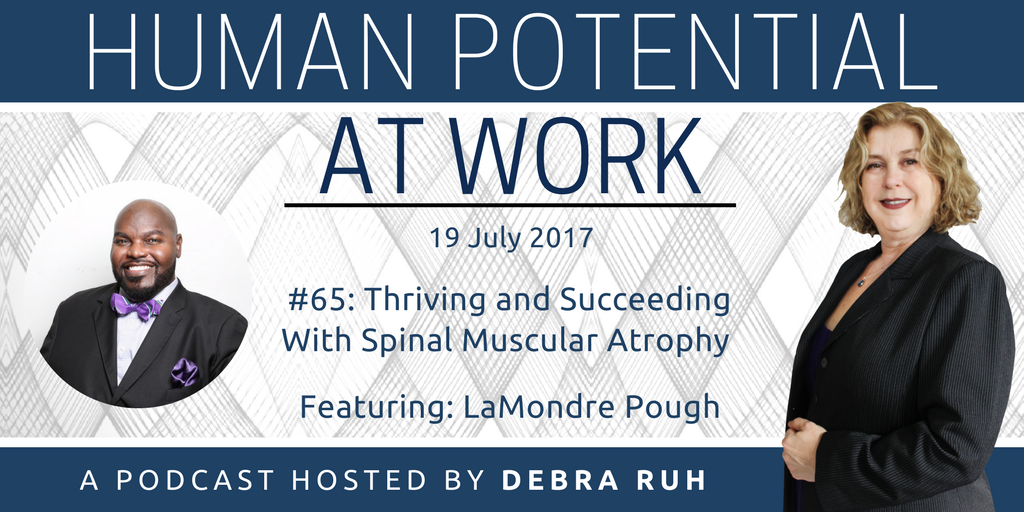
Episode Flyer for #65: Thriving and Succeeding With Spinal Muscular Atrophy
LaMondre Pough shares his story of living with spinal muscular atrophy and succeeding and thriving despite doctors saying that he would not live to be 5 years old. Lamondre shares advice and inspiration for overcoming obstacles and living life to the fullest.
Episode Flyer for #64: Inclusion in Central and Latin America
David Pérez, Chief Global Strategist at Ruh Global Communications, discusses his perspective on disability and inclusion growing up in Costa Rica. David also shares his experience of being diagnosed with ADHD and how he has been able to thrive and earn a masters degree in diplomacy.
Episode Flyer for #63: How Uber is Supporting Diversity and Inclusion
Malcom Glenn, Strategic Partnerships Manager at Uber, joins the program to discuss the efforts that Uber is making in terms of diversity and disability inclusion. Malcom discusses diversity and inclusion both in terms of the culture of Uber and their hiring practices, as well as the ways in which they are working on making their platform as accessible as possible to persons with disabilities, and the implications for the future of transportation and car ownership.
Blogger, Writer, & Systems Administrator at Ruh Global Communications
Photo from Addition Elle
Facebook and other social sites are ubiquitous in today’s society. They bleed over from business into personal and then back again. This can be really great, but of course there are some disadvantages to constant social streaming. The internet has always been a place where people can feel free to state any idea openly and anonymously if they chose. In a time when anonymity on the internet is becoming less frequent, we may see some unsettling things from those we know. This is not to say that these social media sites do not have any merit though.
A year ago I deleted my Facebook (for the third time). It’s easy for me to recall what pushed me over the edge from casual deactivator to resolute detractor. A high school acquaintance had posted a picture of the model Ashley Graham and proceeded to fat-shame her. How dare Ashley Graham call for body-diversity at the sacrosanct Victoria’s Secret fashion show! Once my anger subsided, I paused, and deleted my venomous response. My anger soon turned to deep sadness. My former classmate saw beauty through a precise lens that dissected diversity into ugliness while I felt an effervescent fullness as multitudes of people, places, and things passed.
Ashley Graham (3rd person form the left), photographed in the #ImNoAngel Campaign by Lane Bryant,
Don’t get me wrong. I didn’t just delete my Facebook because everyone was making me angry and I wanted to distill my social interactions into a discourse-free harmony. It was a lack of discourse; a lack of conversation, that made Facebook seem pointless. In place of conversation was what has come to be known as “call out” culture. This is where people attempt to publicly shame people for their views via social media. I saw more “calling-out” than real engagement, and I wasn’t sure what to do about it.
So this is me calling on people to take a moment to re-evaluate their crusade. It’s easy for me, in the heat of the moment, to think of someone as less than me for not sharing the same viewpoint. It’s especially easy when I perceive them as being on the other side of justice. It’s easy, but is it really productive to call them out? To tell them how wrong and hateful and ignorant they are? To make certain to let everyone know in your group of friends that this person has these inexorable qualities and must be shunned? Maybe there just needs to be a little more understanding, a little more listening. Maybe if I had a conversation that carried these qualities, I could have changed my acquaintance’s mind.
I’ve become even more aware of this recently. I work for Ruh Global Communications, a Strategic, Social Media and Consulting firm who specializes in the accessibility and inclusion realm. As a result, I work with many talented individuals with disabilities. That being said, In the community of Persons with Disabilities, I’ve found that, as they try to find their voices, some people can appear negatively vocal on Social Media about slow change in true inclusion of individuals with disabilities.
When a person posts something disparaging on Social Media, maybe we can try different ways to really engage by framing our approach creatively and in a thoughtful way. Not only responding without condescension or presumption, but really listening; seeking to understand, asking the candid questions that drive at the root of someone’s worldview to understand why it is this person thinks the way they do. Also take into consideration whether they truly have positive or negative intent. Remember we can also use these times as an opportunity to share knowledge and training with others. I think this has the potential to be mutually beneficial and well worth the energy required, even though at times it takes a lot. It’s easy to go negative when things are not up to par, but we run the risk of coming off in a way that isn’t adding value to the conversation. Positivity brings change; not to say that we shouldn’t be vocal, Speak up about the change you want to see! Disappointment can be angering, but remember that we want change and others want to help; we all just need to be receptive to change and listen if we want to be heard. We must try to keep the dialogue open, grounded, and as positive as possible.
I hope that the “call out” culture that has become so prevalent on social media amongst my peers can begin to change. I hope that we can begin to try to create meaningful shifts in attitude through genuinely empathetic conversations. Our community would be benefited by allowing a deeper understanding of what barriers exist in people’s minds towards understanding our community and if the person allows it, their world could become a much more enriching, beautiful place.
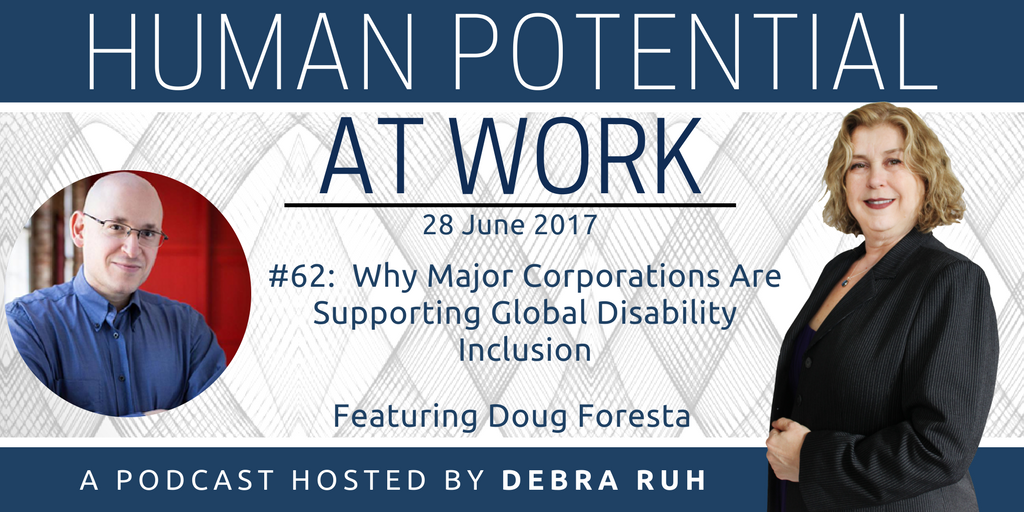
Episode Flyer for #62: Why Major Corporations Are Supporting Global Disability Inclusion
Debra and Doug discuss takeaways and lessons from the event Promoting Disability Inclusion Globally, which took place in Washington DC on June 20th, 2017. Debra shares which brands and corporations attended the event, and why corporations are interested in the global conversation about disability inclusion. Debra also shares what surprised her the most about the event, and the crucial next steps that need to happen to keep the conversation going.
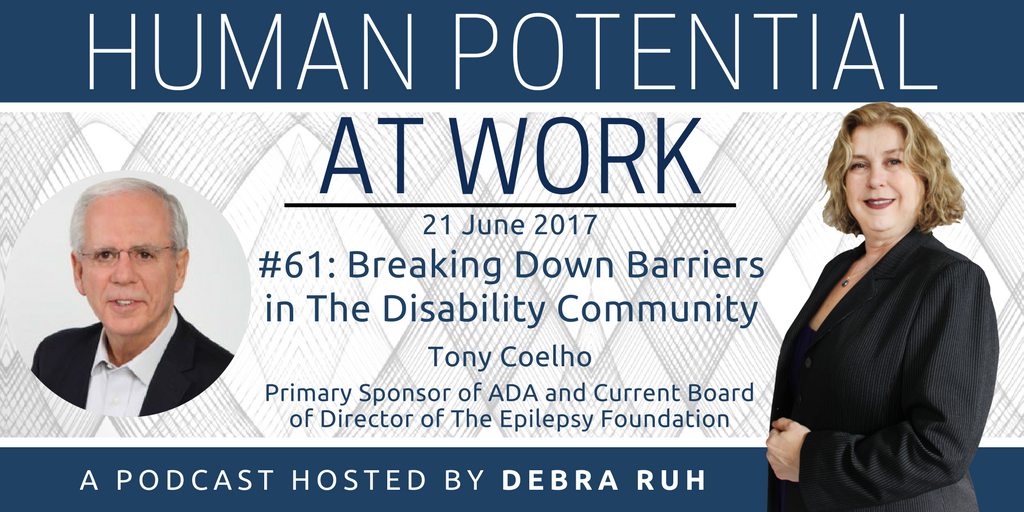
Episode Flyer for #61: Breaking Down Barriers In The Disability Community
Tony Coelho, former US Representative and primary sponsor of the ADA, returns to the program to discuss his story of how he overcame the stigma associated with having epilepsy and how he has been able to positively impact millions of lives through his work. Tony also discusses how the disability community can continue to grow and advocate for change.
Episode Flyer for #60: Having a Global B2B Inclusion Conversation
Debra is joined by her podcast producer, Doug Foresta, and discusses the upcoming event, Promoting Disability Inclusion Globally, which takes place on June 20th, 2017 in Washington DC and the importance of having global conversations about disability inclusion. Discover the topics and speakers at the event, and why the time is right for a global business-to-business conversation.
Stefan Tromel, Senior Disability Specialist of the International Labour Organization (ILO) joins the program to discuss how the ILO promotes equality of opportunity and treatment for persons with disabilities in the world of work. Stefan also shares about the upcoming event “Promoting Disability Inclusion Globally” on June 20th in Washington DC.



 The Sustainable Development Goals are seeking among other things to eliminate disparities and ensure equal access to all levels of education, to achieve productive and decent employment for persons with disabilities, promote social, economic and political inclusion; and access to secure and sustainable transportations for them. If we take into consideration the vast amount of influence that the efforts made in the 90s had over Latin America, these goals will help directly to bring real change for persons with disabilities in Latin America.