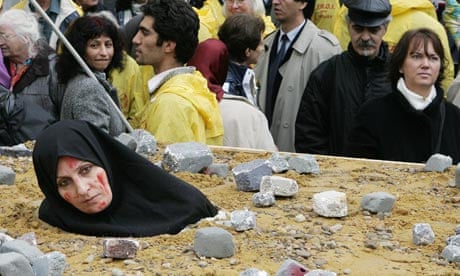
According to the UN, violence against women has become a global epidemic. There are many factors associated with the violence including cultural, religious, political and economic conditions. According to the UN and WHO 1 in 3 women in the world have been beaten or raped.
The Daily News reported in August that two young women in Syria in two separate incidents were stoned and bludgeoned to death because of alleged adultery.
In May 2014, a pregnant woman in Pakistan was stoned to death by her relatives and spurned finance as a crowd watched. USA Today notes that the Lahore Police charged the young woman’s father with murder. The father told police that he killed his daughter because she had shamed the family.
An Iranian woman protesting over death by stoning in Brussels
Women with disabilities are victims of violence more often than the rest of the population. They are at higher risk for many reasons including ignorance, cultural and religious stigmas, discrimination and lack of family and social support.
According to the National Rape Response Service:
U.S. National studies estimate that almost 80% of people with disabilities are sexually assaulted on more than one occasion and 50% of those experienced more than 10 victimizations.
Women with disabilities are raped and abused at a rate at least twice that of the general population of women.
Among adults who are developmentally disabled, as many as 83% of the females and 32% of the males are victims of sexual assault.
The UN believes that the best chance we have to end violence against women is to try and prevent it and address it at the structural and root causes.
My husband and I have two grown children a son and daughter born with Down syndrome. We taught our son to respect and honor women. My husband also modeled good behavior so my son was lucky to have a positive role model. Men and women must work together to find innovative ways to stop the senseless and brutal violence against women with and without disabilities.
Kevin Ruh – Chief Marketing Officer at Ruh Global Communications
Alzheimer’s disease is one of the scariest ailments facing mankind today. The idea of not being in total control of your mind is a prospect most cannot fathom. Many will be negatively and personally impacted in our lifetimes by this scary disease. With the large generation of the baby boomers (76 million Americans) beginning to come of age, this threat becomes more and more frightening. To add to the problems recent studies show that people with Down syndrome have a much higher rate of developing Alzheimer’s and as early as their forties.
According to a recent article: Increasingly, Adults with Down Syndrome Face Alzheimer’s “Adults with Down syndrome are at high risk for developing Alzheimer’s disease, and at an earlier age than the population as a whole. At least 25 percent of those older than 40 have Alzheimer’s, and more than 50 percent of those over 60 do, compared with 6 percent of those over 60 in the overall population.” Source: National Task Group on Intellectual Disabilities and Dementia Practices
My older sister, Sara, was born with Down syndrome makes these statistics even more troubling.
I have been a vegan for over ten years and Debra, my mother has been an on again off again vegan and vegetarian for years. Our family exercises and tries to eat healthy diets. Like many other Americans our family tree includes diseases like cancer, heart disease, high blood pressure, strokes and diabetes.
We all realized that Sara’s best change might come from a dramatic change in Sara’s diet.
Debra was worried even before her own mother had an accident and was diagnosed with dementia. We began looking into the topic and trying to see what could help those we loved. We read several studies that show diet plays a very big part in disease prevention.
When my mother saw the studies about Down syndrome and Alzheimer’s she remembered the work that Dr. Neal Barnard has done on Vegan diets and Alzheimer Disease. Barnard has been researched how a vegan diet can reduce your risks for many diseases including cancer, diabetes, heart disease, strokes and Alzheimer.
Barnard writes a blog on The Physicians Committee on Responsible Medicine website. In his blog: Eating to Prevent Alzheimer’s disease he notes that a vegan diet can reduce the risks associated with these diseases. One reference: “The Ninth Annual Conference on Alzheimer’s Disease and Related Disorders, Harvard researchers discussed the role that fruits and vegetables may play in AD. Jae Hee Kang, Sc.D., and colleagues evaluated approximately 13,000 participants in the Nurse’s Health Study. They calculated the women’s intake of fruits and vegetables between 1984 and 1995 and correlated these values with performance on tests of cognitive function conducted between 1995 and 2003, when the women were in their 70s. Women with the highest consumption of green leafy vegetables and cruciferous vegetables—both high in folate and antioxidants such as carotenoids and vitamin C—declined less than women who ate little of these vegetables.”
So the rest of my family including Emily Ha of Ruh Global Communications have committed to Dr. Barnard’s recommended 21 Day Kickstarter Vegan Diet. On 10/3/2014 they began a diet that is free of animal products for twenty-one days.
Dr. Neal Barnard
With some help from a health and exercise coach, Jo Beardsley at American Family Fitness we are all going to help Sara to lose weight healthily with the goal to significantly lower her risk of developing Alzheimer’s.
Sara eats a healthy diet now, but with this pledge, we stack the odds in her favor by eating her healthiest diet available. The rest of our family is also committing to eating the same way. We all want to see an end to these horrible diseases.
Emily will be keeping a blog tracking the journey that provides recipes for Debra and Sara to check daily with ideas for meals and other information.
The blog is at Rawesomeveganrecipes.tumblr.com and will include many raw vegan recipes too. Join us as we focus on Sara’s journey. We also welcome your stories and recipes.
Kevin Ruh – Chief Marketing Officer at Ruh Global Communications
My name is Kevin Ruh and I support the United Nations “HeForShe” campaign. I hope other men will join this conversation and show women that we support their rights to not be seen only as sexual objects. I believe that men are evolving. We need to raise our voices and show our support of women.
I was raised by a strong mother (Debra Ruh) and have a wonderful sister (Sara Ruh) born with Down syndrome. I am also proud to be in a committed relationship with another strong woman (Emily Ha).
Emily Ha – Chief Creative Officer at Ruh Global Communications
I have seen men treat women as sexual objects or inferior beings – the weaker sex syndrome. It has always annoyed and angered me. I have debated this topic with many male friends and pondered what can be done to stop the violence. Men should never be violent for any reason. If you are in a bad relationship – step away – violence is never the answer. Women should be allowed to dress, walk, or act any way that they choose without fear of men preying upon them.
To make this situation even worse women with disabilities are often victims of violence and the statistics are very troubling. According to the National Rape Response Service:
U.S. National studies estimate that almost 80% of people with disabilities are sexually assaulted on more than one occasion and 50% of those experienced more than 10 victimizations.
Women with disabilities are raped and abused at a rate at least twice that of the general population of women.
Among adults who are developmentally disabled, as many as 83% of the females and 32% of the males are victims of sexual assault.
Source: www.MECASA.org
We must stop the senseless violence against women and people with disabilities.
I was intrigued by Emma Watson’s speech on this topic at the United Nations. Emma Watson is a household name for most. Her portrayal of Hermione Granger in the Harry Potter movies is where I was first introduced to this talented actor. She has gone on to do over fifteen films during her acting career.
More importantly though, are her efforts to help the human race. She has done a lot to help women’s rights over the years. Promoting the education of women is a huge issue. Watson has traveled the world to places like Zambia and Bangladesh to promote her views and aid the women’s rights movement. She believes in equality regardless of gender, I wholeheartedly agree with this and also believe it is a critical issue.
Watson was appointed the UN Women Goodwill Ambassador in July this year. In September she delivered an address that launched a new UN Women campaign called “HeForShe”. It is a program that asks for men to advocate for gender equality. Watson notes that it is impossible to see a change in the violence if only one side is advocating equality.
Emma Watson
She is right – often this is a conversation being held by mostly women. It is time for men to join the conversation. We need to teach boys of all ages that a “Real Man” does not hurt anyone. Emma Watson’s efforts are being applauded globally.
Many Hollywood stars are self-proclaimed “feminists” and are often scrutinized for not practicing what they preach. Emma Watson is the image of a feminist who says equality is for all.Find out more about the “HeForShe” campaign here: www.HeForShe.org
I hope my brothers join me in my efforts to support women. Many of us are evolved and we need to stand with women and stop the violence. I challenge other men and parents raising sons to stand with me. It is Time to STOP the ABUSE.
Kevin Ruh – Chief Marketing Officer at Ruh Global Communications
I am an advocate of using social media to bring awareness about the community of people with disabilities (PwD) and accessible Internet, Communications and Technology (ICT). I believe that the community of PwD is starting to find their voices via social media. However, there are some significant accessibility problems with social media. There are leaps in accessibility that have been made and are in progress. Yet we find that many social media tools and applications are not blending accessibility into their products and when they are, it does not seem to be a priority. PwD are often left out of the social media conversation and movement because the devices are less accessible.
We find that many social media tools and applications are not blending accessibility into their products. PwD are often left out of the social media conversation because they apps are inaccessible. This is difficult to deal with due to the fact that most don’t seem to have accessibility in mind until there is a problem, instead the devices and applications need to be thought of as opportunities for universal access.
Social media has to be accessible or we continue to widen the Digital Divide, it is as simple as that. As long as there are access problems we run the risk of alienating a portion of our community.
The Internet has opened up many opportunities as well as greatly improving the quality of life for these users, but there are still barriers. Many people think of disabilities in extreme terms such as blindness and deafness, but it also includes many others with visual or hearing impairments that are increasingly common in our aging population, and other challenges such motor and cognitive impairment. The spectrum of ability for all users is variable.
Can an organization really afford to lose this audience?
I think not, and this community is chattering on more accessible platforms, about the good and the bad. If social media tools are not accessible those platforms stand to lose out on major benefits, or risk being singled out as not worried about the less able part of the population and their advocates.
Sometimes we hear that it is too hard to make an application or platform accessible. This makes sense only if the organization wishes to put forth the message that their customers are not worth a re-tool of an app. Accessibility should be built into the system similarly to building in privacy, security or usability. The second thought of accessibility as “not an easy add on” and will be noticed by those left out.
The good news is that Social Media applications can be made fully accessible allowing everyone to use them; all aspects of use just need to be considered.
In years past, developers were afraid that making the application accessible would make a system less creative or innovative or other security issues. The good news is we have seen amazing strides with accessible social media and now it is innovative developers take pride in blending accessibility into the process level. This seems to be the future of technology and it should be our end goal to reach universal access.
Is participation for all out of the question? If we don’t make social media accessible than we continue to widen the “Digital Divide” and according to the World Health Organization (WHO) one in seven people are impacted with disabilities worldwide. Plus 1 out of 3 households in the U.S. are impacted by disabilities, there for this is an issue that affects family and community. Worldwide, this group numbers 500-750 million people and is a key influencer of the public’s perceptions.
There is no excuse to not make your Social Media applications fully accessible so that everyone can use them. In years past, developers were afraid that making the application accessible would make a system less usable or “dumbing” the system down. Once again, ridiculous – we have seen amazing strides with accessible social media and now it is BAD design if you do not blend accessibility into the process level.
Kevin Ruh – Chief Marketing Officer at Ruh Global Communications
Finding new aspects to accessibility within the new devices that are forthcoming is exciting and sometimes troubling if accessibility has not been consider. With the recent release of the Apple iPhone 6 questions loom about the added features that make this new device unique and innovative can also cause accessibility concerns.
The screen is slightly larger for the new edition of the iPhone. A larger screen is good for users with a visual impairment as it is simply easier to see. A person with fine motor impairment can make navigating a tiny touch screen accurately very difficult. In that case a larger screen can be an upside to the user. Users that manage the small motions fine may find the larger strokes create a challenge and find it cumbersome. Limited motion due to size has caused some users to criticize the iPad.
The battery life has been improved on the iPhone 6. This is usually seen as a positive to all users. Especially when the user uses their device as communication device or as assistive technology. Longevity is also a huge benefit to everyone but is especially helpful to consumers with disabilities and anyone that needs the device to be accessible.
iPhone 6.0 1
iOS 8 has strived to be an accessible operating system and has accessibility features that previous iOS’s versions inspired. The new iPhone 6 will run iOS 8 when it is released which many hope will include access features that have not yet been announced.
The new OS also promises to run the new Apple Pay, which is a new type of program that is striving to replace credit cards entirely. The accessibility implications of this are numerous. The idea is to use your iPhone to securely transfer money is one that is astounding and would allow many of us easier access to monetary transactions. When the iWatch is released it may too have many accessibility accomplishments that we have yet to imagine. These devices show that accessibility can be a great way to widen the use of mobile technology for all.
Apple has been a leader in accessibility and their innovation has change lives. I hope they continue to blend accessibility into every device, app and service that is offered.
I believe that the best way to further inclusion of persons with disabilities is to tell the stories of the organizations and leaders that are making a difference. Progress is being made all over the world and I want to highlight efforts coming out of Atlanta, Georgia. I have had the pleasure to collaborate with Dr. Christopher Lee and his team at AMAC Accessibility Solutions and Research Center (AMAC). AMAC is part of the Georgia Institute of Technology located in the College of Architecture.
Dr. Christopher Lee has been an advocate and pioneer in promoting social entrepreneurship to benefit humankind and further strive for sustainable social change in the field of disabilities.
Why does Dr. Lee care about the community of persons with disabilities? He is part of the community and was diagnosed with a cognitive deficit disorder in the second grade. He was placed in special education and speech classes.
Dr. Lee describes his dyslexia in this way: “Nothing I hear seems to stick with me and nothing I say seems to come out right. It is as though I am in a world where the air is packed with floating symbols. I watch as everyone swallows the symbols, digesting them to produce something that everyone else understands, but I can only swallow bits and pieces. Choking, I remain hungry in my struggle to find a way to communicate and comprehend effectively.”
He recalls being a student and standing in front of the classroom, he did his best to recall the ways to spell, to read and to say the right words and phrases. He understood that he needed to recall and use the words and phrases in the correct order to be able to connect and communicate with his peers and teachers.
He spent hours organizing his thoughts and preparing for presentations in front of his classmates. He tried to find ways to help him get his thoughts across to his peers and teachers. The efforts left him feeling very alone and frustrated, and in his mind and heart he longed to decipher the code of language.
Dr. Lee has built a lot of character and drive to make the world a better place for individuals with learning disabilities and other disabilities. He admits to being a perfectionist and he worked very hard to fit in and succeed in a world that is not set up for his “twisted perception of language.”
He was determined to go to college and scored low scores on his SAT due to his severe visual and audio process disorders. He had to work his way through developmental studies before he was mainstreamed at the University of Georgia (UGA).
“With everything that has happened to you, you can either feel sorry for yourself or treat what has happened as a gift. Everything is either an opportunity to grow or an obstacle to keep you from growing. You get to choose.” Wayne W. Dyer
He notes that his story is not unique from the high percentage of people in the United States and all over the world who are also dealing with learning disabilities. This story is experienced by parents and teachers globally. Many “experts” expected him to fail, but he worked hard and decided to become a success story and a beacon of hope for others with learning disabilities.
His motivation to become a collegiate swimmer athlete at UGA drove him hard to create his own academic action plan which included strategies, tools like assistive technology, and most importantly, a strong tutoring and mentoring network.
He also developed a communication strategy that included the use of role-playing activities where he perfected how to disclose his learning disabilities. He became an expert in and promoting his strengths and managing his weaknesses.
Today he holds multiple college degrees including a Bachelor of Arts and Sciences in Speech Communication from University of Georgia. He also earned a Ph.D. in Interdisciplinary Studies with a focus on Social Psychology from Union Institute and University.
His work has centered on the innovation of new models and techniques to support accessible electronic information in corporate, governmental and nonprofit entities. Dr. Lee is an internationally recognized advocate, author, speaker, principal investigator and leader in the fields of learning disabilities and assistive technology.
In1992, at age twenty-three Christopher wrote his first book, Faking It: A Look into the Mind of a Creative Learning. This book can be purchased on Amazon by following this link: http://ow.ly/Avs8V
In 2003, he was highlighted in Microsoft “Accessible Technology for Everyone”, a Microsoft video and publication. http://www.microsoft.com/enable/
In 2007, he was featured in the PBS series “A Chance to Read”, hosted by Molly Ringwald, which highlights new strategies driven by emerging research that shows what’s happening across the country to help children with disabilities find success. https://www.youtube.com/watch?v=Us8-tG6R024
Today Dr. Christopher Lee is the Founder, Director and Department Head of the AMAC Accessibility Solutions and Research Center (AMAC), located in the College of Architecture of the Georgia Institute of Technology in Atlanta. AMAC is committed to promoting technological innovation and developing effective user-centered products and services for individuals with disabilities.
AMAC’s mission is to address unmet accessibility needs in government, non-profits, and corporations by providing products that benefit those with physical or cognitive impairments. AMAC has pioneered a cost-effective, replicable, scalable, full service center for alternative, digital and captioned media for college students with disabilities, along with the downloadable assistive technology software. AMAC receives baseline operational funds from the University System of Georgia (USG).
AMAC services and costs vary depending on the annual membership status of its 2,287 participating institutions. AMAC offers a variety of services to meet the individual needs of students with print-related disabilities and post-secondary institutions.
Christopher has been recognized for his advocacy and leadership many times and most recently was awarded a “Campus Technology Innovators Award for 2014”. AMAC was also awarded a coveted “Zero Project Award 2013” from The World Future Council and the European Foundation Centre.
To learn more about Dr. Christopher Lee’s work, please visit AMAC at http://www.amacusg.org/
To learn more about Ruh Global Communications, please visit www.RuhGlobal.com
Kevin and his sister, Sara Ruh who has Down Syndrome
Building accessible mobile technology is becoming more and more a topic of discussion and with good reason. The world is affected by disability; if you do not have any form of a disability then it is likely you know someone who does, so this is a topic that comes very close to home for many of us. As the number of people connecting through the internet grows and people begin to share more and more it become easier to see that even if you don’t have anyone in your life affected by disability, you need only look a short distance to find thousands of stories about how much people care about one another and how awareness can spread, this is the beauty of the internet, and to take this power and harness it for good is forward thinking.
Apple is undoubtedly the leader in accessibility on mobile platforms. Many visually impaired users say that Apple is unmatched at the moment in this regard. One only needs to look at Siri or the iPhone’s voice control options to begin to comprehend the steps taken and with more of Apple’s third party Apps striving to bring themselves up to the bar of Apple’s accessibility standards. Just being in the App store is driving developers to consider wider access.
This is a great accomplishment to say the least. If this is the future of development across multi platforms, as we have seen with things like the accessibility features of the Microsoft Surface, which have given a boost and Microsoft is collaborating with others to unlock the full potential of that device. We need make sure there is not a demographic left out, but where we always have the mindset in development that accessibility is integral, it is the lifeblood of our industry and of the future.
The internet is still inaccessible to a large portion of the world just due to the troubles of lines not reaching far enough. These wires that are necessary to connect until we can active the global wireless network. With such a thing in the future shouldn’t access for all be one of the top concerns of this innovation?
The recent discussions that have been going on across the internet on the #A11Y is interesting because with a hashtag comes internet awareness. If you agree with the A11Y hashtag or not, it looks as though it has been embraced and is becoming part of the internet culture. With awareness and discussions abounding I believe right now is a very important moment in our history, and that it will be seen as a turning point towards access for all. Perhaps not today or this year, but soon, and with the strides that are continuing to be taken it’s not too far around the river bend.
Kevin Ruh – Chief Marketing Officer at Ruh Global Communications
Call for submissions! If you are a person with a disability or have someone close to you that is affected by disabilities then we want to hear from you! Do you have a tattoo? Whats the story behind it? Do you want to get a tattoo? Are you against tattooing? What is your opinion on people who have a disability getting tattooed? What kind of meaningful content do people want? We want to hear your opinion on the subject! If you are a tattoo artist we would love to hear about this topic from your point of view. Are you worried that the tattoo shop may not be accessible or maybe the staff will not be comfortable dealing with a client with a disability? My sister Sara was born with Down syndrome and is now a wonderful 27 year old woman. When she wanted to get her first tattoo at the age of 20 and a family friend expressed concern when our family mentioned that we would be 100% open to Sara getting a tattoo if she wanted one. Who is to say she should not be allowed to get a tattoo, and why? She understands that it will hurt, and not go away. But she is an adult and although she gets support from her family for day to day living she wants to be as independent as anyone would and wants to make her own decisions. After a lot of talk and presenting Sara with the idea that people may not think it was a good idea and may be judgmental. She had the same stance that most do when they have decided that a tattoo is in their future, Who cares what anyone else thinks, this is a tattoo for me and on me. How can I or anyone who loves and respects sara and her opinion say otherwise. The selection process for the Artist who would ink the design was shorter than we expected. The first Artist we visited was told by the shop owners that Sara had a disability and he said he was comfortable with that and would simply like to meet her before and discuss every aspect of the tattoo, this is not uncommon for any tattoo artist to do, you always want to know who you’re working with and it is important to do this on both sides. As an artist talking to a client and as well as someone who is commissioning artwork from an artist. Well thats my story in a nutshell, we hope to hear from you and yours about this, please take a few moments to submit your story to: Kevin@ruhglobal.com
Social media, the omnipresent “second life” of our times. People have split themselves into different personas, some lead completely different lives through the internet, and some falsify a life through the means of deception and identity theft. The population has decided that these platforms and social media applications are the new norm for social interaction. It has become an everyday occurrence while meeting new people in person to exchange social media links to one another.
This has effectively brought a large part of the populous together through the network and makes communication, even through long distance, accessible. With this great hurdle overcome, the only concern is to bring the people who have less access to this technology closer to it so they can become part of the global network.
Part of this is people who have disability as well as people who just live in an area that makes access difficult. I know many people who live outside of cities in the US have trouble getting an internet connection, except through satellite internet, some of you may not have had any experience with this type of connection, but compared to dsl or even dial up it is not as easy to connect and stay connected. This is the future of spreading awareness, ignorance comes from a lack of experience, it is easy to judge something while knowing nothing about it, We need to educate all we can to anyone that will listen. If we make this our goal than global inclusion is possible!
I am an advocate of using social media to bring awareness about the community of people with disabilities (PwD) and accessible Internet, Communications and Technology (ICT). I believe that the community of PwD is starting to find their voices via social media. However, there are some significant accessibility problems with social media. There are leaps in accessibility that have been made and are in progress. Yet we find that many social media tools and applications are not blending accessibility into their products and when they are, it does not seem to be a priority. PwD are often left out of the social media conversation and movement because the devices are less accessible.
We find that many social media tools and applications are not blending accessibility into their products. PwD are often left out of the social media conversation because they apps are inaccessible. This is difficult to deal with due to the fact that most don’t seem to have accessibility in mind until there is a problem, instead the devices and applications need to be thought of as opportunities for universal access.
Social media has to be accessible or we continue to widen the Digital Divide, it is as simple as that. As long as there are access problems we run the risk of alienating a portion of our community.
The Internet has opened up many opportunities as well as greatly improving the quality of life for these users, but there are still barriers. Many people think of disabilities in extreme terms such as blindness and deafness, but it also includes many others with visual or hearing impairments that are increasingly common in our aging population, and other challenges such motor and cognitive impairment. The spectrum of ability for all users is variable.
Can an organization really afford to lose this audience?
I think not, and this community is chattering on more accessible platforms, about the good and the bad. If social media tools are not accessible those platforms stand to lose out on major benefits, or risk being singled out as not worried about the less able part of the population and their advocates.
Sometimes we hear that it is too hard to make an application or platform accessible. This makes sense only if the organization wishes to put forth the message that their customers are not worth a re-tool of an app. Accessibility should be built into the system similarly to building in privacy, security or usability. The second thought of accessibility as “not an easy add on” and will be noticed by those left out.
The good news is that Social Media applications can be made fully accessible allowing everyone to use them; all aspects of use just need to be considered.
In years past, developers were afraid that making the application accessible would make a system less creative or innovative or other security issues. The good news is we have seen amazing strides with accessible social media and now it is innovative developers take pride in blending accessibility into the process level. This seems to be the future of technology and it should be our end goal to reach universal access.
Is participation for all out of the question? If we don’t make social media accessible than we continue to widen the “Digital Divide” and according to the World Health Organization (WHO) one in seven people are impacted with disabilities worldwide. Plus 1 out of 3 households in the U.S. are impacted by disabilities, there for this is an issue that affects family and community. Worldwide, this group numbers 500-750 million people and is a key influencer of the public’s perceptions.
There is NO excuse to not make your Social Media applications fully accessible so that everyone can use them. In years past, developers were afraid that making the application accessible would make a system less usable or “dummy” the system down. Once again, ridiculous – we have seen amazing strides with accessible social media and now it is BAD design if you do not blend accessibility into the process level.